
Projects from Ecuador and the United Republic of Tanzania Win First Edition of UNESCO Global Citizenship Education Prize
© Bosque Escuela Tena/Ecuador
Two exceptional projects from Ecuador and the United Republic of Tanzania were recognized in the inaugural edition of the new UNESCO Prize for Global Citizenship Education (GCED), funded by the Republic of Korea.
9 December 2025 - Last update:10 December 2025
The 2025 edition honoured a school project in the Amazon rainforest in Ecuador that guides children to become empathetic community leaders and forest guardians, and a youth-led non-governmental organization in the United Republic of Tanzania that mobilizes youth nationwide to counter hate speech and promote peace and security.
The two laureates were selected out of 150 nominations from 76 countries, submitted by UNESCO Member States or by non-governmental organizations in official partnership with UNESCO. An independent international jury of five experts reviewed the nominated applications. The two initiatives were recognized for their excellence in promoting the values of global citizenship education and addressing some of the interconnected and complex challenges of the twenty-first century by helping learners or community members to collaborate, overcome differences, promote values of understanding and empathy and make a meaningful impact at local, national or regional levels.
Awarded every two years, the UNESCO Prize for Global Citizenship Education (GCED), recognizes outstanding efforts in promoting and advancing GCED principles and values by two categories of applicants: 1) youth-led organizations and 2) a general category of applicants, which includes individuals, institutions, non-governmental organizations and other entities.
Each laureate received an award of USD 50,000 during a ceremony held at UNESCO Headquarters in Paris on 9 December 2025, also coinciding with the International Day of Commemoration of the Victims of Genocide, Affirmation of their Dignity and Prevention of this Crime.
African Leadership Initiatives for Impact (ALII), United Republic of Tanzania
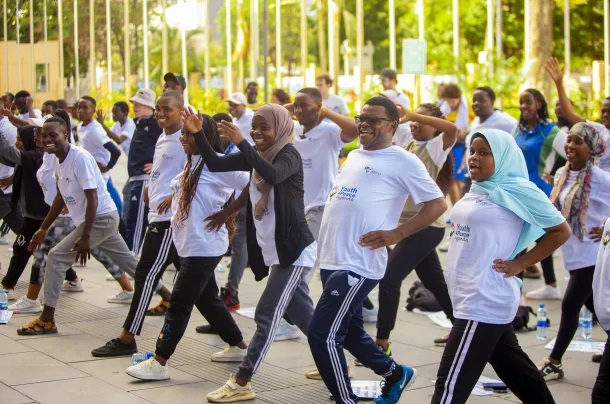
The African Leadership Initiatives for Impact (ALII), a youth-led NGO in the United Republic of Tanzania, received the UNESCO GCED Prize in the youth category for its Youth4Peace Agenda project. The project places young people at the center to promote social cohesion, peace and security. They are trained, connected and empowered across different groups to become changemakers, and to create unity, social cohesion and promote sustainable development at community level while countering misinformation, hate speech and discrimination.
Grounded in local needs and youth priorities, the project promotes key universal values of global citizenship, such as dialogue and understanding, conflict resolution, and cross-cultural collaboration. The organization has reached over 50,000 young people through targeted and mass educational online campaigns, educational outreach through secondary schools, youth peace festivals, and the annual national Forum on Youth, Peace and Security. Through its Youth for Peace Coalition and Agenda, young change- and policy-makers have a platform to co-create and inform the country’s National Action Plan on Youth, Peace and Security.
Bosque Escuela Tena, Ecuador
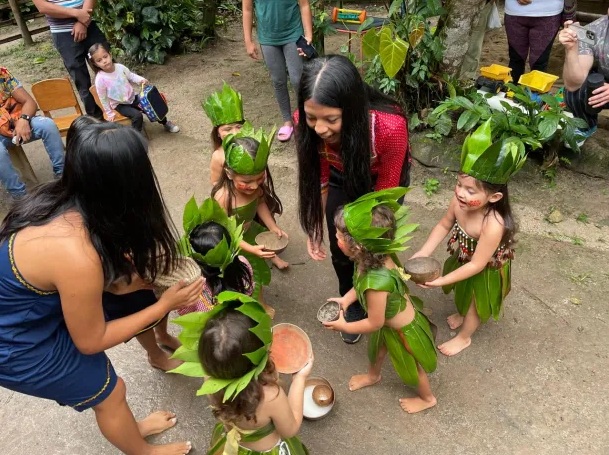
Bosque Escuela Tena, a school in the Kichwa Tamia Yura community of Tena, in the Amazon forest region of Ecuador, received the 2025 Prize for its Guardians of the forest, builders of the future programme. Founded in 2023, the school guides children from preschool to high school to protect nature and to become guardians of a more just and sustainable future. Amazonian and ancestral wisdom are interwoven with innovation in the school’s multicultural and multilingual spaces, fostering respect for diversity and heritage through creative, hands-on educational activities that nurture global citizenship and empathetic action in learners.
Transforming the surrounding forest into a living classroom, the programme addresses today’s challenges, including climate change and community marginalization, by valuing cultural diversity and connecting youth to their heritage, and by developing ecological awareness and personal responsibility. By engaging with elders, artists, and scientists, students are exposed to multiple approaches to learning skills for intercultural dialogue, conflict resolution, leadership and ecological stewardship. Since 2023, the programme has enrolled over 110 children and youth with a vision to reach many more.
Other shortlisted candidates
The international Jury also recognized outstanding efforts in the field by 6 runners-up, three in each category, further highlighting the diversity in GCED approaches and initiatives, and their relevance and impact in all the regions of the world.
The runners-up for the category of youth-led organizations were:
- Cordilleran Youth Center (CYC), Philippines, for their project Youth in Action (Ilocano language: Tignay Agtutubo)
- Asociación Latinoamericana Ímpetu, Ecuador, for their project Ímpetu Liderando la Educación Sin Fronteras (ILESF)
- Associação Internacional de Estudantes em Ciências Económicas e Empresariais, Portugal, for their project: Global Volunteer.
The runners-up for the general category of individuals, institutions, nongovernmental organizations and other entities are:
- Mouza Ali Ahmed Alsaadi, Citizenship Education specialist, Ministry of Education, Oman, for the project Digital Citizenship for Empowered Learners
- Dominique Paola Dakouri, Founder and Director of Centre Esther and Coeur d’Esther, Côte d’Ivoire, for the project To the table... Green future
- Cool.org, Australia, for their project Equipping Educators –Empowering young people
About global citizenship education
There is an urgent need to address global challenges, such as the resurgence of armed conflicts and community tensions, worsening climate change, rising forms of hatred, polarization, discrimination and racism, and persistent and growing inequities at both local and global levels.
The UNESCO Recommendation on Education for Peace, Human Rights and Sustainable Development (2023) provides a framework to address these issues through education.
Global Citizenship Education (GCED) is an approach which responds to such challenges by promoting a sense of belonging to a global community and encouraging the active participation of every person to collaborate, bridge inter-group divides and find solutions in solidarity.