
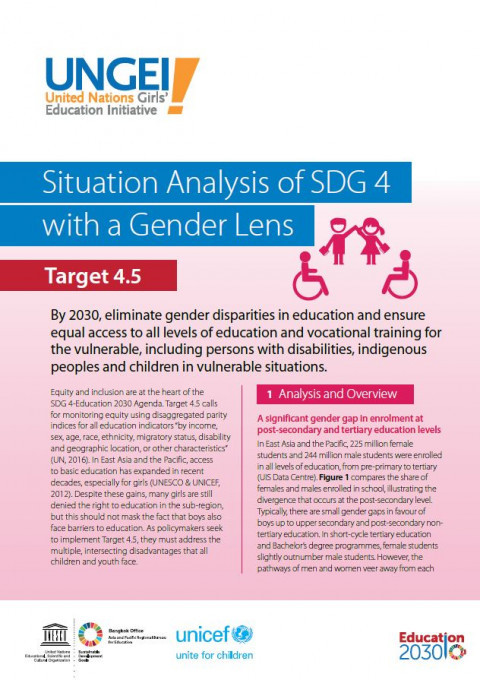
Situation Analysis of SDG 4 with a Gender Lens, Target 4.5
- Corporate Author
- UNESCO Bangkok
- Collation
- 3 p.
- Resource Language
- English
- Year of publication
- 2018
- Topic
- Globalisation and social justice / International understandingDiversity / Cultural literacy / InclusivenessSustainable development / Sustainability
- Resource Type
- Research papers / journal articlesOther
- Level of education
- Primary educationSecondary educationHigher education
- Region
- Asia and the Pacific
- Place of publication
- Bangkok
Equity and inclusion are at the heart of the SDG 4-Education 2030 Agenda. Target 4.5 calls for monitoring equity using disaggregated parity indices for all education indicators “by income, sex, age, race, ethnicity, migratory status, disability and geographic location, or other characteristics” (UN, 2016). In East Asia and the Pacific, access to basic education has expanded in recent decades, especially for girls (UNESCO & UNICEF, 2012). Despite these gains, many girls are still denied the right to education in the sub-region, but this should not mask the fact that boys also face barriers to education. As policymakers seek to implement Target 4.5, they must address the multiple, intersecting disadvantages that all children and youth face.
Related Resources
-
 Report on Digital Transformation in Higher Education in South Asia
 -
 Voices Against Violence: Middle Years
 -
 Study on the Historical Impact of the 1974 Recommendation concerning Education for International Understanding, Cooperation and Peace and Education relating to Human Rights and Fundamental Freedoms
 -
 IIEP-UNESCO 12th Medium-Term Strategy: 2026–2029