
Resources
Explore a wide range of valuable resources on GCED to deepen your understanding and enhance your research, advocacy, teaching, and learning.
22 Results found
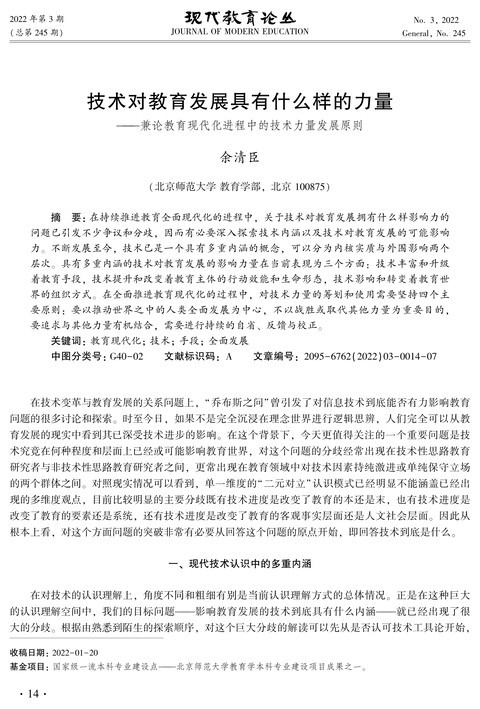 What Kind of Power Does Technology Have on the Development of Education: On the Development Principle of Technical Force in the Process of Educational Modernization (Modern Education Review; No.3, 2022) Year of publication: 2022 Author: 余清臣 In the process of continuously promoting the comprehensive modernization of education, the issue of what influence technology has on the development of education has caused many debates and disputes. Therefore, it is necessary to deeply explore the connotation of technology and the possible influence of technology on the development of education. Up to now, technology has been a concept with multiple connotations, which can be divided into two levels:core essence and peripheral influence. At present, the influence of technology with multiple connotations on educational development is manifested in three aspects:technology enriches and upgrades educational means, promotes and changes the action efficiency and life form of educational subjects, and influences and changes the way the educational world is organized. In the process of comprehensively promoting the modernization of education, the planning and application of technological forces in education should focus on promoting the all-round development of mankind in the world, not on defeating or replacing other forces, and pursue the organic combination with other forces. In addition, continuous introspection, feedback and correction are also very important. 技术对教育发展具有什么样的力量: 兼论教育现代化进程中的技术力量发展原则 (现代教育论丛; No.3, 2022) Year of publication: 2022 Author: 余清臣 在持续推进教育全面现代化的进程中,关于技术对教育发展拥有什么样影响力的问题已引发不少争议和分歧,因而有必要深入探索技术内涵以及技术对教育发展的可能影响力。不断发展至今,技术已是一个具有多重内涵的概念,可以分为内核实质与外围影响两个层次。具有多重内涵的技术对教育发展的影响力量在当前表现为三个方面:技术丰富和升级着教育手段,技术提升和改变着教育主体的行动效能和生命形态,技术影响和转变着教育世界的组织方式。在全面推进教育现代化的过程中,对技术力量的筹划和使用需要坚持四个主要原则:要以推动世界之中的人类全面发展为中心,不以战胜或取代其他力量为重要目的,要追求与其他力量有机结合,需要进行持续的自省、反馈与校正。
 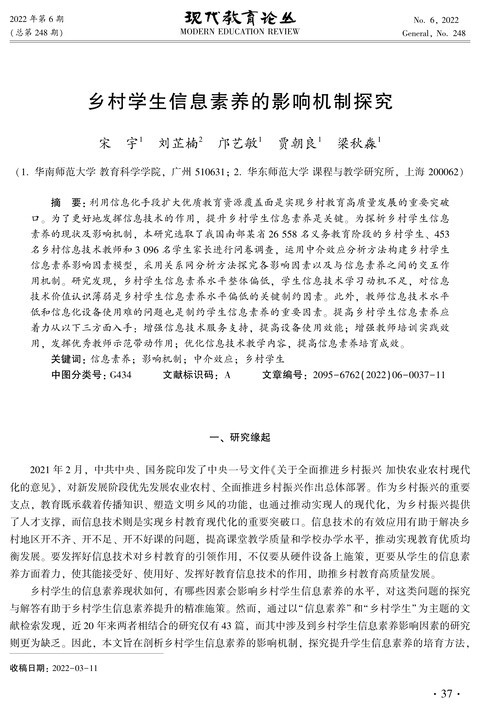 The Influence Mechanism of Students' Information Literacy in Rural Areas (Modern Education Review; No.6, 2022) Year of publication: 2022 Author: 宋宇 | 刘芷楠 | 邝艺敏 | 贾朝良 | 梁秋淼 Using information technology to expand the coverage of good education resources is an important breakthrough to realize the high-quality development of rural education. Improving the information literacy of rural students is the key to better play the role of information technology. In order to explore the current situation and influence mechanism of rural students' information literacy, this study selected 26558 rural students of compulsory education, 453 rural information technology teachers and 3096 parents from a province in south China for questionnaire survey, Using the mediating effect analysis method to construct the influencing factor model of rural students' information literacy and the network analysis method was used to explore the interaction mechanism between the influencing factors and information literacy. The results show a low level of rural students' information literacy and insufficient motivation for learning information technology. The weak understanding of the value of information technology mainly limits the improvement of rural students' information literacy. Besides, teachers' low level of information technology and difficulties in using information equipment are constraints to students' information literacy. To improve the information literacy of rural students, efforts should be made in the following three aspects:enhance information technology service support and improve the using efficiency of equipment, enhance the practical efficiency of teacher training and give full play to the exemplary and leading role of excellent teachers, optimize the teaching content of information technology, and improve the cultivation effect of information literacy. 乡村学生信息素养的影响机制探究 (现代教育论丛; No.6, 2022) Year of publication: 2022 Author: 宋宇 | 刘芷楠 | 邝艺敏 | 贾朝良 | 梁秋淼 利用信息化手段扩大优质教育资源覆盖面是实现乡村教育高质量发展的重要突破口。为了更好地发挥信息技术的作用,提升乡村学生信息素养是关键。为探析乡村学生信息素养的现状及影响机制,本研究选取了我国南部某省26558名义务教育阶段的乡村学生、453名乡村信息技术教师和3096名学生家长进行问卷调查,运用中介效应分析方法构建乡村学生信息素养影响因素模型,采用关系网分析方法探究各影响因素以及与信息素养之间的交互作用机制。研究发现,乡村学生信息素养水平整体偏低,学生信息技术学习动机不足,对信息技术价值认识薄弱是乡村学生信息素养水平偏低的关键制约因素。此外,教师信息技术水平低和信息化设备使用难的问题也是制约学生信息素养的重要因素。提高乡村学生信息素养应着力从以下三方面入手:增强信息技术服务支持,提高设备使用效能;增强教师培训实践效用,发挥优秀教师示范带动作用;优化信息技术教学内容,提高信息素养培育成效。
 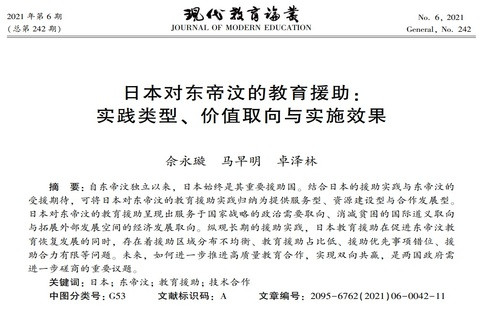 Japan's Educational Aids to Timor-Leste: Types of Aid, Value Orientation and Implementation Effects (Modern Education Review; no. 2) Year of publication: 2021 Author: Yongxuan She | Zaoming Ma | Zelin Zhuo This article introduces Japan's educational assistance to Timor-Leste, including its classification, value proposition and implementation effects, and examines the problems in existing educational assistance. 日本对东帝汶的教育援助:实践类型、价值取向与实施效果 (现代教育论丛; no. 2) Year of publication: 2021 Author: Yongxuan She | Zaoming Ma | Zelin Zhuo 该文介绍了日本对东帝汶进行教育援助的情况,包括分类、价值取向、实施效果等,并检视现有教育援助中存在的问题。
 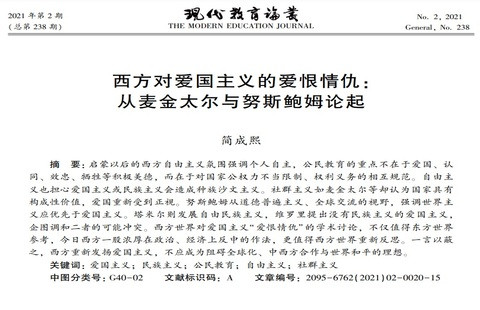 The Love-hate Dilemma of Western Patriotism as Understood by MacIntyre, Nussbaum and Others (Modern Education Review; no. 2) Year of publication: 2021 Author: Chenghsi Chien The article explores different theoretical perspectives on patriotism in the West and offers reflections on the current state of globalisation and international cooperation. 西方对爱国主义的爱恨情仇:从麦金太尔与努斯鲍姆论起 (现代教育论丛; no. 2) Year of publication: 2021 Author: Chenghsi Chien 该文探讨了西方关于爱国主义的不同理论观点,并针对当下全球化和国际合作的状况,提出反思意见。
 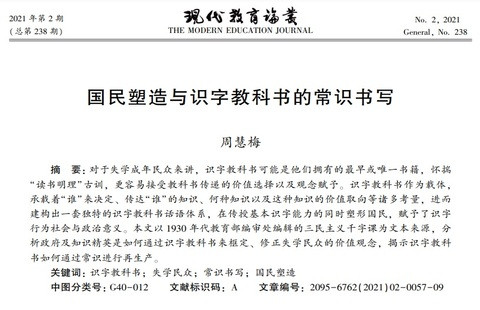 Making Nationals Through Writing of Commonsense Knowledge in Literacy Textbooks (Modern Education Review; no. 2) Year of publication: 2021 Author: Huimei Zhou This article reviews the process of compiling literacy textbooks by the government during the Republic of China (1912-1949), focusing on the politically relevant content of textbooks and exploring the relationship between the content of textbooks and the shaping of national identity. 国民塑造与识字教科书的常识书写 (现代教育论丛; no. 2) Year of publication: 2021 Author: Huimei Zhou 该文回顾了中华民国时期政府编写识字教科书的过程,着重考察教科书中与政治相关的内容,并探讨教科书内容与国民塑造的关系。