
Resources
Explore a wide range of valuable resources on GCED to deepen your understanding and enhance your research, advocacy, teaching, and learning.
2,161 Results found
 Узбекистан по пути развития медиаобразования Year of publication: 2015 Corporate author: Организация Объединенных Наций по вопросам образования, науки и культуры (UNESCO) Пособие представляет в популярной визуальной форме основы медийной и информационной грамотности (МИГ), используя программы обучения ЮНЕСКО для педагогов, а также другие материалы организации. Данное пособие разработано в рамках совместной программы ООН и Правительства Республики Казахстан «Повышение благосостояния и качества жизни в Кызылординской области через внедрение иннова-ционных подходов к оказанию экономических, социальных и экологи-ческих услуг местному населению, включая наиболее уязвимые слои», выполняемого совместно Правительством республики Казахстан и агентствами ООН в РК: ЮНЕСКО, ПРООН, ЮНФПА, ООН Женщины, ВОЗ и ЮНИСЕФ до декабря 2016 года.
  Media and Information Literacy: Training Materials Year of publication: 2015 Corporate author: UNESCO This compendium contains the reports of four studies on religion and democracy conducted by the International Alert project "Constructive Dialogues on Religion and Democracy". The studies were carried out by young professionals trained in the framework of the project in 2017 and 2018. Медийная и информационная грамотность Year of publication: 2015 Corporate author: Организация Объединенных Наций по вопросам образования, науки и культуры (UNESCO) Данный сборник содержит отчеты четырех исследований по вопросам религии и демократии, проведенных в рамках проекта International Alert "Конструктивные диалоги по религии и демократии". Исследования были проведены молодыми специалистами, обученными в рамках деятельности проекта в 2017 и 2018 гг.
  Reflect–Share–Act: A Guide to Community-based Education for Sustainable Development Year of publication: 2021 Corporate author: UNESCO This guidebook aspires to build a community where learning for sustainable development takes place everywhere for everyone as an ongoing practice. It introduces you to Reflect-Share-Act, a process to discover and define sustainable development in your own contexts together with others in your community. The guide compiles resources that can support this learning process, including stories of various communities’ actual experiences of Reflect-Share-Act.
  Global Guidance on Reopening Early Childhood Education Settings Year of publication: 2020 Corporate author: United Nations Children's Fund (UNICEF) | World Bank | UNESCO This guidance note outlines key principles and practical measures for decision-makers to consider before, during and after the transition from closure to reopening. It focuses on safe operations in ECE settings, staff training and support, child well-being and development, and parental communication and support.
 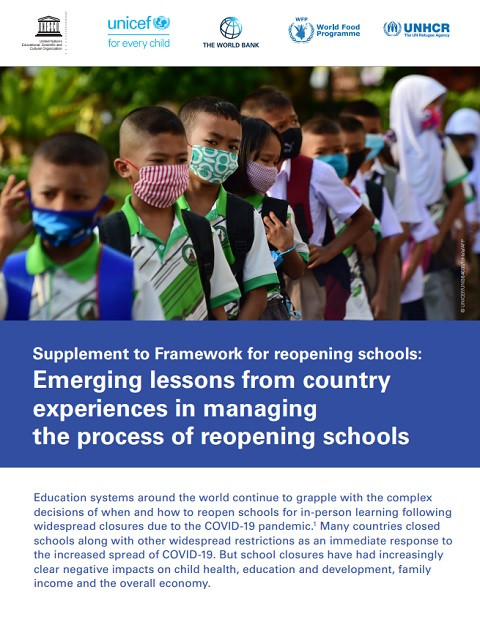 Supplement to Framework for Reopening Schools: Emerging Lessons From Country Experiences in Managing the Process of Reopening Schools Year of publication: 2020 Corporate author: UNESCO | United Nations Children's Fund (UNICEF) | World Bank | World Food Programme | UN. Office of the United Nations High Commissioner for Refugees (UNHCR) Education systems around the world continue to grapple with the complex decisions of when and how to reopen schools for in-person learning following widespread closures due to the COVID 19 pandemic. This supplement to the Framework for reopening schools, originally published jointly by UNICEF, UNESCO, the World Bank, the World Food Programme, and the UN Refugee Agency (UNHCR) in April 2020, summarizes emerging lessons learnt over the past months.The supplement follows the four main dimensions of the Framework (safe operations, focus on learning, wellbeing & protection, and reaching the most marginalized) and highlighting a number of country examples.
  Guidelines to Strengthen the Right to Education in National Frameworks Year of publication: 2021 Corporate author: UNESCO These Guidelines aim to strengthen national frameworks by assisting countries and stakeholders in conducting an assessment of the compatibility of their national education legal and policy framework with international standard-setting instruments on the right to education, and in light of SDG 4 commitments. These Guidelines provide a hands-on approach aiming to assist in the review of national education legal and policy frameworks in view of:Developing practical knowledge on the right to education based on the Right to education handbook and supporting capacity developmentProviding operational tools to assess the status of the right to education at country level and its compatibility with international and regional human rights obligations and international commitments (notably SDG 4)Identifying legal and policy gaps in education at country level and resulting challengesMaking recommendations for the full alignment of national constitutions, legislation , singular and policies with international standards and provisionsProviding insights on how to implement the recommendations in view of necessary reforms.
  Global Media and Information Literacy Assessment Framework: Country Readiness and Competencies Year of publication: 2013 Corporate author: UNESCO The MIL Assessment Framework can foster lifelong learning initiatives by building on the relationship between information, media, digital, and ICT literacies, along with societal transformations, education, workforce, policy and decision making processes, economic growth and democracy. The overall goal of the publication is to guide UNESCO’s Member States throughout the assessment of country readiness and competencies regarding the media and information literacy of citizens, in particular teachers in service and in training. The document is particularly aimed at the following stakeholders: policy makers and decision makers; national officers responsible for statistical data collection and analysis; educational policy makers and planners working in formal and informal education settings; teacher training institutions and teachers. It is also of relevance to the professional information and communication community, and has wide applicability for civil society at large.
  لعربية للإدماج الحضري: تعزيز الإدماج الحضري من خلال المشاركة العامة، والوصول إلى المعلومات، والرياضة والتربية على المواطنة وحقوق الإنسان Year of publication: 2020 Author: Kareem Ibrahim | Deena Khalil | Marwa Barakat | Salwa Salman Corporate author: UNESCO | European Training and Research Centre for Human Rights and Democracy (Austria) | UNESCO Cairo ً ً ـا متسـارع ّ ا، حيـث باتـت تسـتضيف أكـر مـن نصـف سـكان املنطقـة. وتحولـت معظـم املـدن العربيـة ً تشـهد املـدن العربيـة توسـعا حرضي ّـات والثقافـات واألعـراق. وميكـن لهـذه التحـوالت أن تسـهم يف تحقيـق الرخـاء ِبف ّ عـل عوامـل مختلفـة إىل فضـاءات مختلطـة، تتنـوع فيهـا الهوي ًــا محــوره اإلنســان، وتطبيــق سياســات وتدابــر دامجــة مــن شــأنها توفــر الفــرص االجتامعــي بــرط اعتــا ً د مســؤويل املــدن نهجــا حقوقي املتسـاوية لجميـع السـكان. ُقـدم مجموعـة مـن األدوات والنصائـح العمليـة ليسرتشـد بهـا قـادة املـدن عـى هـذه الخلفيـة، يـأيت دليـل املـدن العربيـة لإلدمـاج الحـري لي العربيــة واملســؤولون بالحكومــات املحليــة يف مســعاهم نحــو إقامــة مــدن شــاملة ومســتدامة. ينطلــق الدليــل مــن خــرات وتجــارب املــدن ّ املنتسـبة لتحالـف املـدن العربيـة ضـد ّ العنرصيـة والتمييـز وكراهيـة األجانـب والتعصـب يف تخطيـط وتنفيـذ وتقييـم برامـج ومشـاريع تُعـزز اإلدمـاج الحـري وتتصـدى لإلقصـاء بأشـكاله كافـة. ويركّـز الدليـل عـى أربعـة موضوعـات اعتربتهـا املـدن األعضـاء يف التحالـف مـن ضمـن أولوياتهـا، وهـي: املشـاركة العامـة، والوصـول إىل املعلومـات، والرياضـة مـن أجـل إدمـاج الشـباب، والرتبيـة عـى املواطنـة وحقـوق اإلنسـان. Toolkit for Urban Inclusion in Arab Cities: Cities Promoting Inclusion Through Public Participation, Access to Information, Sport, and Citizenship and Human Rights Education Year of publication: 2020 Author: Kareem Ibrahim | Deena Khalil | Marwa Barakat | Salwa Salman Corporate author: UNESCO | European Training and Research Centre for Human Rights and Democracy (Austria) | UNESCO Cairo Arab cities are witnessing an unprecedented expansion. Home to more than half of the region’s population, Arab cities have transformed into heterogeneous spaces that host diverse identities, cultures, and ethnicities. In order for this transformation to lead to prosperity, city officials must adopt a rights-based, human-centred approach, and implement inclusive policies and measures that provide equal opportunities for all.In this context, the Toolkit for Urban Inclusion in Arab Cities provides Arab city leaders and local government officials with practical tools and advice to guide their efforts towards establishing inclusive and sustainable cities. The Toolkit is based on the real experiences and practices of cities members of the Coalition of Arab Cities against Racism, Discrimination, Xenophobia and Intolerance in planning, implementing and evaluating programs and projects that promote urban inclusion and combat exclusion in all its forms.The Toolkit focuses on four topics of high priority to the Arab Coalition member cities: public participation, access to information, sport for youth inclusion, and citizenship and human rights education.