
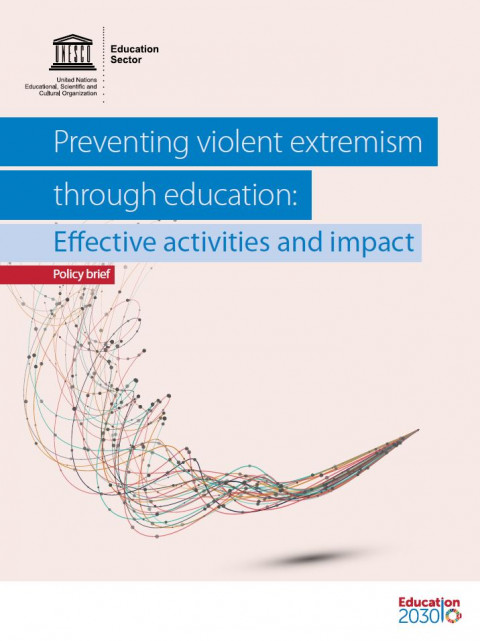
Preventing Violent Extremism through Education: Effective Activities and Impact; Policy Brief
- Autor Corporativo
- Organización de las Naciones Unidas para la Educación, la Ciencia y la Cultura (UNESCO)
- Colección
- 12 p.
- Idioma del recurso
- inglésfrancésárabe
- Año de publicación
- 2018
- Tipo de Recurso
- International normative instruments / policy and advocacy documentsResearch papers / journal articles
- Nivel de Educación
- Educación primariaEducación secundariaEducación no formal
- Región
- Global
- Lugar de publicación
- Paris
Since 2015, UNESCO has driven forward the importance of education in preventing violent extremism (PVE-E) in the framework of its efforts to advance Global Citizenship Education (GCED). Despite the growing number of PVE-E activities globally, there is a lack of evidence on their effectiveness and impact.
This Policy Brief seeks to provide answers to two questions: (i) What types of PVE-E activities tend to be more effective in having impact? and (ii) What is the proven impact of PVE-E activities?
The aim is to help education stakeholders undertake programmes with stronger positive impact and take evidenced-informed decisions on spending priorities.
The Policy Brief shows that PVE-E does work, highlighting various kinds of activities proven to be particularly effective, and recommending ways forward to develop stronger evidence on what works and does not.
Recursos Relacionados
-
 Addressing Violent Pasts through Education: A Policy Guide
 -
 UNESCO Framework for Culture and Arts Education: Implementation Guidance
 -
 Mainstreaming the General History of Africa into Education Systems: The Curriculum Pathway
 -
 The Representation of Jews, Judaism and Antisemitism in School Textbooks and Curricula in Europe