
Recursos
Exploren una amplia gama de recursos valiosos en GCED para profundizar su comprensión y promover su búsqueda, incidencia, enseñanza y aprendizaje.
1,443 resultados encontrados
 [Summary] 4th Global Report on Adult Learning and Education: Leave No One Behind: Participation, Equity and Inclusion; Key Messages and Executive Summary Año de publicación: 2020 Autor corporativo: UNESCO Institute for Lifelong Learning (UIL) The fourth Global Report on Adult Learning and Education (GRALE 4) argues that achieving SDG 4, and realizing its cross-cutting contribution to the other 16 goals, demands a much more integrated and comprehensive approach to education, with adult learning and education at its heart. GRALE 3, published in 2016, showed that adult learning and education produces significant benefits across a range of policy areas. Countries reported a positive impact on health and well-being, employment and the labour market, and social, civic and community life. GRALE 4, while reinforcing the message that the benefits of participation in ALE are substantial, shows that they remain unevenly distributed. [요약문] 제4차 유네스코 성인학습 및 교육에 관한 글로벌 보고서: 참여, 형평 및 포용을 통해 그 누구도 소외되지 않는 세상; 주요 결과 및 요약 Año de publicación: 2020 Autor corporativo: UNESCO Institute for Lifelong Learning (UIL) 제4차 유네스코 성인학습 및 교육에 관한 글로벌 보고서(GRALE IV)는 SDG 4의 달성 및 이를 통한 나머지 16개 목표에 대한 범분야적 기여 실현에 있어 성인학습 및 교육을 중심으로 교육에 대해 훨씬 더 통합적이고 포괄적인 접근이 요구된다고 주장한다. 본 보고서의 주요내용은 대부분의 회원국이 능동적 시민성 함양을 위한 성인학습 및 교육(ALE for active citizenship)의 가능성을 인정하고 있음에도 불구하고 여전히 정책우선순위에서 밀려나 있다는 것이다. 이러한 정책 흐름을 바꾸지 않는 이상, SDG 4의 다양한 세부 목표를 이행할 수 없으며 교육분야 목표가 달성되지 못하면 다른 목표 역시 달성되지 못할 위험에 빠질 것이라고 강조한다. GRALE IV는 성인학습 및 교육 참여가 가져오는 다양한 이점을 강조함과 동시에 이러한 이점들이 고르지 않게 분배되어 있음을 보여준다.
  UNESCO COVID-19 Education Response: Open and Distance Learning to Support Youth and Adult Learning (Education Sector Issue Note; No. 2.5 – June 2020) Año de publicación: 2020 Autor corporativo: UNESCO Institute for Lifelong Learning (UIL) A new UNESCO issue note, produced by the UNESCO Institute for Lifelong Learning (UIL), aims to support education policy-makers and planners in ensuring open and distance learning to support youth and adult learning in the context of the current pandemic, now and in its aftermath.Since the COVID-19 outbreak and the worldwide school closures that followed, ministries of education have endeavoured to ensure continuity of learning and encourage schools and educational institutions to explore and utilize online and distance modes of learning. Unfortunately, learners outside of the formal school system who are already in need of urgent learning support, such as low-skilled adults, women, out-of-school youth, migrants and refugees, and persons with disabilities, have suffered disproportionally from the suspension of face-to-face learning at the majority of adult learning centres and non-formal educational institutions.The current pandemic calls for people from people from all socio-economic backgrounds, wherever they live in the world, to develop new knowledge and skills in order to cope with the uncertainty that this crisis imposes. These learning needs include basic health literacy, media literacy, parenting for home-schooling children and professional development to counteract job losses brought on by the pandemic. Correspondingly, enrolment in massive open online courses (MOOCs) is soaring. As such, there have been positive and demand-driven trends in exploring alternative options, such as open and distance learning (ODL), to ensure the continuity and expansion of non-formal education and adult learning.This issue note takes stock of opportunities and challenges in using ODL, both online and offline as defined in the UNESCO Issue Note on Distance Learning Strategies, for youth and adult learners outside the formal education system. After examining key issues and illustrating promising cases from public and private sectors, it provides key messages for policy interventions to support inclusive lifelong learning for youth and adults during and after the current pandemic.UNESCO Education Sector’s issue notes cover key topics related to the COVID-19 education response.
  Annual Report 2018 : UNESCO INSTITUTE FOR LIFELONG LEARNING Año de publicación: 2019 Autor corporativo: UNESCO Institute for Lifelong Learning (UIL) UIL’s 2018 Annual Report shows how, last year, our work contributed to fulfilling our mission to support better policy-making and strengthen the capacities of UNESCO Member States in the field of lifelong learning. UIL’s vision is for all children, youth and adults to benefit from quality lifelong learning, within the framework of sustainable development and peace, and we pursue it in the context of the United Nations 2030 Agenda for Sustainable Development, particularly Sustainable Development Goal (SDG) 4 on quality education and lifelong learning. Its publications are a valuable resource for education researchers, planners, policy-makers and practitioners.
  차기 교육과정과 평화・세계시민교육 Año de publicación: 2021 Autor corporativo: 한국교육과정평가원 2021년 2월 16일 유네스코 아태교육원과 한국교육과정평가원이 공동 개최한 온라인 토론회 “차기 교육과정과 평화·세계시민교육” 자료집이다. 2015 개정 교육과정에서 ‘평화와 세계시민성’을 강화하기 위한 방안 및 논의 내용을 정리하였다.
 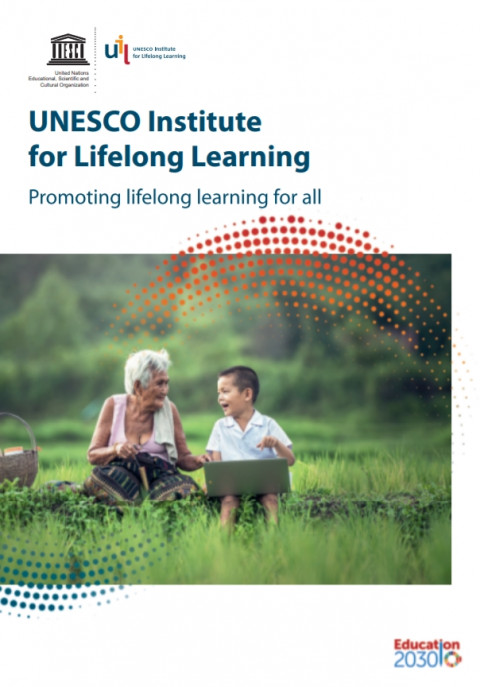 UNESCO Institute for Lifelong Learning: promoting lifelong learning for all Año de publicación: 2019 Autor corporativo: UNESCO Institute for Lifelong Learning (UIL) The UN’s 2030 Agenda for Sustainable Development is our guide to action. Leaving no one behind is at the centre of this global planof action for people, planet and prosperity. The 2030 Agenda for Sustainable Development consists of 17 Sustainable Development Goals (SDGs). UIL has a special responsibility for supporting countries to ‘ensure inclusive and equitable quality education and promote lifelong learning opportunities for all’ (SDG 4). But we are also charged with realizing the potential contribution of lifelong learning to the other 16 SDGs. In today’s fast-changing world, where social, economic and political contexts are being constantly reshaped, learning must be continuous and lifelong, for everyone.
  Towards CONFINTEA VII: adult learning and education and the 2030 Agenda Año de publicación: 2019 Autor corporativo: UNESCO Institute for Lifelong Learning (UIL) The CONFINTEA VI Mid-Term Review (MTR) Conference took place in Suwon and Osan, Republic of Korea, in October 2017. Stakeholders from 95 UNESCO Member States assessed progress in implementing the Belém Framework for Action (BFA) and discussed the next steps. The BFA, which was adopted by delegates at the Sixth International Conference on Adult Education (CONFINTEA VI) in Belém, Brazil, in December 2009, records the commitments of Member States and presents a strategic guide for the future development of adult learning and education (ALE) within the perspective of lifelong learning. This publication constitutes the third outcome document of the conference. It provides an overview of the main thematic debates. The chapters follow the conference themes and aim to illustrate or underpin the main arguments and way forward set out in the Suwon-Osan Statement.
  유네스코 1974 국제이해교육 권고 개정안 검토 포럼 자료집 Año de publicación: 2022 Autor corporativo: 한국국제이해교육학회 | 유네스코 아시아태평양 국제이해교육원 | 유네스코한국위원회 2022년 10월 5일 유네스코 아태교육원과 유네스코한국위원회, 한국국제이해교육학회가 공동으로 개최한 <유네스코 1974 국제이해교육 권고 개정안 검토 포럼> 자료집 입니다. 본 포럼은 유네스코의 「국제이해, 협력, 평화를 위한 교육과 인권, 기본 자유에 관한 교육 권고( 1974 국제이해교육 권고)」가 오늘날 변화된 시대 상황과 지구촌의 새로운 과제 등을 반영할 수 있도록 개정안 초안에 대한 전문적 검토 요지 발표와 토론을 실시한 후, 참가자들의 의견을 수렴하였습니다. <목차> I. 인사말 한경구 (유네스코한국위원회 사무총장) 임현묵 (유네스코 아시아태평양 국제이해교육원장) 박순용 (한국국제이해교육학회장) II. [1부] 1974 국제이해교육 권고 개정 배경 및 현황 1974 국제이해교육 권고 개요와 개정 추진 현황 - 유네스코 아시아태평양 국제이해교육원 / 유네스코한국위원회 국제전문가그룹의 주요 활동 및 1974 국제이해교육 권고 개정안 초안의 주요 내용 / 강순원 (한신대학교 교수) III. [2부] 1974 국제이해교육 권고 개정안 초안 검토 조대훈 (성신여자대학교 교수) 김병연 (양재고등학교 교사) 권혁장 (국가인권위원회 인권교육기획과장) 이선경 (청주교육대학교 교수) 변순용 (서울교육대학교 교수) 이동연 (한국예술종합학교 교수) 손동빈/장경희 (서울시교육청 민주시민생활교육과 과장/장학사) 부록 Recommendation concerning Education for International Understanding, Co-operation and Peace and Education relating to Human Rights and Fundamental Freedoms 국제이해, 협력, 평화를 위한 교육과 인권, 기본 자유에 관한 교육 권고 REVISED RECOMMENDATION CONCERNING EDUCATION FOR INTERNATIONAL UNDERSTANDING, CO-OPERATION AND PEACE AND EDUCATION RELATING TO HUMAN RIGHTS AND FUNDAMENTAL FREEDOMS (‘1974 RECOMMENDATION’)
  제22회 한국국제이해교육학회 국제학술대회: 미래형 교육과정과 세계시민교육: 도전과 과제 Año de publicación: 2021 Autor corporativo: 한국국제이해교육학회 2021년 11월 13일에 개최되었던 제22회 한국국제이해교육학회 국제학술대회 자료집으로 '미래형 교육과정과 세계시민교육: 도전과 과제'라는 주제로 세계시민교육의 역할과 가능성을 어떻게 학교교실 안으로 가져올지에 대한 토론과 발표내용을 담고 있습니다. 본 자료집에는 기조강연/패널부터 자유 발표 등에 이르기까지 모든 발표자들의 자료가 포함되어 있으며 기조강연 및 패널, 패널4(이기 프로젝트)의 경우 일본어 번역자료도 함께 수록되어 있습니다.
 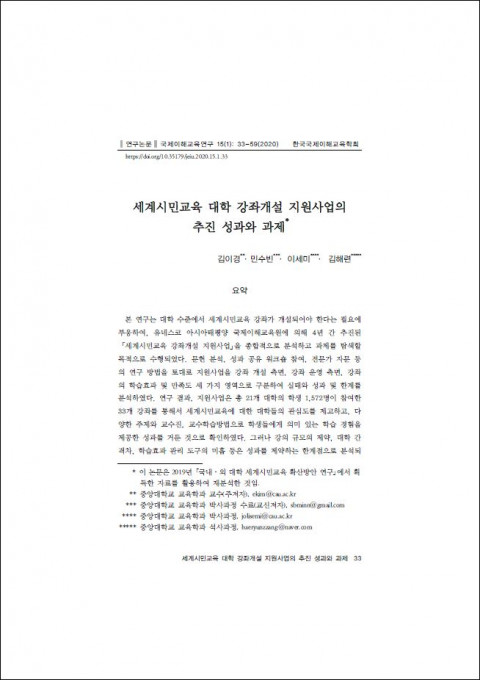 The Achievements and Tasks of the Global Citizenship Education University Course Development Project Año de publicación: 2020 Autor: Eegyeong Kim | Soobin Min | Semi Lee | Haeryun Kim Autor corporativo: Korean Society of Education for International Understanding (KOSEIU) This study seeks to analyze the achievements and tasks of the 「GCED University Course Development Project」 promoted by APCEIU. Using such research methods as literature review, workshops, and expert consultation, we analyzed the four-year project surrounding course providers, course contents, and student learning and satisfaction. The findings show that the project has heightened universities’ interest in GCED through 33 courses involving 1,572 students from 21 universities. It was also confirmed that a variety of supports allowed students to have meaningful learning experiences. However, large class sizes, disparity among universities, and the absence of performance measuring tools seemed to limit the success of the project. As a strategy for overcoming these limitations, we suggested the tasks in terms of both quantitative and qualitative aspects.