
Recursos
Exploren una amplia gama de recursos valiosos en GCED para profundizar su comprensión y promover su búsqueda, incidencia, enseñanza y aprendizaje.
3,436 resultados encontrados
 학교 평화·통일교육 내실화를 위한 교육과정 개선 방향 탐색 Año de publicación: 2020 Autor: 김상범 Autor corporativo: 한국교육과정평가원 본 연구의 목적은 학교 평화·통일교육의 개념을 정립하여 핵심역량, 목표를 설정하고 이에 근거하여 평화·통일교육의 현황 및 요구를 심층 분석함으로써 학교 평화·통일교육 내실화를 위한 교육과정 개선 방향을 탐색하며 향후 교육과정 개정 시 평화·통일교육이 일부 교과에만 집중되지 않고 전 교과 교육과정을 통해 체계적이고 지속적으로 구현될 수 있도록 실질적이고 종합적인 정책 구상을 제시하는 것이다.
 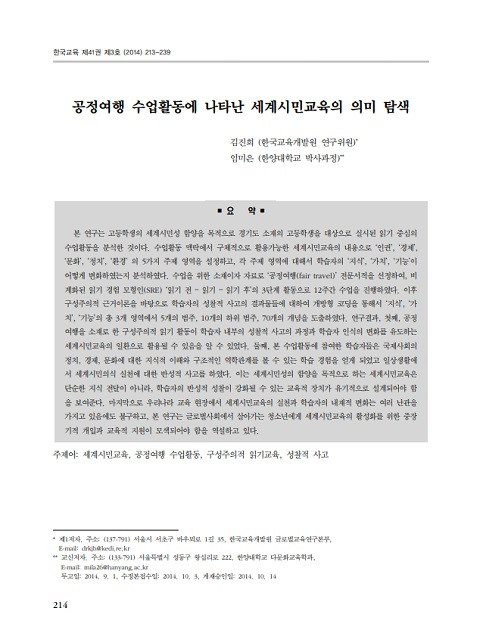 A Study on Global Citizenship Education Based on Scaffolded Reading Activities Utilizing a ‘fair travel’ Book in a High School (Journal of Korean Education; Vol. 41, No. 3) Año de publicación: 2014 Autor: Jinhee Kim | Mieun Lim Autor corporativo: Korean Educational Development Institute (KEDI) This study investigated the guiding principles associated with global citizenship education and their educational implications as they are engaged through scaffolded reading activities using a ‘fair travel’ book in a high school at Gyeonggi-do. The reading activities were designed to cultivate global citizenship for high school students. This study defined five major themes/subjects within global citizenship education such as ‘human rights,’ ‘economy,’ ‘culture,’ ‘politics,’ and ‘environment.’ The study sought to explore the learning domains of global citizenship education by considering the ‘knowledge,’ ‘value,’ and ‘function’ of each domain. To conduct this study, researchers selected a book with a specialized focus on ‘fair travel’ and analyzed how its contents if utilized in a 12 week program relate to the learning domains in global citizenship education. The activity stage of the program contained a ‘before reading,’ ‘on reading,’ and ‘after reading’ sections based on the Scaffolded Reading Experience Program. Embracing open-coding methodology, researchers produced 70 concepts within 10 subcategories of 5 categories in the 3 dimensions, ‘knowledge,’ ‘value,’ and ‘function.’ Major findings showed that the constructive model of scaffolded reading activities could be used as a meaningful program for global citizenship education at the high school level. This activity encouraged learners to engage in reflective thinking in a critical manner. Second, this study indicated that collective classroom activities using ‘fair travel’ contents enabled learners to acquire reshaped learning domains in the areas of global awareness, international knowledge, sense of global connectedness and local involvement. This study’s findings underscore the idea that practicing reflective critical thinking is required to enhance global citizenship education in practice. Lastly the findings support that the notion that effective educational provisioning and long-term implementation are both required to foster global citizenship education. 공정여행 수업활동에 나타난 세계시민교육의 의미 탐색 (한국교육; Vol. 41, No. 3) Año de publicación: 2014 Autor: 김진희 | 임미은 Autor corporativo: 한국교육개발원 본 연구는 고등학생의 세계시민성 함양을 목적으로 경기도 소재의 고등학생을 대상으로 실시된 읽기 중심의 수업활동을 분석한 것이다. 수업활동 맥락에서 구체적으로 활용가능한 세계시민교육의 내용으로 ‘인권’, ‘경제’, ‘문화’, ‘정치’, ‘환경’의 5가지 주제 영역을 설정하고, 각 주제 영역에 대해서 학습자의 ‘지식’, ‘가치’, ‘기능’이 어떻게 변화하였는지 분석하였다. 수업을 위한 소재이자 자료로 ‘공정여행(fair travel)’ 전문서적을 선정하여, 비계화된 읽기 경험 모형인(SRE) ‘읽기 전 – 읽기 – 읽기 후’의 3단계 활동으로 12주간 수업을 진행하였다. 이후 구성주의적 근거이론을 바탕으로 학습자의 성찰적 사고의 결과물들에 대하여 개방형 코딩을 통해서 ‘지식’, ‘가치’, ‘기능’의 총 3개 영역에서 5개의 범주, 10개의 하위 범주, 70개의 개념을 도출하였다. 연구결과, 첫째, 공정 여행을 소재로 한 구성주의적 읽기 활동이 학습자 내부의 성찰적 사고의 과정과 학습자 인식의 변화를 유도하는 세계시민교육의 일환으로 활용될 수 있음을 알 수 있었다. 둘째, 본 수업활동에 참여한 학습자들은 국제사회의 정치, 경제, 문화에 대한 지식적 이해와 구조적인 역학관계를 볼 수 있는 학습 경험을 얻게 되었고 일상생활에 서 세계시민의식 실천에 대한 반성적 사고를 하였다. 이는 세계시민성의 함양을 목적으로 하는 세계시민교육은 단순한 지식 전달이 아니라, 학습자의 반성적 성찰이 강화될 수 있는 교육적 장치가 유기적으로 설계되어야 함을 보여준다. 마지막으로 우리나라 교육 현장에서 세계시민교육의 실천과 학습자의 내재적 변화는 여러 난관을 가지고 있음에도 불구하고, 본 연구는 글로벌사회에서 살아가는 청소년에게 세계시민교육의 활성화를 위한 중장 기적 개입과 교육적 지원이 모색되어야 함을 역설하고 있다.
 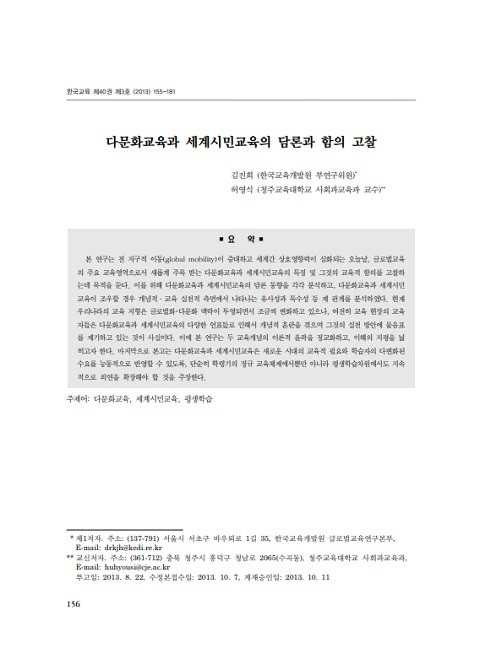 Understanding Multicultural Education and Global Citizenship Education: Characteristics, Conceptual Relations and Educational Implications (Journal of Korean Education; Vol. 40, No. 3) Año de publicación: 2013 Autor: Jinhee Kim | Jinhee Kim Autor corporativo: Korean Educational Development Institute (KEDI) Thanks to the impact of globalized educational discourses and the resulting changes, much attention has been paid to multicultural education and global citizenship education in Korea. This study attempted to demonstrate the characteristics and conceptual relations of similarity and differences between multicultural education and global citizenship education. Finally, the study sought to produce educational implications and policy recommendations in response to a change in global education discourse and the accompanying practices. The major findings of the study showed that multicultural education and global citizenship education could be conceptualized as mechanisms for “learning to live together,” emphasizing diversity, equality and involvement in a global community. This type of education should be promoted while espousing an epistemology of lifelong learning, not only within the formal education system, but also in society as a whole. Despite the differences between multicultural education and global citizenship education, both fields are capable of continuously complementing each other. The study shows that multicultural education and global citizenship education emphasize critical reflection and engagement (praxis) by the learner rather than the formulation of knowledge and skills. It was argued that teacher education and teacher training is a very important part of nurturing multicultural education and global citizenship education in practice, which can bring about changes for the better in the current field of education. As democratic citizenship education, both educations could play an important role in reshaping Korean education. 다문화교육과 세계시민교육의 담론과 함의 고찰 (한국교육; Vol. 40, No. 3) Año de publicación: 2013 Autor: 김진희 | 허영식 Autor corporativo: 한국교육개발원 본 연구는 전 지구적 이동(global mobility)이 증대하고 세계간 상호 영향력이 심화되는 오늘날, 글로벌교육의 주요 교육 영역으로서 새롭게 주목받는 다문화교육과 세계시민교육의 특징 및 그것의 교육적 함의를 고찰하는데 목적을 둔다. 이를 위해 다문화교육과 세계시민교육의 담론 동향을 각각 분석하고, 다문화교육과 세계시민교육이 조우할 경우 개념적·교육 실천적 측면에서 나타나는 유사성과 특수성 등 제 관계를 분석하였다. 현재 우리나라의 교육 지형은 글로벌화・다문화 맥락이 투영되면서 조금씩 변화하고 있으나, 여전히 교육 현장의 교육자들은 다문화교육과 세계시민교육의 다양한 언표들로 인해서 개념적 혼란을 겪으며 그것의 실천 방안에 물음표를 제기하고 있는 것이 사실이다. 이에 본 연구는 두 교육개념의 이론적 윤곽을 정교화하고, 이해의 지평을 넓히고자 한다. 마지막으로 본고는 다문화교육과 세계시민교육은 새로운 시대의 교육적 필요와 학습자의 다변화된 수요를 능동적으로 반영할 수 있도록, 단순히 학령기의 정규 교육체제에서 뿐만 아니라 평생학습차원에서도 지속적으로 외연을 확장해야 할 것을 주장한다.
 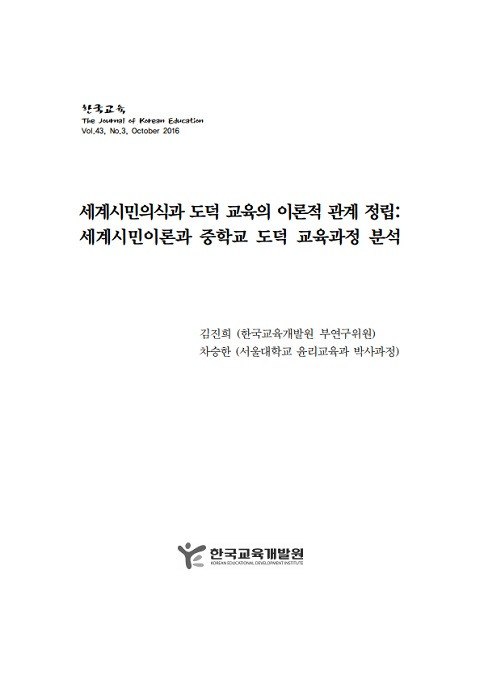 The Theoretic Relationship Between Global Citizenship and Moral Education: An Analysis of Global Citizenship and the Moral Education Curriculum for Middle School Students in South Korea (The Journal of Korean Education; Vol.43, No.3) Año de publicación: 2016 Autor: Jinhee Kim | Seunghan Cha Autor corporativo: Korean Educational Development Institute (KEDI) This study explores the theoretical relationship between global citizenship and moral education to enhance global citizenship as espoused within a moral education context. 세계시민의식과 도덕 교육의 이론적 관계 정립: 세계시민이론과 중학교 도덕 교육과정 분석 (한국교육; Vol.43, No.3) Año de publicación: 2016 Autor: 김진희 | 차승한 Autor corporativo: 한국교육개발원 본 연구는 국제사회에서 세계시민교육이 강조되고 있는 오늘날 세계시민의식과 밀접한 연관을 가지고 있는, 도덕 교육을 통한 세계시민성의 개념 정립이 필요하다는 문제의식에서 출발하였다. 세계시민의식 함양이 도덕교육에 주는 의미를 분석하고, 현행 중학교 도덕 교육에 세계시민의식의 내용을 얼마나 반영되어 있는지 진단하고자 하였다. 이를 위해 칸트, 아렌트, 너스봄, 아피아를 중심으로 세계시민과 도덕의 관계에 대한 이론을 분석하였고, 각 이론에서 중시한 ‘세계관찰자, 도덕적 공동체, 뿌리내린 세계시민’ 담론을 세계시민적 정체성(belonging), 세계시민적 태도(attitude), 세계시민적 개입(engagement)과 연계지어 논리적으로 정련함으로써 도덕 교육에서 세계시민의식을 측정할 수 있는 분석틀을 도출하였다. 분석결과, 세계문제에 대한 다양한 쟁점을 다루는 글로벌 윤리 개념이 세계시민의식과 도덕 교육 사이에서 징검다리 역할을 할 수 있다는 점을 밝혔다. 한국의 현행 도덕 교육과정은 세계시민의식과 관련한 내용을 직간접적으로 반영하고 있으나 ‘공적 영역에 대한 헌신’을 반영하는 내용 요소는 빈약한 것으로 드러났다. 본 연구는 한국교육의 상황에 맞는 세계시민의식의 개념 정립을 위해 학교 교육의 장면 중 중학교 도덕 교육에서 세계시민교육을 내실화하는 단초를 이론적으로 제시하였다.
 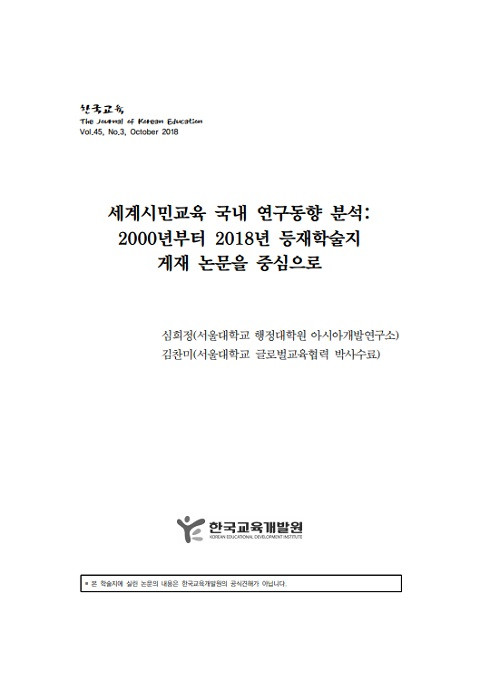 Research Trends in Global Citizenship Education in South Korea: An Analysis and Its Implications (The Journal of Korean Education; Vol.45, No.3) Año de publicación: 2018 Autor: HeeJung Raina Sim | Chanmi Kim Autor corporativo: Korean Educational Development Institute (KEDI) Purpose: Global citizenship education(GCED) has drawn the attention of researchers in the last decade; yet, the number of systematic reviews is still not enough. This study therefore aims to examine general research trends in GCED published in the Korean Citation Index(KCI) journals from January 2000 to July 2018.Design/ Methods: The study implemented a systematic review following the Preferred Reporting Items for Systematic Reviews and Meta-Analyses(PRISMA) statement guidelines. As a result, 218 relevant articles have been identified and this study employed a classification form to categorize the characteristics of the studies during meta analyses.Findings/ Results: The results showed that the number of published articles has significantly increased since 2016. Social science was the most common subject. The most frequently used keywords were multicultural education and global citizenship. while glocal and ecological citizenship has recently emerged. Most studies equally cover all education levels. A literature review was most often employed as a research method. Values: In conclusion, many studies have been published on GCED in South Korea in the last decade, but their general consensus is that most of the studies are too often based on a Western school of thought. The findings from the current study direct future studies on the subject. 세계시민교육 국내 연구동향 분석: 2000년부터 2018년 등재학술지 게재 논문을 중심으로 (한국교육; Vol.45, No.3) Año de publicación: 2018 Autor: 심희진 | 김찬미 Autor corporativo: 한국교육개발원 본 연구는 세계시민교육과 관련된 국내 논문을 체계적으로 고찰하여 이에 대한 학문적 성과 및 한계 점을 파악하고 나아가 후속 연구의 과제와 방향을 제시하고자 하였다. 이를 위해 2000년부터 2018년까 지 출간된 국내 등재 학술지(KCI)를 대상으로 체계적 문헌고찰 연구방법을 수행하였다. 이를 위해 본고는 PRISMA 모형 흐름도 및 COSI 모델을 이용하여 KISS, RISS, DBpia 세 종류의 국내학술데이터베 이스에서 검색을 실시하였다. 최초 검색된 논문은 900편이었으나 절차에 따라 논문 선정을 진행한 바 최종 218편이 분석 대상으로 도출되었다. 세계시민교육 관련 국내 연구는 총 73개 학술지에 출판되 었는데 그 중 ‘사회과교육’이 가장 큰 비중(24편, 11%)을 차지했다. 연구영역은 실천방안연구가 171편 으로 가장 높았고 주제별로는 교육과정 개발 및 적용이, 주제어 분석에서는 다문화교육과 세계시민성 이 가장 많이 사용되었다. 교육단계에서는 초・중・고등 대상 연구가 비교적 균등하게 이뤄졌고 연구 방법으로는 문헌연구가 가장 많이 사용되었다(43.3%). 한편, 세계시민교육 분야 국내연구는 영미권을 중심으로 논의되어온 단편적 이론 및 담론 재해석 등 대부분 기술적인 면에 치중되어 있는 것으로 나타났다. 따라서 앞으로 세계시민교육의 연구논문 활성화를 위해 보다 한국적・동양적 관점에서의 대안적 담론과 실증적 근거에 기반한 다양한 연구 논문의 필요성이 제기된다.
  2030 지속가능개발목표(SDGs)실천 방안 연구: 교육 분야를 중심으로 Año de publicación: 2016 Autor: 안혜정 | 서예원 | 윤종혁 | 김은영 | 염후남 | 박환보 | 최동주 | 김명진 | 이정화 Autor corporativo: 한국교육개발원 이 연구는 새천년개발목표(MDGs)의 이행종료와 더불어 향후 2030년까지 국제사회가 함께 성취해야 할 개발목표로 채택된 지속가능개발목표(SDGs) 중 네 번째 목표인 교육 목표(SDG 4)의 전략적 실천방안을 마련하기 위하여 수행되었다. 현 정부는 “ODA 지속 확대 및 모범적・통합적 개발협력 추진”을 국정과제로 삼고, 개도국 소녀교육 및 아프리카 직업/ICT 교육을 포함한 4대 구상을 선정하는 등 교육 분야 개발협력의 중요성과 필요성을 강조한 바 있다. 이에 본 연구에서는 우리나라 교육개발협력 사업의 현황과 수행주체별 참여 실태 및 인식 조사를 토대로 실효성 있는 정책방안을 도출하고 SDG 4의 실천 방안을 제시하였다.