
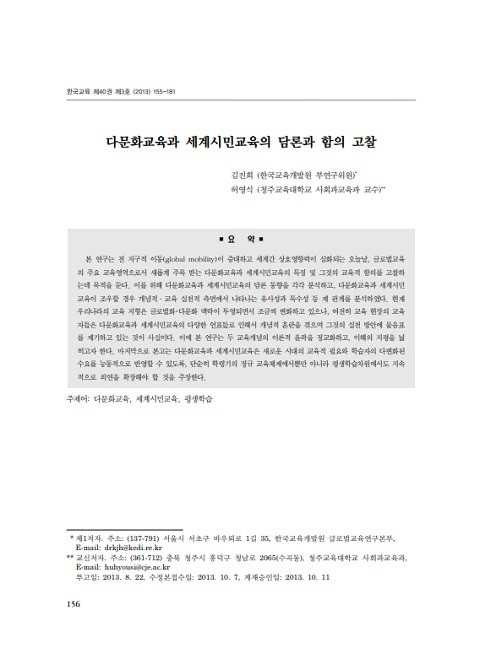
Understanding Multicultural Education and Global Citizenship Education: Characteristics, Conceptual Relations and Educational Implications (Journal of Korean Education; Vol. 40, No. 3)
- Author
- Jinhee KimJinhee Kim
- Corporate Author
- Korean Educational Development Institute (KEDI)
- ISBN
- ISSN 1599-2659
- Collation
- p.155-181
- Resource Language
- Korean
- Year of publication
- 2013
- Topic
- Civic / Citizenship / DemocracyDiversity / Cultural literacy / InclusivenessGlobalisation and social justice / International understanding
- Resource Type
- Research papers / journal articles
- Level of education
- Primary educationSecondary educationHigher educationLifelong learning
- Region
- Asia and the Pacific
- Place of publication
- Jincheon
Thanks to the impact of globalized educational discourses and the resulting changes, much attention has been paid to multicultural education and global citizenship education in Korea. This study attempted to demonstrate the characteristics and conceptual relations of similarity and differences between multicultural education and global citizenship education. Finally, the study sought to produce educational implications and policy recommendations in response to a change in global education discourse and the accompanying practices. The major findings of the study showed that multicultural education and global citizenship education could be conceptualized as mechanisms for “learning to live together,” emphasizing diversity, equality and involvement in a global community. This type of education should be promoted while espousing an epistemology of lifelong learning, not only within the formal education system, but also in society as a whole. Despite the differences between multicultural education and global citizenship education, both fields are capable of continuously complementing each other. The study shows that multicultural education and global citizenship education emphasize critical reflection and engagement (praxis) by the learner rather than the formulation of knowledge and skills. It was argued that teacher education and teacher training is a very important part of nurturing multicultural education and global citizenship education in practice, which can bring about changes for the better in the current field of education. As democratic citizenship education, both educations could play an important role in reshaping Korean education.
Related Resources
-
 IIEP-UNESCO 12th Medium-Term Strategy: 2026–2029
 -
 Youth Lens on the Silk Roads: Best Photos from the International Silk Roads Photo Contest; 6th Edition
 -
 Advancing Intergenerational Learning: Identifying Challenges and Opportunities for Older Adults; Integrated Case Study Report
 -
 Digital Empowerment for Lifelong Learning and Transformative Andragogy (DELTA) for Adult Educators: Introduction to the DELTA Framework and Resources