
Recursos
Exploren una amplia gama de recursos valiosos en GCED para profundizar su comprensión y promover su búsqueda, incidencia, enseñanza y aprendizaje.
8,354 resultados encontrados
 Alfabetización para el desarrollo sostenible y el empoderamiento de las mujeres Año de publicación: 2014 Autor: Anna Robinson-Pant Autor corporativo: UNESCO Institute for Lifelong Learning (UIL) The fact that women constitute two-thirds of the world’s non-literate population has been a cause for concern for several decades now. Despite a number of high-profile literacy interventions specifically targeting women – including UNESCO’s LIFE initiative – the disparity between male and female literacy rates persists in many countries of the world (UIL, 2013). This starting point for thinking about women’s literacy has however often led to a narrow focus on literacy access and outcomes. Whilst educational policy makers and planners have attempted to identify and overcome barriers to women’s participation, researchers have directed their attention to measuring the social and economic benefits of women’s literacy (see Robinson-Pant, 2004). Statistical correlations have been presented as evidence of the impact of women’s literacy: for instance, in Pakistan, women with a high level of literacy earned 95% more than women with no literacy skills yet there was only a 33% differential amongst men (UNESCO 2012: 196). Barriers to participation have been analysed in terms of structural (timing, location, women-only versus mixed gender) and social (marriage, poverty, language hierarchies) factors (see Ballara 1991). Within such analysis however, little attention has been given to the social processes associated with literacy learning and development. By contrast, this paper sets out to take a wider lens on literacy in order to explore not only ‘what works’ in practical terms of encouraging women to participate programmes, but also to look at how and why literacy programmes can contribute to sustainable development and processes of empowerment. Taking this perspective on women’s literacy involves asking alternative questions from the more usual ‘how can we make more women literate?’ Approaching literacy through the lens of sustainable development and women’s empowerment means that we develop a more nuanced understanding of how different kinds of literacy emerge from or support different development approaches and how women engage with such processes of change. How is literacy related to sustainable development programmes? What does empowerment mean to different women in different situations? What kind of research evidence and knowledge are literacy programmes and policy building on? How can adult learning facilitate economic, social and environmental change? These larger questions will guide the conceptual exploration of sustainable development, women’s empowerment and literacy, as well as the review of literacy programmes presented in this paper. The starting assumption is that only by looking in depth at the processes of literacy learning and development practice can we begin to address the challenge of narrowing the gender gap in literacy attainment. Panorámica regional: América Latina y el Caribe Año de publicación: 2011 Autor corporativo: Organización de las Naciones Unidas para la Educación, la Ciencia y la Cultura (UNESCO) The past decade has seen mixed progress towards Education for All (EFA) in Latin America and the Caribbean. More children are participating in pre-school education, many countries have achieved universal primary education and more students are moving from primary to secondary education. Gender parity has been achieved at the primary level in the majority of countries and adult literacy rates are improving. The region invests a relatively high share of national income in education and external aid to basic education has increased in recent years. However, challenges remain. The Caribbean has seen a decline by nearly one-tenth in primary enrolment ratios and 2.9 million children were not enrolled in school in the region as a whole in 2008. Some 36 million adults are still illiterate and levels of learning achievement are low in many countries. The 2011 EFA Global Monitoring Report puts the spotlight on armed conflict and one of its most damaging yet least reported consequences: its impact on education. Conflict-affected states have some of the world’s worst indicators for education. The Report documents the scale of this hidden crisis in education, looks at its underlying causes and explores the links between armed conflict and education. It also presents recommendations to address identified failures that contribute to the hidden crisis. It calls on governments to demonstrate greater resolve in combating the culture of impunity surrounding attacks on schoolchildren and schools, sets out an agenda for fixing the international aid architecture and identifies strategies for strengthening the role of education in peacebuilding. Resonancias: Décimo Aniversario de la Adopción de la Declaración Universal de la UNESCO sobre la Diversidad Cultural Año de publicación: 2011 Autor corporativo: Organización de las Naciones Unidas para la Educación, la Ciencia y la Cultura (UNESCO) This founding text was the first to acknowledge cultural diversity as “the common heritage of humanity”. It is with great pride that UNESCO is commemorating the 10th anniversary of the Declaration. Commemorate – from the Latin cum memorare – means quite literally “to remember together” or “to remember with”. This collection is compiled the voices of all those who have contributed to the heightening of human awareness by throwing into relief the inestimable value of cultural diversity. These excerpts from books, articles and statements by global intellectual and political leaders, artists and Nobel Prize-winners all call for the safeguarding of cultural diversity, which is inseparable from respect for human dignity. Their voices resound in bearing witness to the strength of cultural diversity and to its capacity to enlighten the minds of women and men. We are duty-bound to ensure that it is central to public policies and a resource for development and dialogue among nations. The United Nations was born of the determination of men and women “to save succeeding generations from the scourge of war...”. In accordance with that principle, UNESCO was established on a key idea, expressed at the very beginning of its Constitution: “... since wars begin in the minds of men, it is in the minds of men that the defences of peace must be constructed”. In the world today, globalized, connected and interdependent as never before, this mission is more vital than ever. The rapprochement of peoples and cultures requires a commensurately global awareness. Cultural diversity has always been at the heart of international relations. It is also, increasingly, a feature of the contemporary mixed and plural societies in which we live. In view of this reality, we must formulate appropriate public policies and rethink the mechanisms of social cohesion and civic participation. How can we build common ground on the basis of such diversity? How can we construct genuine moral and intellectual solidarity of humanity? Any new vision of humanism must be grounded itself in the dynamism and diversity of cultural heritage. It is a source of inspiration and knowledge to be shared and a means of broadening our horizons. The goal of the UNESCO Universal Declaration on Cultural Diversity is to provide keys and benchmarks for capitalizing on this wealth. There can be no sustainable governance if cultural diversity is not acknowledged. There can be no economic and social development if specific features of every culture are belittled and ignored. Educación en pro de la 'ciudadanía mundial': marco para el debate Año de publicación: 2013 Autor: Sobhi Tawil Autor corporativo: Organización de las Naciones Unidas para la Educación, la Ciencia y la Cultura (UNESCO) The notion of ‘global citizenship’ has recently gained prominence in international development discourse with the recently-adopted United Nations Secretary-General’s Global Education First Initiative (2012). Among the three priority areas outlined in this global initiative, the third aims to ‘foster global citizenship’. Education must fully assume its central role in helping people to forge more just, peaceful, tolerant and inclusive societies. It must give people the understanding, skills and values they need to cooperate in resolving the interconnected challenges of the 21st century. The notion of ‘global citizenship’, however, remains very broad, if not contested, and consequently difficult to operationalize in education. There are two possible reasons for this. Firstly, it is unclear whether the very notion of ‘global citizenship’ is a metaphor, a contradiction of terms, or an oxymoron (Davies, 2006). What does ‘global citizenship’ possibly imply both from a legal perspective, as well as from that of collective identity, sense of belonging, and civic engagement? Secondly, when applied to education, the notion of ‘global citizenship’ implies a certain degree of confusion. Is ‘global citizenship education’ (or ‘education for global citizenship’) merely an expression of a fundamental purpose of education systems? Does it also refer to a broad area of teaching and learning? If so, what are the contours of this domain? How does it relate to other often overlapping areas of learning associated with civic and political socialization? Reflexiones sobre el progreso, el desarrollo sostenible y la ciudadanía mundial Año de publicación: 2013 Autor: Georges Haddad Autor corporativo: Organización de las Naciones Unidas para la Educación, la Ciencia y la Cultura (UNESCO) The arguments developed in this concise presentation demonstrate that sustainable development, progress and global citizenship, efficiently embedded in the context of the Knowledge Society, undeniably participate in the development of the New Humanism promoted by the Director-General of UNESCO, and which we all agree to consider essential for the wealth and prosperity of Humanity in an agreeable, peaceful and friendly common environment.
 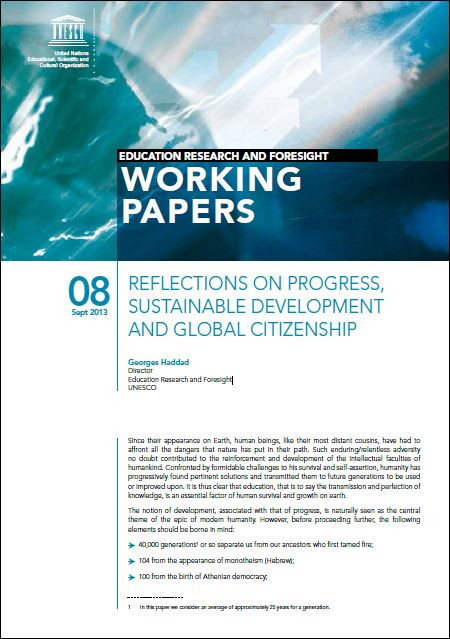 Reflexiones Sobre el Progreso, el Desarrollo Sostenible y la Ciudadanía Mundial Año de publicación: 2013 Autor: Georges Haddad Autor corporativo: Organización de las Naciones Unidas para la Educación, la Ciencia y la Cultura (UNESCO) Los argumentos desarrollados en esta breve ponencia ponen de manifiesto que el desarrollo sostenible, el progreso y la ciudadanía mundial sólidamente arraigados en la Sociedad del Conocimiento contribuyen indudablemente a construir este Nuevo Humanismo promovido por la Directora General de la UNESCO, y que todos coincidimos en considerar esencial para la riqueza y la prosperidad de la Humanidad, en un entorno común grato, pacífico y cordial. Los dos primeros años del Decenio de las Naciones Unidas de la Educación para el Desarrollo Sostenible (2005-2014) Año de publicación: 2007 Autor corporativo: Organización de las Naciones Unidas para la Educación, la Ciencia y la Cultura (UNESCO) The implementation of the DESD has made considerable progress since its international launch in March 2005. Apart from regional and national launches, progress has been achieved in both institutional and programmatic areas at international, regional and national levels. The objective of this report is not solely to highlight and showcase to Member States all that has been achieved in the two years since the international launch. The report also takes stock of on-going UNESCO initiatives, established prior to the Decade, which are providing major contributions to the implementation of the DESD, and thus cannot be by-passed. Equally important are the recommendations to remedy problems in the implementation of the DESD and strengthen those measures that are working efficiently. Conferencia mundial de la UNESCO sobre la educación para el desarrollo sostenible, 31 de Marzo-2 de Abril 2009, Bonn, Alemania: actas Año de publicación: 2009 Autor corporativo: German Federal Ministry of Education and Research (BMBF) | German Commission for UNESCO As the United Nations Decade of Education for Sustainable Development (DESD) approached its midpoint, the “UNESCO World Conference on Education for Sustainable Development – Moving into the Second Half of the UN Decade” was held from 31 March to 2 April 2009 in Bonn, Germany. It brought together 900 participants from 147 countries, among them 49 Ministers and Deputy-Ministers. Participants included representatives of UNESCO Member States, UN agencies, civil society organizations, education institutions, youth, and the private sector, as well as individual experts. The Conference was organized by UNESCO and the German Federal Ministry of Education and Research, in cooperation with the German Commission for UNESCO. The programme was developed in consultation with an international advisory group. Estrategia de la UNESCO para la segunda mitad del decenio de las Naciones Unidas de la educación para el desarrollo sostenible Año de publicación: 2010 Autor corporativo: Organización de las Naciones Unidas para la Educación, la Ciencia y la Cultura (UNESCO) The UNESCO Strategy for the Second Half of the United Nations (UN) Decade of Education for Sustainable Development (DESD) draws on the findings and lessons learnt from the first phase of the DESD monitoring and evaluation (M&E) process (as reflected in the 2009 DESD M&E report Learning for a Sustainable World: Review of Contexts and Structures for Education for Sustainable Development. It also builds on the UNESCO World Conference on ESD and the Bonn Declaration as well as on the outcomes of other key international ESD meetings. The Bonn Declaration gives particular emphasis to the importance of education for the global development agenda and underlines the essential contribution of ESD to shaping the purpose, content and quality of all education. The UNESCO strategy will be implemented in line with the International Implementation Scheme (IIS), which, along with the Bonn Declaration, will provide the global strategic framework for UNESCO and its DESD partners during the second half of the Decade. The Strategy takes into account key DESD regional challenges and opportunities. It is also shaped by the shared vision of education emerging from the four 2008-2009 UNESCO international education conferences: one of education systems that encourage equity and inclusion, quality learning, flexibility and innovation. While UNESCO puts highest emphasis on achieving Education for All (EFA), the Organization’s actions in education extend beyond this, to pay explicit attention to inclusion, social cohesion and social justice, to lifelong learning and to the crucial role of higher education and research. The overall goal of the UNESCO Strategy for the Second Half of the DESD is to support Member States and other stakeholders in addressing global sustainable development challenges at regional, national and global level through ESD, thus addressing the challenges of learning for bringing about a more sustainable world. Buenas prácticas de educación para el desarrollo sostenible en la primera infancia Año de publicación: 2012 Autor corporativo: Organización de las Naciones Unidas para la Educación, la Ciencia y la Cultura (UNESCO) To support the growing interest in early childhood issues and ESD, UNESCO is publishing this volume containing 12 examples of programmes addressing ESD in early childhood settings and practices. These good practices and shared experiences, which were provided by a range of different stakeholders, are concrete examples of successful implementation of ESD in different fields and sectors, from the political to the school level, and including formal, nonformal and informal learning situations.