
Stratégie de l'UNESCO pour la seconde moitié de la décennie de l'éducation au service du développement durable
- Auteur institutionnel
- UNESCO
- Collation
- 12p
- Langue de la ressource
- Français
- Année de publication
- 2010
- Thème
- Mondialisation et justice sociale / Compréhension internationaleDéveloppement durable / Durabilité
- Type de ressource
- International normative instruments / policy and advocacy documents
- Région
- Global
- Lieu de publication
- Paris
The UNESCO Strategy for the Second Half of the United Nations (UN) Decade of Education for Sustainable Development (DESD) draws on the findings and lessons learnt from the first phase of the DESD monitoring and evaluation (M&E) process (as reflected in the 2009 DESD M&E report Learning for a Sustainable World: Review of Contexts and Structures for Education for Sustainable Development. It also builds on the UNESCO World Conference on ESD and the Bonn Declaration as well as on the outcomes of other key international ESD meetings. The Bonn Declaration gives particular emphasis to the importance of education for the global development agenda and underlines the essential contribution of ESD to shaping the purpose, content and quality of all education. The UNESCO strategy will be implemented in line with the International Implementation Scheme (IIS), which, along with the Bonn Declaration, will provide the global strategic framework for UNESCO and its DESD partners during the second half of the Decade. The Strategy takes into account key DESD regional challenges and opportunities. It is also shaped by the shared vision of education emerging from the four 2008-2009 UNESCO international education conferences: one of education systems that encourage equity and inclusion, quality learning, flexibility and innovation. While UNESCO puts highest emphasis on achieving Education for All (EFA), the Organization’s actions in education extend beyond this, to pay explicit attention to inclusion, social cohesion and social justice, to lifelong learning and to the crucial role of higher education and research. The overall goal of the UNESCO Strategy for the Second Half of the DESD is to support Member States and other stakeholders in addressing global sustainable development challenges at regional, national and global level through ESD, thus addressing the challenges of learning for bringing about a more sustainable world.
Ressources associées
-
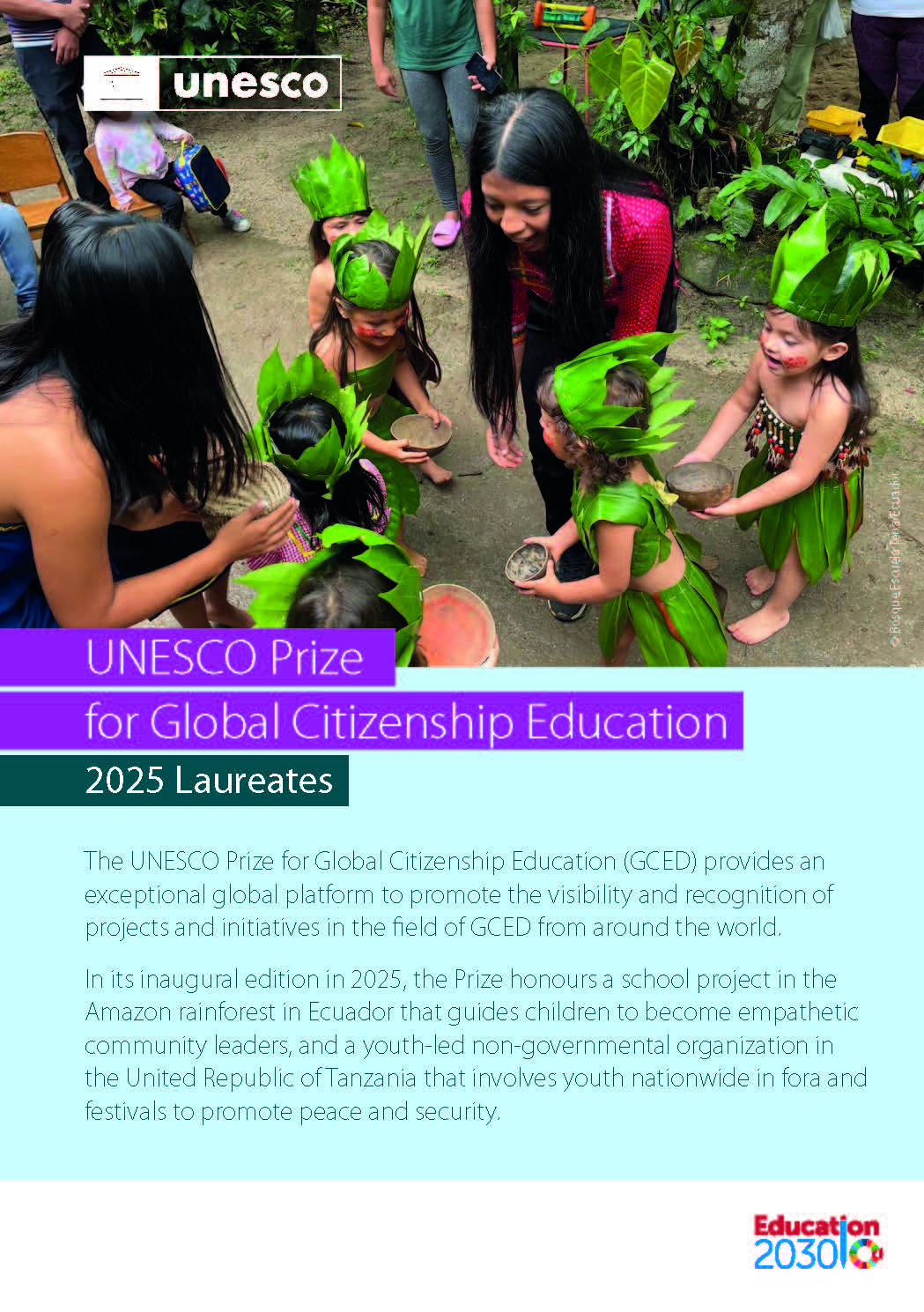 UNESCO Prize for Global Citizenship Education 2025 Laureates
 -
 Confronting Inequality through GCED: Toward Justice, Inclusion, and Transformation (SangSaeng; No.65, 2025)
 -
 ACER-APCEIU Global Citizenship Education Monitoring Toolkit: For Teachers, Schools and System Leaders
 -
 Recommendation on Education for Peace, Human Rights and Sustainable Development: An Implementation Guide