
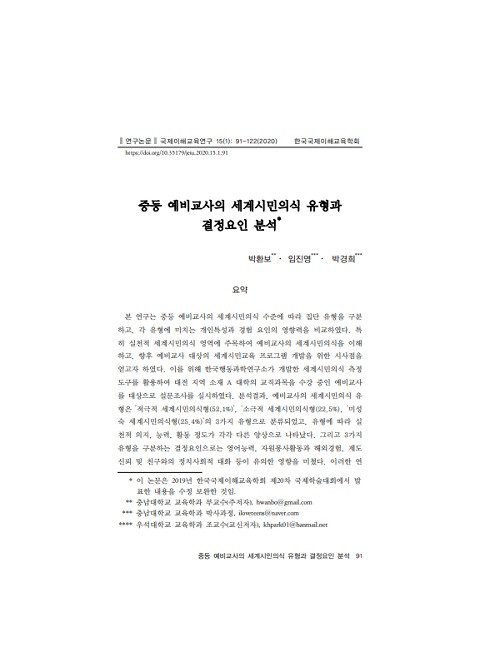
An Analysis on the Types of Global Citizenship Among the Pre-Service Secondary Teachers and the Determinant Factors (Journal of Education for International Understanding; Vol. 15, No. 1)
- Auteur institutionnel
- Korean Society of Education for International Understanding (KOSEIU)
- ISBN
- ISSN 2005-3665
- Collation
- p. 91-122
- Langue de la ressource
- Coréen
- Année de publication
- 2020
- Thème
- Civisme / Citoyenneté / DémocratieMondialisation et justice sociale / Compréhension internationale
- Type de ressource
- Research papers / journal articles
- Niveau d’éducation
- Enseignement supérieur
- Région
- Asie et Pacifique
- Lieu de publication
- Seoul
This study aims to investigate the types of global citizenship among pre-service teachers based on the level of global citizenship and to explore the factors effect on each types. Especially, this study focus on the action area among the three dimension of global citizenship. For this purpose, 180 students were surveyed A university in Daejeon metro city with measurement tool developed by Korea Institute for Research in the Behavioral Sciences (KIRBS). The results show that the types of pre-service teachers divided into 3 group, ‘active global citizenship (52.1%)’, ‘passive global citizenship (22.5%)’, and ‘immature global citizenship (25.4%)’. fluency of English language, experience of volunteer and overseas, institutional trust, and communication with friends about political issues were significant factor effect on the practical type of global citizenship. The findings suggest that it is necessary to provide global citizenship education based on the characteristics of the pre-service teachers.
Ressources associées
-
 IIEP-UNESCO 12th Medium-Term Strategy: 2026–2029
 -
 Advancing Intergenerational Learning: Identifying Challenges and Opportunities for Older Adults; Integrated Case Study Report
 -
 Digital Empowerment for Lifelong Learning and Transformative Andragogy (DELTA) for Adult Educators: Introduction to the DELTA Framework and Resources
 -
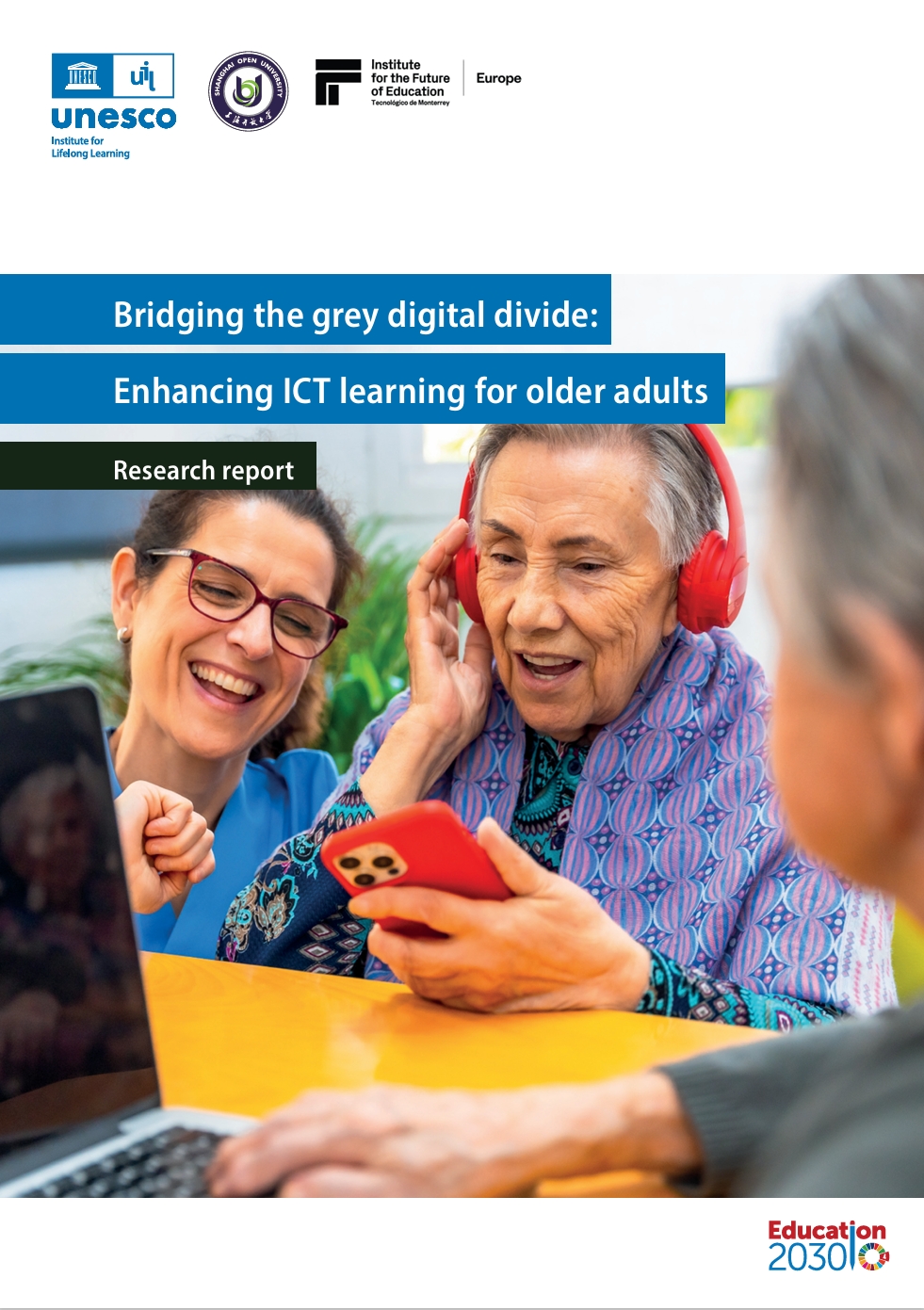 Bridging the Grey Digital Divide: Enhancing ICT Learning for Older Adults; Research Report