
Ressources
Explorez une large gamme de ressources sur le GCED afin d’approfondir votre compréhension et de renforcer vos activités de recherche, de plaidoyer, d’enseignement et d’apprentissage.
18 résultats trouvés
 Education at a Glance 2021: OECD Indicator Année de publication: 2021 Auteur institutionnel: Organisation for Economic Co-operation and Development (OECD) Education at a Glance is the authoritative source for information on the state of education around the world. It provides data on the structure, finances and performance of education systems across OECD countries and a number of partner economies. More than 100 charts and tables in this publication – as well as links to much more available on the educational database – provide key information on the output of educational institutions; the impact of learning across countries; access, participation and progression in education; the financial resources invested in education; and teachers, the learning environment and the organisation of schools.The 2021 edition includes a focus on equity, investigating how progress through education and the associated learning and labour market outcomes are impacted by dimensions such as gender, socio‐economic status, country of birth and regional location. A specific chapter is dedicated to Target 4.5 of the Sustainable Development Goal 4 on equity in education, providing an assessment of where OECD and partner countries stand in providing equal access to quality education at all levels. Two new indicators on the mechanisms and formulas used to allocate public funding to schools and on teacher attrition rate complement this year’s edition. Regards sur l’éducation 2021: Les indicateurs de l’OCDE Année de publication: 2021 Auteur institutionnel: Organisation for Economic Co-operation and Development (OECD) Regards sur l’éducation est le rapport de référence sur l’état de l’éducation dans le monde. Ce rapport étudie la structure, le financement et la performance des systèmes d’éducation des pays de l’OCDE et d’un certain nombre de pays partenaires. Avec plus d’une centaine de tableaux et graphiques – et de nombreux liens vers la base de données de l’OCDE sur l’éducation – Regards sur l’éducation foisonne d’informations sur les résultats des établissements d’enseignement ; l’impact de l’apprentissage ; l’accès à l’éducation, les taux de scolarisation et les parcours scolaires ; les investissements dans l’éducation ; et les enseignants, l’environnement d’apprentissage et l’organisation de l’enseignement.L’édition 2021 s’intéresse à la question de l’équité : elle étudie dans quelle mesure le sexe, le milieu socio-économique, le pays d’origine ou encore la situation géographique influencent le parcours éducatif des élèves et étudiants, et ont un impact sur les résultats en termes d’apprentissage et d’emploi. Un chapitre spécifique est consacré à la cible 4.5 de l’objectif de développement durable 4 sur l’équité dans l’éducation. Il situe les pays membres et partenaires de l’OCDE par rapport aux objectifs en matière d’égalité d’accès à une éducation de qualité à tous les niveaux d’enseignement. Deux nouveaux indicateurs sur les mécanismes et les formules utilisés pour allouer les fonds publics aux établissements et sur le taux d’attrition des enseignants complètent l’édition 2021.
  Schools as Hubs for Social and Emotional Learning Année de publication: 2023 Auteur institutionnel: Organisation for Economic Co-operation and Development (OECD) Schools are perfect hubs for social and emotional learning, but are they ready for this task? To address this question, this Spotlight reports previously unpublished findings from the OECD’s Survey on Social and Emotional Skills (SSES) and discusses their implications for education policy and practice. Both an active promotion in schools and extensive learning opportunities for teachers on relevant topics provide a fertile ground for an effective social and emotional education. They boost teachers’ self-efficacy and use of active learning pedagogies, as well as quality relationships at school. The Spotlight also points to important differences for teachers of 10- vs. 15-year-old students that can explain higher skills at a younger age. Younger students benefit more often from key elements of an effective social and emotional education in school, i.e. the evaluation of their social and emotional skills and teachers teaming up with parents to reinforce skill promotion. Teachers of 10-year-olds are also more intensively trained and requested to promote social and emotional learning in their work.
 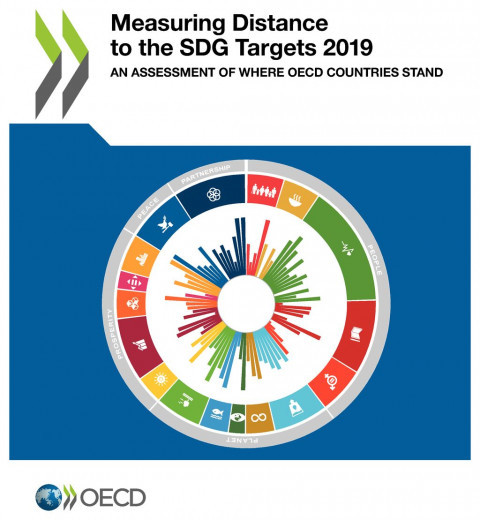 Measuring Distance to the SDG Targets 2019 - An Assessment of Where OECD Countries Stand Année de publication: 2019 Auteur institutionnel: Organisation for Economic Co-operation and Development (OECD) The Sustainable Development Goals (SDGs) set a broad and ambitious programme for the world to achieve by 2030. With 17 Goals, underpinned by 169 Targets, the complex and integrated nature of the 2030 Agenda presents national governments with huge challenges for implementation. To assist countries, the OECD has developed a unique methodology allowing comparison of progress across SDG goals and targets. Based on the UN Global List of 244 indicators, this study evaluates the distance that OECD countries need to travel to meet SDG targets for which data is currently available. This 2019 edition of the study presents the latest results for OECD countries, both on average and individually, as well as new exploratory approaches to assessing progress over time and transboundary aspects of the SDGs. By providing a high-level overview of countries’ strengths and weaknesses in performance across the SDGs, this study aims to support member countries in navigating the SDGs and in setting their own priorities for action within the broad 2030 Agenda.
  Trends Shaping Education 2019 Année de publication: 2019 Auteur institutionnel: Organisation for Economic Co-operation and Development (OECD) This book, published every two to three years, is designed to give policy makers, researchers, educational leaders, administrators and teachers a robust, non-specialist source to inform strategic thinking and stimulate reflection on the challenges facing education, whether in schools, universities or programmes for older adults. Trends Shaping Education 2019 is designed to support long-term strategic thinking in education. It provides an overview of key economic, social, demographic and technological trends and raises pertinent questions about their impact on education. This book fills an important need: decision makers and practitioners in education often have only anecdotal or local information on the megatrends that play out in their context; too often they do not have solid facts in front of them, especially about trends.` Les grandes mutations qui transforment l'éducation 2019 Année de publication: 2019 Auteur institutionnel: Organisation for Economic Co-operation and Development (OECD) Vous êtes-vous déjà demandé si l’éducation avait un rôle à jouer dans la préparation de nos sociétés à l’ère de l’intelligence artificielle ? Ou quel peut être l’impact du réchauffement climatique sur nos établissements scolaires, nos familles et collectivités ? La publication Les grandes mutations qui transforment l’éducation 2019 donne un aperçu des principales tendances économiques, politiques, sociales et technologiques qui affectent l’éducation. Si les mesures sont robustes, les questions soulevées dans ce recueil sont suggestives et ont pour objet d’informer la pensée stratégique et de stimuler une réflexion sur les défis de l’éducation – et montrer si et comment l’éducation peut influencer ces tendances. L’ouvrage couvre une riche variété de sujets liés à la mondialisation, la démocratie, la sécurité, le vieillissement et les cultures modernes. Le contenu pour l’édition 2019 a été révisé et étendu avec une large sélection d’indicateurs. En plus des différentes tendances et de leur interaction avec l’éducation, la publication inclut également une nouvelle section dédiée à la réflexion sur le futur, inspirée par des méthodologies de la prospective stratégique. Cet ouvrage a pour objet de fournir aux décideurs politiques, aux chercheurs, aux chefs d’établissements, aux administrateurs scolaires et aux enseignants, une source non spécialisée de tendances qui affectent l’éducation comparables à l’échelle internationale, dans les écoles, les universités ou encore dans les programmes de formation pour adultes. Cet ouvrage s’adresse également aux élèves/ étudiants et à la société dans son ensemble, notamment aux parents.
  Reviews of National Policies for Education: Kazakhstan, Kyrgyz Republic and Tajikistan 2009; Students With Special Needs and Disabilities Année de publication: 2009 Auteur institutionnel: Organisation for Economic Co-operation and Development (OECD) This OECD publication provides an overview of current education policies for children with special educational needs and disabilities in Kazakhstan, the Kyrgyz Republic and Tajikistan. Provides an idea of the socio-historical context, education systems and the corresponding legislation, critically analyzes the adopted views on access to education for the most vulnerable group of children in these countries. Particular attention is paid to political measures, aimed at ensuring inclusive education, procedures identification and assessment, overall coordination of educational service delivery, integration into the general education system, as well as best practices and the role of NGOs and community donors. Oбзор национальной политики в области образования: Казахстан, Кыргызская Pеспублика и Таджикистан 2009; Учащиеся с особыми потребностями и ограниченными возможностями Année de publication: 2009 Auteur institutionnel: Organisation for Economic Co-operation and Development (OECD) В данной публикации ОЭСР предлагается обзор текущей образовательной политики в отношении детей с с особыми образовательными потребностями и ограниченными возможностями в Казахстане, Кыргызской Республике и Таджикистане. Дается представление о социальноисторическом контексте, системах образования и соответствующего законодательства, критически анализируются принятые взгляды на доступ к образованию для самой уязвимой группы детского населения в данных странах. Особое внимание уделяется политическим мерам, направленным на обеспечения инклюзивности образования, процедурам идентификации и оценки, общей координации предоставления образовательных услуг, интеграции в общеобразовательную систему, а также наиболее успешным практикам и роли НПO и общественных доноров.
  The Future of Education and Skills: Education 2030 Année de publication: 2018 Auteur institutionnel: Organisation for Economic Co-operation and Development (OECD) The aim of OECD’s Education 2030: The Future of Education and Skills project is to support countries to find answers to two far-reaching questions: “What knowledge, skills, attitudes and values will today’s students need to shape and thrive their world in 2030?” and “How can instructional systems develop these knowledge, skills, attitudes and values effectively?” This OECD Education 2030 position paper considers the challenges that young people will face; suggests the importance of the concept of learner agency; proposes an overarching learning framework with transformative competencies; reviews the nature of the knowledge, skills, attitudes and values that young people will need; and ends with possible curriculum design principles. It encapsulates the key messages of the project so far. Le Futur de l’éducation et des compétences: Projet Éducation 2030 Année de publication: 2018 Auteur institutionnel: Organisation for Economic Co-operation and Development (OECD) Le projet Le Futur de l’éducation et des compétences : Éducation 2030 a pour objectif d’aider les pays à trouver des réponses à deux questions d’une portée considérable : « De quelles connaissances, compétences, attitudes et valeurs les élèves d’aujourd’hui auront-ils besoin pour réussir leur vie et bâtir le monde de demain ? » et « Comment les systèmes éducatifs peuvent-ils transmettre ces connaissances, compétences, attitudes et valeurs de manière efficace ? » Cette note d’information sur le projet Éducation 2030 de l’OCDE étudie les défis auxquels les jeunes générations vont être confrontées, met en lumière l’idée de capacité d’agir des apprenants, propose un cadre d’apprentissage global reposant sur des compétences transformatives, revient sur la nature des connaissances, des compétences, des attitudes et des valeurs dont les jeunes auront besoin à l’avenir et se conclut par de possibles principes de conception des programmes scolaires. Les principaux messages tirés du projet jusqu’à présent sont également présentés.