
Ressources
Explorez une large gamme de ressources sur le GCED afin d’approfondir votre compréhension et de renforcer vos activités de recherche, de plaidoyer, d’enseignement et d’apprentissage.
280 résultats trouvés
 Feuille de route de l'UNESCO pour la mise en œuvre du programme d'action mondiale sur l'éducation pour le développement durable Année de publication: 2014 Auteur institutionnel: UNESCO Les défis mondiaux interconnectés d'aujourd'hui exigent des réponses qui sont enracinées dans l'esprit de notre humanité collective. Je crois que les risques et les opportunités auxquels nous sommes confrontés appellent à un changement de paradigme qui ne peut être intégré dans nos sociétés par le biais de l'éducation et de l'apprentissage. Le rôle de l'éducation en tant que catalyseur pour la construction d'un avenir meilleur et plus durable pour tous a acquis une reconnaissance croissante, ce qui conduit à la déclaration de la Décennie des Nations Unies pour l'éducation pour le développement durable en 2005. Cet engagement a gagné davantage de force lorsque les États membres se sont engagés à promouvoir Education pour le développement durable au-delà de la fin de la Décennie au Royaume-Nationsconférenceon développement durable 2012 - Rio + 20. Pour tirer profit des réalisations et de créer un nouvel élan lorsque la Décennie des Nations Unies se ferme en 2014, l'UNESCO, en tant qu'organisme chef de file de la Décennie, a mis au point un programme d'action mondiale sur l'éducation pour le développement durable. Sur la base de larges consultations et des contributions d'un large éventail de parties prenantes, le programme a été approuvé par le Generalconférencein UNESCO 2013. Elle intervient à un moment où la communauté internationale est chargé de proposer un nouvel ensemble d'objectifs de développement durable qui sont orientés vers l'action, global dans la nature et universellement applicable.En tant que suivi de la Décennie, le Programme d'action mondial est également conçu comme un béton, contribution tangible à l'après 2015 développement et d'éducation agendas L'. Le Programme d'action mondial est livré avec une feuille de route de mise en œuvre détaillé. Il est destiné à toutes les parties prenantes - gouvernements, les organisations de la société civile, le secteur privé, les médias, la communauté universitaire et de recherche, les organisations intergouvernementales et d'autres institutions pertinentes qui facilitent et appuyer l'apprentissage et la formation, tout le chemin aux enseignants et aux apprenants individuels. La feuille de route explique le Programme de but, les objectifs et les domaines d'action prioritaires afin de permettre l'orientation stratégique et l'engagement des parties prenantes, ainsi que des stratégies de mise en œuvre et de Suivi. Je souhaite que le Programme d'action mondial, qui sera lancé à l'éducation Worldconférenceon pour le développement durable à Aichi-Nagoya, au Japon (Novembre 2014), sera successed dans la mobilisation de la communauté des acteurs de l'éducation pour le développement durable et de fournir des conseils pratiques pour sa mise en œuvre effective . Nous avons tous un intérêt profond dans son succès. Avant-propos Introduction - A Better Tomorrow Begins Today - De la Décennie de l'EDD au programme d'action mondial - Esquisse d'une vision commune - Comprendre EDD Feuille de route - But et objectifs - Domaines d'action prioritaires - Stratégies - Mécanismes - Ressources - Suivi et évaluation Annexe - Action Globale Programme sur l'éducation pour le développement durable comme le suivi de la Décennie des Nations Unies pour le développement durable après 2014.
  Coordination mondiale/régionale et soutien de l'UNESCO pour la mise en oeuvre de l'ODD 4-Education 2030 Année de publication: 2017 Auteur institutionnel: Organisation des Nations Unies pour l'éducation, la science et la culture (UNESCO)
  Education 2030: Déclaration d'Incheon et Cadre d'action: vers une éducation inclusive et équitable de qualité et un apprentissage tout au long de la vie pour tous Année de publication: 2016 Auteur institutionnel: Organisation des Nations Unies pour l'éducation, la science et la culture (UNESCO) | United Nations Development Programme (UNDP) | United Nations Children's Fund (UNICEF) | United Nations Entity for Gender Equality and the Empowerment of Women (UN Women) | World Bank | United Nations Population Fund (UNFPA) | UN. Office of the United Nations High Commissioner for Refugees (UNHCR) This framework — painstakingly drafted over many months with input from governments, international agencies, civil society and experts — provides guidance for implementing the education commitments made in the 2030 Agenda for Sustainable Development at a national, regional and global level. In particular: it aims at mobilizing all countries and partners around Sustainable Education Goal 4 and its targets; it proposes ways of implementing, coordinating, financing and monitoring the new commitments; and it proposes indicative strategies which countries may wish to draw upon in developing their plans, taking into account different national realities, capacities and levels of development and respecting national policies and priorities.
  L'Education physique de qualité (EPQ): directives à l'intention des décideurs Année de publication: 2015 Auteur: Nancy, McLennan | Jannine, Thompson Auteur institutionnel: UNESCO A key feature of the Post-2015 Development Agenda is sustainable development. Sustainable development starts with safe, healthy, well-educated children. Participation in quality physical education (QPE), as part of a rounded syllabus, enhances young peoples’ civic engagement, decreases violence and negative patterns of behaviour, and improves health awareness. The UNESCO QPE Policy Package is an original piece of work, which draws upon results from extensive global research (including the Worldwide Survey of School Physical Education). These guidelines, designed for global application and local adaptation, provide a means of analysing current policy through practical guidance and a ‘how-to’ approach. The materials have been developed in consultation with key partners including the European Commission, the International Council for Sport Science and Physical Education (ICSSPE), UNDP, UNICEF, UNOSDP and WHO.
  [vidéo] Les Dix Cibles de l’Objectif de Développement Durable 4...avec Elyx ! Année de publication: 2017 Auteur institutionnel: UNESCO Regardez cette nouvelle animation expliquant les dix cibles de l'Objectif de développement durable 4. Avec Elyx, le premier ambassadeur numérique de l'ONU, découvrez comment garantir une éducation inclusive et de qualité pour tous et promouvoir l'apprentissage tout au long de la vie.
  Déchiffrer le Code: L'Éducation des Filles et des Femmes aux Sciences, Technologie, Ingénierie et Mathématiques (STEM) Année de publication: 2017 Auteur institutionnel: Organisation des Nations Unies pour l'éducation, la science et la culture (UNESCO) Malgrédes améiorations notables ces dernièes déennies, l’éucation n’est pas universellement disponible et les inéalité entre les genres persistent, souvent en déaveur des filles. Des facteurs socio-culturels et éonomiques complexes et lié entre eux pèent non seulement sur les possibilité de scolarisation des filles mais aussi sur la qualitéde l’éucation qu’elles recevront, les éudes qu’elles suivront et, au bout du chemin, leurs carrièes et leurs parcours de vie. Une préccupation majeure tient àla faiblesse de la participation et des réultats des filles dans les éudes de sciences, technologie, ingéierie et mathéatiques (STEM). Les STEM sous-tendent le Programme de déeloppement durable àl’horizon 2030 et l’éucation aux STEM peut apporter aux apprenants les connaissances, les compéences et les comportements néessaires àdes sociéé inclusives et durables. Laisser les filles et les femmes àl’éart de l’éucation et des professions des STEM non seulement les prive de la possibilitéde contribuer aux STEM et d’en bééicier, mais aussi perpéue le fosséentre les sexes et, plus gééalement, les inéalité sociales et éonomiques. Le présent rapport vise à« déhiffrer le code » en déryptant les facteurs qui entravent ou facilitent la participation, la réssite et la réention des filles et des femmes dans l’éucation aux STEM et, en particulier, ce que peut faire le secteur de l’éucation pour promouvoir l’intéê et l’engagement des filles et des femmes dans l’éucation aux STEM et finalement dans les carrièes des STEM. Il entend constituer une ressource pour les parties prenantes de l’éucation et autres personnes qui travaillent àpromouvoir l’éalitédes genres. De l'insulte à l'inclusion: Rapport sur l'Asie-Pacifique sur les brimades à l'école, la violence et la discrimination sur la base de l'orientation sexuelle et l'identité de genre Année de publication: 2015 Auteur institutionnel: Organisation des Nations Unies pour l'éducation, la science et la culture (UNESCO) Cet avis reconnaît la complexité de la terminologie au niveau mondial, et dans la région, sur le sexe, la sexualité et le genre. Par souci de simplicité, ‘sur la base Sogie l'intimidation, la violence et la discrimination’ est utilisé pour désigner les différents anifestations de violence et d'exclusion fondées sur la discrimination entre les sexes, les attentes de rôle de genre et les stéréotypes, les préjugés intersexe et attentes de la société pour les relations hétérosexuelles. Ceci est parfois désigné comme homosexuels ou les transsexuels intimidation, la violence et la discrimination. Ce rapport considère la violence vécue par les enfants et les jeunes en raison de l'orientation et l'identité ou l'expression sexuelle réelle ou perçue, ou parce que leurs corps diffèrent des définitions typiques de sexe masculin ou féminin. Le terme «personnes LGBTI / jeunesse» est utilisé dans ce rapport lorsque compris les personnes intersexuées et LGBT lorsque la situation ou les besoins des personnes intersexuées / jeunes n'ont pas été pris en considération. Les termes locaux et ceux des études originales sont également inclus, et le glossaire fournit des informations pour les lecteurs sur les concepts et termes utilisés dans ce rapport. Le rapprochement des cultures; feuille de route Année de publication: 2016 Auteur institutionnel: UNESCO Today, the sheer compression of the world is bringing people and their cultures into the same space with intense speed, rendering new levels and forms of human interaction and interdependence. Population growth and migration are increasing in scale and complexity, and technology and media are bringing people together in ways never before thought possible. As a result, new creative expressions, innovation and immense opportunities have been generated and developed. While these phenomena have brought people together across geographic spaces, it has concurrently exposed a widening moral gap in our societies and the extent to which our societies are ill-equipped to effectively manage and overcome the challenges that continue to arise. Often in parallel with developmental progress, retrogressive patterns have emerged that present persistent threats to peace-building and social cohesion. Recurrent cycles of deadlock and conflict undermine governance and legislation at international, national and local levels preventing long-term peace and development. The litany of polarization within our societies often defined along the lines of ‘identity’ – religious, cultural, ethnic, or otherwise – are increasingly manifested in prejudice, intolerance, racism, xenophobia, discrimination, radicalization and extreme violence. The challenges are often multidimensional and interrelated, and their impacts cross conventional borders, thus revealing a pervading vulnerability at global level and the accompanying need for a global response. From a policy and governance perspective, this has rendered new levels of complexity in addressing challenges. It has also reinforced the need for a more inclusive and participatory notion of development, including integrated approaches that tackle the issues at hand as well as their foundations. The Decade has come into being in an era marked by increased divisiveness, and learning to live together in the 21st century presents a new frontier for managing cultural diversity. Respect for the inherent dignity of all persons underpins the values of the Decade and is one of the core pillars of the UN system, to ensure that all people have equal rights and opportunities to shape their future. These principles are reflected in the values of many cultures around the world. Intercultural dialogue denotes an open process of exchange and respect between individuals and groups of different cultures, points of view and aspirations. In such a way, the respect for and exercise and enjoyment of human rights and fundamental freedoms are not only key inroads to dialogue, but they are integral to its process. Ultimately they are crucial to sustaining the rapprochement of cultures as the central aspiration of the Decade.
 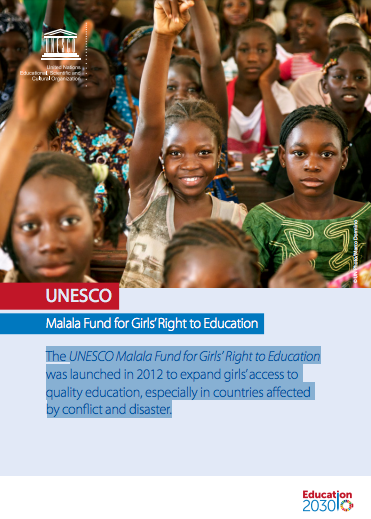 UNESCO Malala Fund for Girls' Right to Education Auteur institutionnel: Organisation des Nations Unies pour l'éducation, la science et la culture (UNESCO) The UNESCO Malala Fund for Girls’ Right to Education was launched in 2012 to expand girls’ access to quality education, especially in countries affected by conflict and disaster. UNESCO's global/regional coordination of and support for the implementation of SDG 4-Education 2030 Année de publication: 2017 Auteur institutionnel: Organisation des Nations Unies pour l'éducation, la science et la culture (UNESCO) Pursuant to 200 EX/7, the Director-General submits to the Executive Board the report on UNESCO’s contribution to the coordination of and support for SDG 4 – Education 2030.The financial and administrative implications of this document have been covered in document 38 C/5.Action expected of the Executive Board: Proposed decision in paragraph 18.