
Ressources
Explorez une large gamme de ressources sur le GCED afin d’approfondir votre compréhension et de renforcer vos activités de recherche, de plaidoyer, d’enseignement et d’apprentissage.
46 résultats trouvés
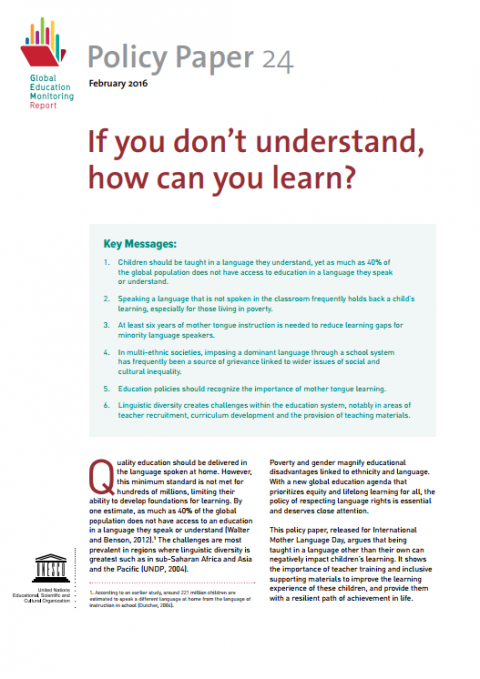 听不懂,怎能学会? Année de publication: 2016 Auteur institutionnel: UNESCO Key Messages:1. Children should be taught in a language they understand, yet as much as 40% of the global population does not have access to education in a language they speak or understand.2. Speaking a language that is not spoken in the classroom frequently holds back a child’s learning, especially for those living in poverty.3. At least six years of mother tongue instruction is needed to reduce learning gaps for minority language speakers.4. In multi-ethnic societies, imposing a dominant language through a school system has frequently been a source of grievance linked to wider issues of social and cultural inequality.5. Education policies should recognize the importance of mother tongue learning. 6. Linguistic diversity creates challenges within the education system, notably in areas of teacher recruitment, curriculum development and the provision of teaching materials. If you don't understand, how can you learn? Année de publication: 2016 Auteur institutionnel: UNESCO Key Messages:1. Children should be taught in a language they understand, yet as much as 40% of the global population does not have access to education in a language they speak or understand.2. Speaking a language that is not spoken in the classroom frequently holds back a child’s learning, especially for those living in poverty.3. At least six years of mother tongue instruction is needed to reduce learning gaps for minority language speakers.4. In multi-ethnic societies, imposing a dominant language through a school system has frequently been a source of grievance linked to wider issues of social and cultural inequality.5. Education policies should recognize the importance of mother tongue learning. 6. Linguistic diversity creates challenges within the education system, notably in areas of teacher recruitment, curriculum development and the provision of teaching materials. Comment apprendre, quand on ne comprend pas? Année de publication: 2016 Auteur institutionnel: UNESCO Key Messages:1. Children should be taught in a language they understand, yet as much as 40% of the global population does not have access to education in a language they speak or understand.2. Speaking a language that is not spoken in the classroom frequently holds back a child’s learning, especially for those living in poverty.3. At least six years of mother tongue instruction is needed to reduce learning gaps for minority language speakers.4. In multi-ethnic societies, imposing a dominant language through a school system has frequently been a source of grievance linked to wider issues of social and cultural inequality.5. Education policies should recognize the importance of mother tongue learning. 6. Linguistic diversity creates challenges within the education system, notably in areas of teacher recruitment, curriculum development and the provision of teaching materials. Si no entiendes, ¿cómo puedes aprender? Année de publication: 2016 Auteur institutionnel: UNESCO Key Messages:1. Children should be taught in a language they understand, yet as much as 40% of the global population does not have access to education in a language they speak or understand.2. Speaking a language that is not spoken in the classroom frequently holds back a child’s learning, especially for those living in poverty.3. At least six years of mother tongue instruction is needed to reduce learning gaps for minority language speakers.4. In multi-ethnic societies, imposing a dominant language through a school system has frequently been a source of grievance linked to wider issues of social and cultural inequality.5. Education policies should recognize the importance of mother tongue learning. 6. Linguistic diversity creates challenges within the education system, notably in areas of teacher recruitment, curriculum development and the provision of teaching materials. Как вы можете учиться, если вы не понимаете? Année de publication: 2016 Auteur institutionnel: UNESCO Key Messages:1. Children should be taught in a language they understand, yet as much as 40% of the global population does not have access to education in a language they speak or understand.2. Speaking a language that is not spoken in the classroom frequently holds back a child’s learning, especially for those living in poverty.3. At least six years of mother tongue instruction is needed to reduce learning gaps for minority language speakers.4. In multi-ethnic societies, imposing a dominant language through a school system has frequently been a source of grievance linked to wider issues of social and cultural inequality.5. Education policies should recognize the importance of mother tongue learning. 6. Linguistic diversity creates challenges within the education system, notably in areas of teacher recruitment, curriculum development and the provision of teaching materials.
  Reaching the Unreached: Indigenous Intercultural Bilingual Education in Latin America Année de publication: 2009 Auteur: Luis Enrique López Auteur institutionnel: UNESCO The paper focuses on the educational situation of the most marginalized children and adolescents in Latin America: those belonging to indigenous homes and communities. To illustrate indigenous marginalization and exclusion as well as the development of intercultural bilingual education (IBE) six countries have been chosen: Bolivia, Ecuador, Guatemala, Mexico, Paraguay and Peru. Atteindre les exclus: indigène éducation interculturelle bilingue en Amérique latine Année de publication: 2009 Auteur: Luis Enrique López Auteur institutionnel: UNESCO Le document met l'aCECnt sur la situation de l'éducation des enfants les plus marginalisés et les adolescents en Amérique latine: ceux appartenant à des foyers et des communautés autochtones. Pour illustrer la marginalisation et l'exclusion des autochtones ainsi que le développement de l'éducation interculturelle bilingue (BIE) six pays ont été choisis: la Bolivie, l'Equateur, le Guatemala, le Mexique, le Paraguay et le Pérou.
  Expert meeting on intercultural education, Paris, 20-22 March 2006; report Année de publication: 2006 Auteur institutionnel: UNESCO This report will give for each panel a summary of the presentation, the ensuing debates and a synthesis. The discussions of the draft UNESCO Guidelines and of the database on Intercultural Education, including the results and next steps to be taken are also presented. In addition, the report provides a summary of the debate around the presentation of the UNESCO World Report on Cultural Diversity. Expert meeting on intercultural education, Paris, 20-22 March 2006; report Année de publication: 2006 Auteur institutionnel: UNESCO Ce rapport donnera pour chaque panneau un résumé de la présentation, les débats qui ont suivi et une synthèse. Les discussions sur le projet de directives de l'UNESCO et de la base de données sur l'éducation interculturelle, y compris les résultats et les prochaines mesures à prendre sont également présentés. En outre, le rapport fournit un résumé du débat autour de la présentation du Rapport mondial de l'UNESCO sur la diversité culturelle. 상호 문화 간 교육에 관한 전문가 회의 보고서(2006년 3월 20~23일, 파리) Année de publication: 2006 Auteur institutionnel: 유네스코 이 보고서는 각 패널을 위하여 프리젠테이션 요약, 연이은 토론과 그 종합적인 것들을 제공한다. 또한 유네스코 가이드라인 초안 및 상호문화 간 교육에 관한 데이터베이스에 대한 논의와 그 결과, 그리고 그 다음 단계를 제시한다. 아울러, 유네스코 세계문화 다양성 보고서(UNESCO World Report on Cultural Diversity) 프리젠테이션과 관련된 토론에 대한 요약본도 제공한다.