
Ressources
Explorez une large gamme de ressources sur le GCED afin d’approfondir votre compréhension et de renforcer vos activités de recherche, de plaidoyer, d’enseignement et d’apprentissage.
224 résultats trouvés
 Global Citizenship: A plural and Transformative Vision of Society and School; Volume Ⅰ Année de publication: 2020 Auteur: Rafael Díaz-Salazar | Alfonso Díez Prieto | Antonio Roura | Begoña Carmona | Carme García Yeste | Carmen Magallón | César García-Rincón | Florencio Luengo | Gema Celorio | Gonzalo Fanjul | Juan Iglesias | Juan Pablo Rayo | Luis González Reyes | Manuela Mesa | María Laín | Mónica Cantón de Celis | Pedro Sáez | Pilar Álvarez Cifuentes | Rafael Feito | Regina Gairal | Santiago Álvarez Cantalapiedra | Victoria Camps | Violeta Velasco | Yayo Herrero | Augusto Ibañez Auteur institutionnel: SM Foundation The objective of this work, which brings together the voices of great specialists, reinforced by the vision of the school itself, is to promote and channel the debate on global citizenship towards an education oriented to the care of the person, society and nature. Understood in this way, education for global citizenship can help us form fulfilled people, prepared to intervene positively in a world in continuous change, and capable of adopting a sustainable way of life for ourselves, those around us and those who will succeed us.
 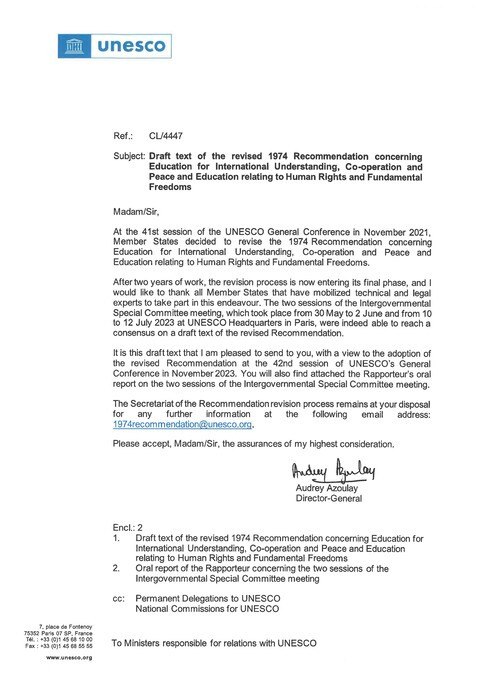 Draft Text of the Revised 1974 Recommendation Concerning Education for International Understanding, Co-Operation and Peace and Education Relating to Human Rights and Fundamental Freedoms Année de publication: 2023 Auteur institutionnel: UNESCO In accordance with the UNESCO Constitution and the Rules of Procedure concerning Recommendations to Member States and international conventions covered by the terms of Article IV, paragraph 4, of the Constitution, the draft text of the revised Recommendation concerning education for international understanding, co-operation and peace and education relating to human rights and fundamental freedoms, and the related preliminary report, were sent to UNESCO Member States through the circular letter CL/4401 (September 2022) for their written commentsand observations. On the basis of their comments, a second draft of the text was prepared. In circular letter CL/4433 (April 2023), the second draft together with the Definitive Report were submitted to Member States. The Special Committee meeting of experts designated by Member States took place from 30 May to 2 June 2023, as per the circular letter CL/4417 (November 2022), and from 10 to 12 July 2023, as per circular letter CL/4442 (June 2023).
  Empowering Students for Just Societies: A Handbook to Teach Integrity in Secondary Schools Année de publication: 2024 Auteur institutionnel: UNESCO | UN. Office on Drugs and Crime (UNODC) The importance of education lies in its power to shape the values of upcoming generations and equip them with the knowledge to make informed decisions. Contemporary challenges, including corruption must be addressed through education, transparency, accountability and the rule of law, among other efforts. This joint publication by UNODC and UNESCO is a response to this important issue. It is aimed at educators who are striving to inspire and prepare future generations to actively contribute to societies grounded in integrity, ethics and respect for the rule of law. The handbook builds on the first two launched in 2019. This publication highlights the transformative power of education in strengthening the knowledge, skills, attitudes and values necessary for addressing global challenges, especially those that stem from a lack of integrity, like corruption. It underlines the crucial role education plays in nurturing critical thinking, empathy, ethical behaviour, and a commitment to justice and equality among people. The handbook presents a catalogue of educational activities, lesson plans and outside the classroom resources designed to empower youth to reject corrupt practices and become agents of change, promoting integrity and upholding democratic values.
  UNESCO Futures of Education Report Explained by Members of the International Commission Année de publication: 2022 Auteur institutionnel: UNESCO Initiated by UNESCO, the International Commission on the Futures of Education has prepared a new report on how education can best shape the future of humanity and the planet. In this video, members of the Commission and its chair explain the main recommendations and defining features of their report, Reimagining our futures together: A new social contract for education. The report is part of UNESCO’s Futures of Education initiative which aims to rethink education and shape the future. The initiative is catalyzing a global debate on how knowledge, education and learning need to be reimagined in a world of increasing complexity, uncertainty, and precarity.
  Recommendation on Education for Peace, Human Rights and Sustainable Development: An Implementation Guide Année de publication: 2025 Auteur institutionnel: UNESCO There is no peace without education. With conflicts rising on so many fronts, there has never been a more urgent need for a transformed education geared towards building and sustaining peace.The Recommendation on Education for Peace and Human Rights, International Understanding, Cooperation, Fundamental Freedoms, Global Citizenship and Sustainable Development, adopted by all 194 Member States of UNESCO in 2023, articulates a humanistic and transformative vision of education that can help address contemporary and future affronts to peace. These challenges range from the resurgence of conflicts driven by systemic inequalities and injustices, the rise and spread of hate speech, racism and discrimination particularly online, to the adverse effects of digital technologies and the existential threat of climate change.UNESCO has developed this Guide as the first of several tools to assist Member States in unpacking and fully implementing the 2023 Recommendation. The Guide elaborates its contents, integrating the 2023 Recommendation’s transdisciplinary lens to connect key concepts and issues. It also provides concrete ideas and curated resources for action at different levels and types of education, while calling for a multi-stakeholder and whole-of-society approach that includes everyone and builds on existing positive efforts.The Guide is a timely addition to the pool of available collective resources to fully implement the 2023 Recommendation and foster an education that is transformative for a just and peaceful world.
 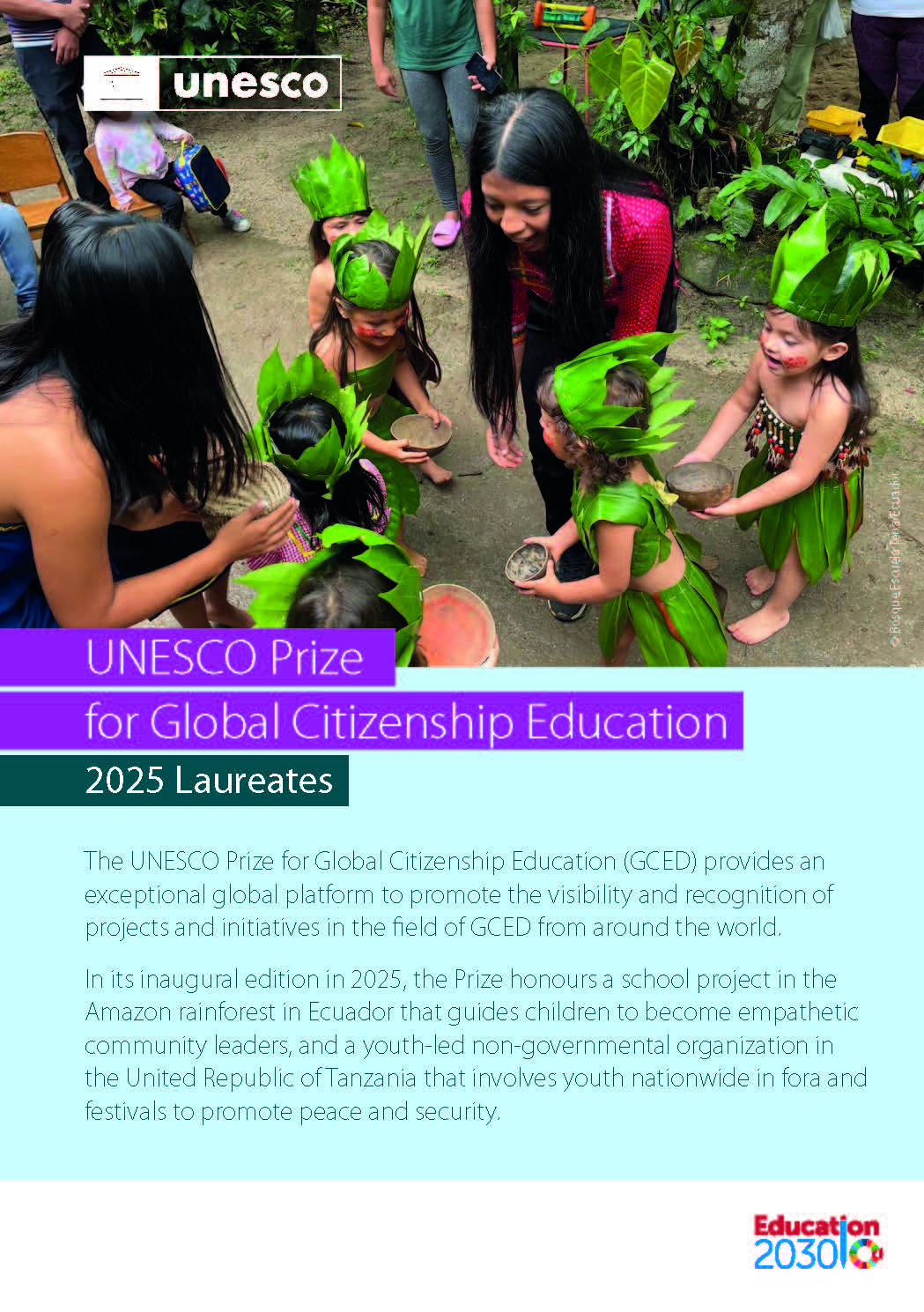 UNESCO Prize for Global Citizenship Education 2025 Laureates Année de publication: 2025 Auteur institutionnel: UNESCO The UNESCO Prize for Global Citizenship Education (GCED) provides an exceptional global platform to promote the visibility and recognition of projects and initiatives in the field of GCED from around the world.In its inaugural edition in 2025, the Prize honours a school project in the Amazon rainforest in Ecuador that guides children to become empathetic community leaders, and a youth-led non-governmental organization in the United Republic of Tanzania that involves youth nationwide in fora and festivals to promote peace and security.
  Strategies to Counter Antisemitism: A Handbook for Educators Année de publication: 2025 Auteur institutionnel: UNESCO Education is the first line of defence against hate and prejudice. By targeting the root causes of hate ideologies, deconstructing the stereotypes that underlie them from an early age, and promoting inclusive models, education is the keystone of a holistic approach to combating discrimination. Tackling antisemitism through education requires tailored content that addresses its complex, shifting and multilayered forms, both past and present.Acknowledging the topic’s complexity and the paucity of resources available to education stakeholders, this concise guide developed by UNESCO and funded by the European Commission aims to provide a roadmap for policymakers, curriculum developers and educators on current approaches and initiatives. It presents ten educational practices, each grounded in academic literature and illustrated by a promising educational initiative that operationalizes core pedagogical principles. The handbook is built around the three core learning domains which inform UNESCO’s approach to Global Citizenship Education: cognitive, socio-emotional, and behavioural learning.Conceived as an accessible operational guide for practitioners, this resource sets out to start a larger conversation about the needs of educators for tackling contemporary forms of antisemitism. It aims to encourage investments in high-quality empirical research that can pave the way for a better approach to combat antisemitism.
 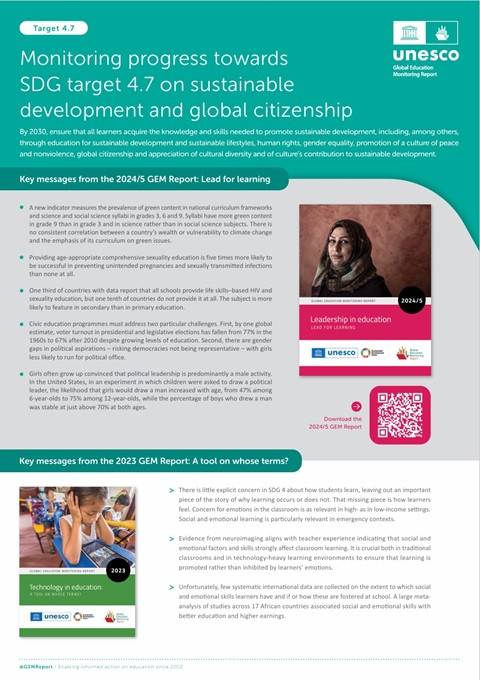 Monitoring Progress towards SDG Target 4.7 on Sustainable Development and Global Citizenship Année de publication: 2024 Auteur institutionnel: UNESCO | Global Education Monitoring Report Team This document introduces key messages from the GEM Reports and other related publications and online resources regarding the progress towards SDG Target 4.7.
  Addressing Violent Pasts through Education: A Policy Guide Année de publication: 2025 Auteur institutionnel: UNESCO Teaching about violent pasts and their legacies is a powerful way to foster sustainable peace.Education can build a nuanced understanding of complex histories, raise awareness of the roots and legacies of violence, nationally and internationally, and sensitize learners for their own agency as actors of change for reconciliation and conflict prevention.Educating about violent pasts is a challenging yet critical endeavour for policy-makers globally. It entails tailored approaches and an important support for educators to address traumatic pasts sensitively and to navigate related emotions and narratives successfully.Building on UNESCO’s programme on Global Citizenship Education, this guide offers education policy-makers a set of strategies, principles, and education practices to effectively integrate education about violent pasts into local education systems. It suggests a comprehensive approach that spans formal and informal education and aligns with the 2023 Recommendation on Education for Peace, Human Rights and Sustainable Development, opening new perspectives on history education, dialogue, and conflict transformation.
  Inaugural Meeting of the GCED Actors' Platform: Final Report Année de publication: 2020 Auteur institutionnel: APCEIU This final report gives an overview of discussions and outcomes from the “Inaugural Meeting of the GCED Actors’ Platform” on 2 September 2019 in Seoul, Republic of Korea, held back-to-back with the 4th International Conference on GCED (3-4 September 2019, Seoul) In line with the call for closer collaboration on GCED inter-regionally, the GCED Actors’ Platform was launched by UNESCO Headquarters and APCEIU in 2019. Convening regional coordinators and different partners working on GCED, the “Inaugural Meeting of the GCED Actors’ Platform” provided an open space for the participants to discuss ways to coordinate activities and promote synergies.The regional representatives have imparted their own experiences and challenges on the ground and shared best practices of facilitating GCED.