
Ressources
Explorez une large gamme de ressources sur le GCED afin d’approfondir votre compréhension et de renforcer vos activités de recherche, de plaidoyer, d’enseignement et d’apprentissage.
451 résultats trouvés
 UNESCO's work on education for peace and non-violence: building peace through education Année de publication: 2008 Auteur institutionnel: UNESCO La promotion de la paix par l'éducation est au cœur de la mission de l'UNESCO. Comme indiqué dans sa constitution de 1945, l'UNESCO fait avancer la paix internationale et le bien-être commun de l'humanité à travers les relations éducatives, scientifiques et culturelles entre les peuples du monde. Bien que le monde a changé au cours des soixante dernières années et continue de changer à un rythme de plus en plus élevé, la mission de l'UNESCO - un engagement à la promotion des valeurs universelles de paix et de non-violence, les droits de l’homme et la justice sociale, le dialogue interculturel et la compréhension mutuelle - persiste avec une urgence croissante . L'approche de l'UNESCO à l'éducation pour la paix est multidimensionnelle, en ce qu'il lie l'éducation avec une gamme d'activités qui abordent les causes profondes de la violence, de la sécurité humaine au développement durable. L'objectif des programmes et des partenariats de l'éducation de l'UNESCO est le développement de systèmes complets d'éducation qui embrassent les valeurs des droits de l'homme, de la compréhension interculturelle et la tolérance. L'éducation pour la paix et la non-violence favorise les connaissances, les compétences, les attitudes et les comportements qui reflètent et inspirent ces valeurs. En tant qu'organisme responsable au sein du système de l’ONU pour la Décennie internationale pour une culture de la paix et de la non-violence pour les enfants du monde, 2001- 2010, l'UNESCO est chargée de coordonner et mettre en œuvre directement des activités qui favorisent les objectifs de la Décennie par l'éducation , les sciences, la culture, la communication et de l'information. La culture de la paix est définie comme un ensemble de valeurs, attitudes, modes de comportement et des modes de vie qui rejettent la violence et visant à prévenir les conflits à leurs causes profondes par le dialogue et la négociation entre les individus, les groupes et les nations. L'UNESCO promeut la culture de la paix à travers une plate-forme intersectorielle. Cette plate-forme comprend les cinq secteurs de l'UNESCO: l'éducation, les sciences naturelles, les sciences sociales et humaines, la culture et la communication et de l'information. Il cherche à intégrer le dialogue interculturel dans les politiques et les actions dans le but de promouvoir la compréhension mutuelle, la tolérance et le respect, qui sont tous considérés comme des forces créatives pour un avenir durable. La plate-forme intersectorielle développera également des outils basés sur les bonnes pratiques dans le dialogue interculturel.
 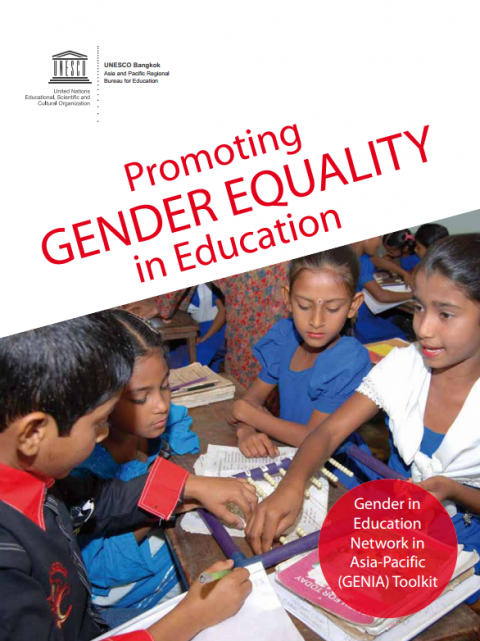 Promoting gender equality in education Année de publication: 2009 Auteur institutionnel: UNESCO Kathmandu This publication was originally designed in 2003 when the Gender in Education Network in Asia-Pacific (GENIA) was established. Few gender in education resources were available at that time, and until the 2006 version, documents were mainly intended to be used by GENIA members, who are representatives (gender focal points) from ministries of education in the Asia-Pacific region. GENIA members have been using the Toolkit to sensitize and train their national counterparts ever since. However, the Toolkit has not only been distributed and used by gender focal points, but also by other people who have heard about GENIA, and/or who were interested in the resource materials published by UNESCO Bangkok. For this reason, the Toolkit has been accessible via the UNESCO Bangkok website1 since 2006. As a result, anyone searching the Web for information on gender equality can easily access the Toolkit. This fourth edition of the Toolkit, thus, expands the scope of the target audience. The content has likewise been adapted accordingly in order to meet the needs of all who could potentially access it. The Toolkit also integrates existing information and tools designed by other national or international organizations dedicated to promoting and providing training on gender equality in education and other sectors. Further information from these sources is obtained by consulting the references section at the end of the Toolkit. The Toolkit is designed as a user-friendly resource. As such, a matrix is provided on pages 4 and 5 to indicate each tool’s potential for use, based on its relevance to each prospective user group. Still, every tool will have relevance to many contexts or situations and, therefore, we encourage you to make use of all the materials by adapting them to your country context.
  Enseigner le respect pour tous: activité 2: cartographie des matériels et pratiques existants, en coopération avec les universités et les centres de recherche, rapport final Année de publication: 2013 Auteur: Peter G. Kirchschlaeger | Stefanie Rinaldi | Franziska Brugger | Tanja Mitrovic Auteur institutionnel: University of Teacher Education (Switzerland). Centre of Human Rights Education The constant rise of racism, xenophobia and intolerance despite the renewed commitments made by the international community is giving the United Nations Educational, Scientific and Cultural Organisation (UNESCO) a reason to consider education as key to strengthen the foundations of tolerance, reducing discrimination and violence and learning to live together. It is required to cultivate respect for all people regardless of colour, gender, descent or national, ethnic or religious identity. The project “teaching respect for all” aims at reducing intolerance, violence and discrimination trough education. The project is founded on the universal values and common core principles promoted by UNESCO, even though UNESCO is aware, that the countries differ from one another in dealing with issues related to anti-racism and tolerance in education according to each country’s history and culture. Human rights education in Russia: analytical report Année de publication: 2008 Auteur: Anatoly Azarov Auteur institutionnel: Moscow School of Human Rights The book examines the status, trends, and issues of human rights education, including HIV/AIDS prevention education in the Russian Federation. It spans the period from the early 1990s to December 2008, analyzing both positive preconditions for the spread of human rights and freedoms knowledge in Russia and obstacles encountered in the process. A special focus is on laws, regulations and standards applicable to higher education. The book describes the activities of the primary social institutions engaged in HRE: comprehensive schools and universities, human rights commissioners, NGOs. It shows examples of international humanitarian law teaching; offers an evaluation of HRE literature for Russian universities; offers a concept of Science and Discipline of Human Rights. The book also examines the condition of HIV/AIDS prevention education within the context of human rights observance. The authors’ conclusions and judgments are supported with a special opinion poll. Éducation aux Droits de l'Homme en Russie: rapport analytique Année de publication: 2008 Auteur: Anatoly Azarov Auteur institutionnel: Moscow School of Human Rights Le livre examine l'état, les tendances et les questions de l'éducation des droits de l'homme, y compris le VIH / SIDA éducation à la prévention dans la Fédération de Russie. Il couvre la période allant du début des années 1990 à Décembre 2008, l'analyse des deux conditions préalables positives pour la diffusion des droits de l'homme et des libertés connaissances en Russie et les obstacles rencontrés dans le processus. Une attention particulière est sur les lois, les règlements et les normes applicables à l'enseignement supérieur. Le livre décrit les activités des institutions primaires sociaux engagés dans EDH: écoles polyvalentes et les universités, les commissaires des droits de l'homme, des ONG. Il montre des exemples de l'enseignement du droit international humanitaire; offre une évaluation de la littérature EDH pour les universités russes; offre un concept de la science et de la discipline des droits de l'homme. Le livre examine aussi l'état de l'éducation de la prévention du VIH / SIDA dans le cadre du respect des droits de l'homme. Les conclusions et les jugements des auteurs sont soutenus par un sondage spécial.
  Reaching the Unreached: Indigenous Intercultural Bilingual Education in Latin America Année de publication: 2009 Auteur: Luis Enrique López Auteur institutionnel: UNESCO The paper focuses on the educational situation of the most marginalized children and adolescents in Latin America: those belonging to indigenous homes and communities. To illustrate indigenous marginalization and exclusion as well as the development of intercultural bilingual education (IBE) six countries have been chosen: Bolivia, Ecuador, Guatemala, Mexico, Paraguay and Peru. Atteindre les exclus: indigène éducation interculturelle bilingue en Amérique latine Année de publication: 2009 Auteur: Luis Enrique López Auteur institutionnel: UNESCO Le document met l'aCECnt sur la situation de l'éducation des enfants les plus marginalisés et les adolescents en Amérique latine: ceux appartenant à des foyers et des communautés autochtones. Pour illustrer la marginalisation et l'exclusion des autochtones ainsi que le développement de l'éducation interculturelle bilingue (BIE) six pays ont été choisis: la Bolivie, l'Equateur, le Guatemala, le Mexique, le Paraguay et le Pérou.
 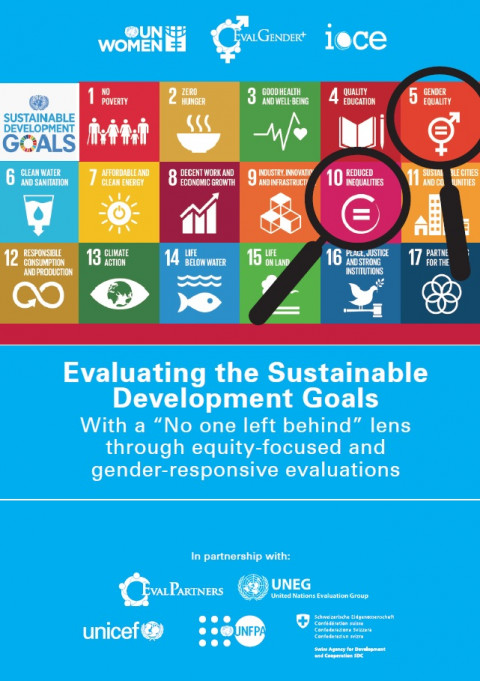 Evaluating the Sustainable Development Goals with a “No one left behind” lens through equity-focused and gender-responsive evaluation Année de publication: 2016 Auteur: Michael Bamberger | Marco Segone | Florencia Tateossian The purpose of this publication is to provide guidance on how to integrate an equity-focused and gender-responsive (EFGR) approach to national evaluation systems that should inform national Sustainable Development Goal (SDG) reviews. This guidance is intended to support national evaluation systems on how to integrate EFGR evaluations to inform the national reviews of SDGs. The guidance is expected to primarily serve national evaluation systems, the UN system, multilateral and bilateral development agencies, academic institutions, including specialized research centres and think tanks, private foundations, the private sector, and voluntary organizations of professional evaluators. Оценка Целей Устойчивого Развития на основе принципа «Развитие для всех без исключения» через призму гендерного равенства и социальной справедливости Année de publication: 2016 Auteur: Michael Bamberger | Marco Segone | Florencia Tateossian Цель данной публикации – предоставить рекомендации относительно возможных путей интеграции принципов социальной справедливости и гендерного равенства в национальные системы оценки, которые должны будут передавать информацию для страновых обзоров Целей в области устойчивого развития (ЦУР). Статистический анализ с учетом гендера и дезагрегированных показателей, хотя и имеет важное значение, должен дополняться оценками, проводимыми на основе принципов социальной справедливости и гендерного равенства, для того, чтобы развитие охватывало всех без исключения. Руководство в первую очередь предназначено для лиц, вовлеченных в национальные системы оценки; системы Организации Объединенных Наций; многосторонних и двусторонних агентств развития; академических институтов, в том числе специализированных исследовательских и аналитических центров; частных фондов; организаций частного сектора и добровольных объединений в области профессиональной оценки.
 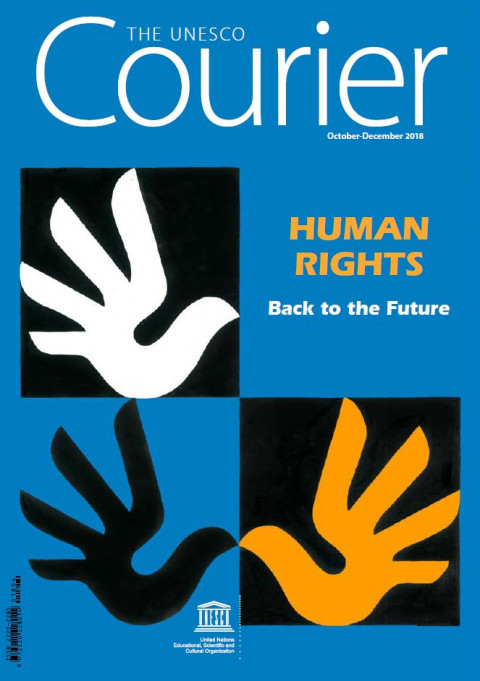 Human Rights: Back to the Future (The UNESCO Courier no. 4, October-December 2018) Année de publication: 2018 Auteur institutionnel: UNESCO Benedetto Croce, Aldous Huxley, Humayun Kabir, Harold J. Laski, Lo Chung-Shu, Salvador de Madariaga, Jacques Maritain, F.S.C. Northrop, Arnold Schoenberg, Pierre Teilhard de Chardin – these are some of the contributors to this issue of the Courier. To mark the seventieth anniversary of the Universal Declaration on Human Rights, adopted on 10 December 1948, we decided to take a detour into the past to enable us to better orient ourselves in the future. This explains the title of this issue: “Back to the Future”. Travelling back to 1946, when the world was grappling with the aftermath of the Second World War, “what kind of moral statement could the international community make that would adequately express its collective outrage and hope, however utopian, for a better future?” Mark Goodale discusses this massive international effort in his introductory article for our Wide Angle section, which he also guest-edited. The series of articles in this section uncovers a hitherto little-known part of the history of the Universal Declaration on Human Rights – the inquiry into the origins and philosophic bases of human rights. This initiative was decided upon during the first UNESCO General Conference (November-December 1946) and launched the following year by the Organization’s first Director-General, Julian Huxley. It was coordinated by the young French philosopher, Jacques Havet. For this project, UNESCO brought together leading intellectual figures of the post-war world, thus making an essential contribution to the reflection on human rights at the time. It remains amazingly relevant today. Equally relevant today are the drawings of Our Guest, the Peruvian artist Fernando Bryce, who derives his inspiration from this historic period “when the idea of progress was genuinely linked to a whole new perspective”. His series, The Book of Needs – which takes pages of the Courier between 1948 and 1954 and transforms them into works of art – is featured as a supplement in this issue.