
Ressources
Explorez une large gamme de ressources sur le GCED afin d’approfondir votre compréhension et de renforcer vos activités de recherche, de plaidoyer, d’enseignement et d’apprentissage.
102 résultats trouvés
 L’université de paix, ressources pédagogiques Auteur institutionnel: L'université de paix L'Université de Paix diffuse des outils pédagogiques et des articles de fond pour apprendre à mieux communiquer et développer des relations plus sereines et constructives.The University of peace distributes teaching tools and in-depth articles to help people learn to communicate better and develop calmer, more constructive relationships.
  AntiClash Année de publication: 2023 Auteur: Rafael Tyszblat | Olivier Fournout Auteur institutionnel: AntiClash AntiClash est un concept d’émission qui va contre la culture du c"lash" en mettant en avant l’esprit et la méthode du dialogue. Lors des émissions thématiques, facilitées par des professionnels du dialogue, les intervenants – connus ou non, experts ou pas, mais en désaccord sur un sujet à potentiel polémique – sont invités à aller au fond de leurs divergences, avec authenticité et respect.Il ne s’agit pas d’une émission d’information. Les animateurs ne sont ni journalistes, ni experts dans les domaines abordés par les personnes invitées. Ainsi, ils ne font pas de « fact checking », ni de « debunking » mais invitent leurs auditeurs à vérifier eux-mêmes les faits avancés par les intervenants.L’objectif d’AntiClash est de montrer de quoi a l’air un véritable dialogue en permettant une meilleure compréhension des discours antagonistes, que la culture du clash dans les médias et les réseaux ne permet pas.Il ne s’agit pas de créer une société où tout le monde est d’accord, mais nos différences, si elles font l’objet d’une conversation constructive, doivent enrichir notre compréhension des lignes de fracture politique et nous permettre de nous rapprocher d’une vérité partagée en rétablissant des liens de confiance et une communication éthique entre citoyens.AntiClash, c’est la tentative de montrer une alternative à l’affrontement sur les sujets qui comptent. AntiClash is a program concept that goes against the culture of c "lash" by emphasizing the spirit and method of dialogue. During themed programs, facilitated by dialogue professionals, speakers - well-known or not, experts or not, but disagreeing on a potentially controversial subject - are invited to get to the bottom of their differences, with authenticity and respect.This is not a news program. The hosts are neither journalists nor experts in the fields covered by the guests. As such, they do not engage in "fact checking" or "debunking", but invite their listeners to verify for themselves the facts put forward by the speakers. The aim of AntiClash is to show what real dialogue looks like, by enabling a better understanding of antagonistic discourses, which the culture of clash in the media and networks does not allow. It's not about creating a society where everyone agrees, but our differences, if the subject of constructive conversation, should enrich our understanding of political fault lines and enable us to move closer to a shared truth by re-establishing bonds of trust and ethical communication between citizens. AntiClash is an attempt to show an alternative to confrontation on the issues that matter.
 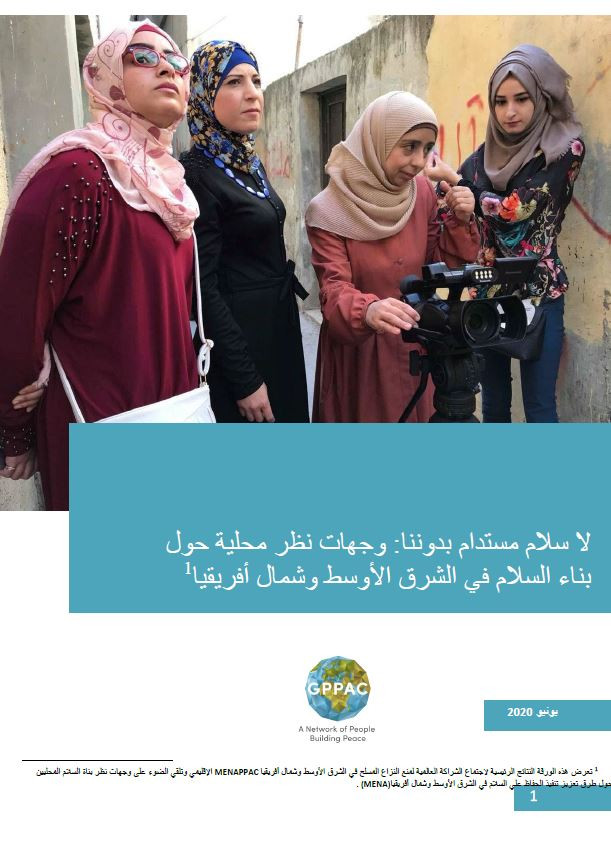 No Sustainable Peace Without Us: Local Perspectives on Peacebuilding in the Middle East and North Africa Année de publication: 2020 Auteur institutionnel: Global Partnership for the Prevention of Armed Conflict (GPPAC) This paper presents the main outcomes of the Global Partnership for the Prevention of Armed Conflict in the Middle East and North Africa meeting. The paper sheds light on the perspectives of local peacebuilders on ways to promote peacekeeping in the Middle East and North Africa region. لا سلام مستدام بدوننا: وجهات نظر محلية حول بناء السلام في الشرق الأوسط وشمال أفريقيا Année de publication: 2020 Auteur institutionnel: Global Partnership for the Prevention of Armed Conflict (GPPAC) تعرض هذه الورقة النتائج الرئيسية لاجتماع الشراكة العالمية لمنع النزاع المسلح في الشرق الأوسط وشمال أفريقيا. وتلقي الورقة الضوء على وجهات نظر بناة السلام المحليين حول طرق تعزيز الحفاظ على السلام في منطقة الشرق الأوسط وشمال أفريقيا.
  Women Influencing Multi-Stakeholder Peace Dialogue, Processes and Policy Spaces Année de publication: 2023 Auteur institutionnel: United Nations Entity for Gender Equality and the Empowerment of Women (UN Women) This paper seeks to draw lessons on how women have been participating as actors in influencing peace dialogue and processes related to the women, peace and security agenda in Europe and Central Asia. It also highlights challenges that need to be taken into consideration and offers recommendations to promote their greater contribution, influence, and participation in peace processes. Женщины, влияющие на многосторонние диалоги, процессы и политику в интересах мира Année de publication: 2023 Auteur institutionnel: United Nations Entity for Gender Equality and the Empowerment of Women (UN Women) Целью данного документа является извлечение уроков о том, как женщины участвуют в качестве действующих лиц, влияя на мирный диалог и процессы, связанные с повесткой дня «Женщины, мир и безопасность» в Европе и Центральной Азии. В нем также освещаются проблемы, которые необходимо принять во внимание, и предлагаются рекомендации по содействию их большему вкладу, влиянию и участию в мирных процессах.
  Alert 2024! : Report on Conflicts, Human Rights and Peacebuilding Année de publication: 2024 Auteur institutionnel: Escola de Cultura de Pau (ECP) Published since 2001, this yearbook analyses the state of the world in terms of conflict and peacebuilding based on three axes: armed conflict, tensions and gender, peace and security. The analysis of the most relevant events of the year and the nature, causes, dynamics, actors and consequences of the main scenarios of armed conflict and socio-political tension in the world allows for a comparative regional view and the identification of global trends, as well as elements of risk and preventive warning for the future. Likewise, the report also identifies opportunities for peacebuilding or for the reduction, prevention or resolution of conflicts. Alerta 2024!: Informe sobre conflictos, derechos humanos y construcción de paz Année de publication: 2024 Auteur institutionnel: Escola de Cultura de Pau (ECP) Editado desde 2001, este anuario analiza el estado del mundo en términos de conflictividad y construcción de paz a partir de tres ejes: conflictos armados, tensiones y género, paz y seguridad. El análisis de los hechos más relevantes del año y de la naturaleza, causas, dinámicas, actores y consecuencias de los principales escenarios de conflicto armado y tensión socio-política en el mundo permite ofrecer una mirada comparativa regional e identificar tendencias globales, así como elementos de riesgo y alerta preventiva de cara al futuro. Del mismo modo, el informe también identifica oportunidades para la construcción de paz o para la reducción, prevención o resolución de conflictos.
  دعوة إلى السلام: عن ثقافة السلام واللاعنف والتسامح ومفاهيم أخرى Année de publication: 2017 Auteur institutionnel: HRDO Center هذا اصدار من مركز هردو يلقي الضوء حول ثقافة السلام وآليات تحقيقها وانعكاسات اختفائها من السلوك المجتمعي والشخصي في مصر وكيف يمكن أن تضمن السياسات والتشريعات تعزيز مفاهيم السلام شديدة الارتباط بكفالة حقوق الإنسان، يرصد هذا التقرير عدة مفاهيم أساسية وكيفية تناولها التشريع الدولي والوطني وجدوى تبني ثقافة السلام والتسامح واللاعنف كخطوة مبدئية للتوعية بضرورة نبذ العنف والتمييز والكراهية كمدخل أساسي لمجتمع أفضل وأكثر أمان واستقرارا. A Call to Peace: On a Culture of Peace, Nonviolence, Tolerance and Other Concepts Année de publication: 2017 Auteur institutionnel: HRDO Center This is a publication by the HRDO Center that sheds light on the culture of peace, the mechanisms for achieving it, and the repercussions of its disappearance from the societal and personal behavior in Egypt. How can policies and legislation ensure the promotion of notions of peace that are closely linked to ensuring human rights. This report monitors several basic concepts and how they are addressed by international and national legislation and the feasibility of adopting a culture of peace, tolerance and non-violence as an initial step to raise awareness of the need to renounce violence, discrimination and hatred as a basic entry point for a better, safer and more stable society.