
Ressources
Explorez une large gamme de ressources sur le GCED afin d’approfondir votre compréhension et de renforcer vos activités de recherche, de plaidoyer, d’enseignement et d’apprentissage.
3,128 résultats trouvés
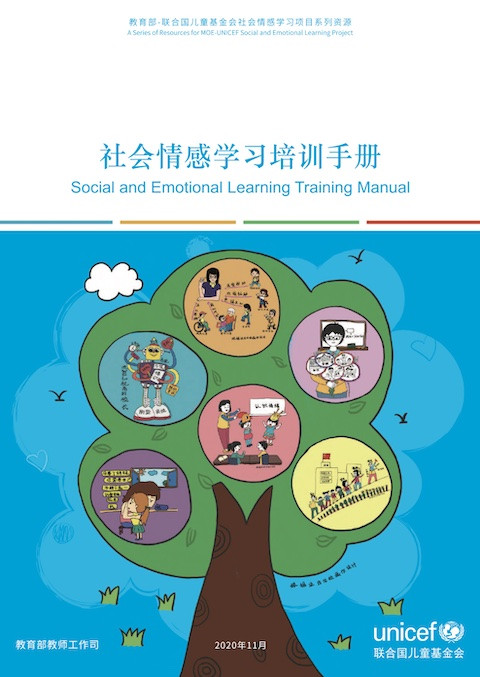 社会情感学习培训手册 Année de publication: 2020 Auteur institutionnel: China. Ministry of Education | United Nations Children's Fund (UNICEF) 本材料是中国教育部与联合国儿童基金社会情感学习项目系列资源的培训手册的第一册。主要介绍社会情感学习的概念及意义,以及项目实施内容。
 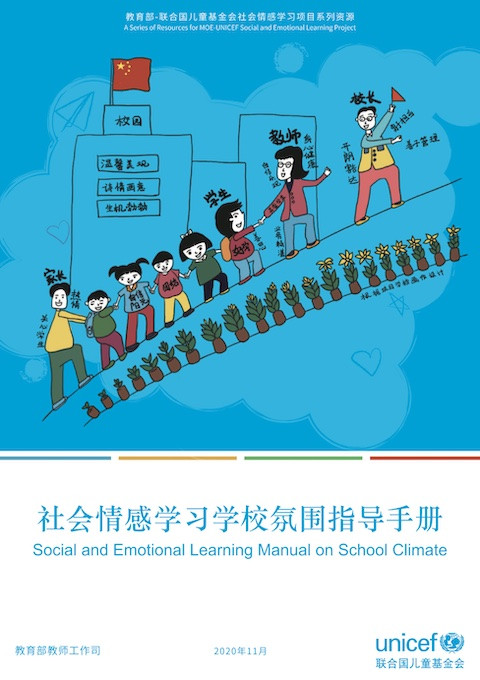 Social and Emotional Learning Manual on School Climate Année de publication: 2020 Auteur institutionnel: China. Ministry of Education | United Nations Children's Fund (UNICEF) This material is a guide for school leaders and teachers to promote a positive school climate that supports children's social and emotional learning. It talks about the relationship between school climate and school environment, the key elements of school climates etc. 社会情感学习学校氛围指导手册 Année de publication: 2020 Auteur institutionnel: China. Ministry of Education | United Nations Children's Fund (UNICEF) 这份材料是社会情感学习项目中学校氛围指导手册,包括学校氛围的构成要素及作用等,旨在为学校校长和教师在全校范围内推进学校氛围提供针对性的指导和参照。
  Introducing the Global Goals Auteur institutionnel: United Nations Children's Fund (UNICEF) Learners can explain what the Global Goals for Sustainable Development are, why they are important and how they relate to the learner her/himself.
  The global goals debate Auteur institutionnel: United Nations Children's Fund (UNICEF) Learning outcomes: To encourage critical debate about the Global Goals for Sustainable Development, so that young people are aware of the Goals, have critically evaluated them in their own minds and have drawn their own conclusions
  What To Do With The Global Goals In My Daily Life? Auteur institutionnel: United Nations Children's Fund (UNICEF) Learning outcomes: Be able to identify creative ways of implementing the Global Goals, understand how to build on each other’s ideas and use creativity in the initial steps of developing sustainability projects
  Gender Equality and Empowerment of Women and Girls in the UK: Meeting the Challenge of the Sustainable Development Goals Année de publication: 2016 Auteur: Holly Dustin | Helen Mott | Nicola Waterworth | Gillian Cowell | Janet Veitch Auteur institutionnel: British Council This research provides the first stocktake of gender equality in the UK from the perspective of the UN’s Sustainable Development Goals (SDGs), the 17 goals adopted by world leaders in 2015 in order to end poverty, protect the planet and ensure prosperity for all.It focuses on the UK’s successes towards achieving gender equality, as well as gaps and priorities for further action in five key areas: participation, power and leadership; education; economy; justice and violence against women and girls and culture (including arts, sports and technology). There are many examples of good practice from the UK, such as strong legislation, data gathering and structures. However, the research also concludes that women and girls continue to lag behind men and boys on key rights, opportunities and well-being, with men over-represented in almost all positions of power and decision-making. It also explores the impact of international linkages and collaboration to determine whether as the UK’s cultural relations organisation, there is a role for the British Council in this.
  Media Literacy Education to Counter Truth Decay: An Implementation and Evaluation Framework Année de publication: 2021 Auteur: Alice Huguet | John F. Pane | Garrett Baker | Laura S. Hamilton | Susannah Faxon-Mills Auteur institutionnel: RAND Corporation Media literacy (ML) education has emerged as a promising approach to slowing the spread of Truth Decay, described as the diminishing role that facts, data, and analysis play in political and civil discourse. Several factors contribute to Truth Decay, including a rapidly evolving information ecosystem and overburdened educational institutions. Many teachers believe their students lack the complex skills that are necessary to navigate today’s information- saturated world. This gap—between students’ existing competencies and those required to engage responsibly in a fast-paced media environment— could lead to negative consequences for individuals and society writ large.However, teachers report a lack of guidance around promoting ML education in their practice, and rigorous research about what kinds of ML educationwork best, and in what conditions, remains limited. This report presents a framework for implementing and evaluating ML educational efforts. Following an introduction to the framework, the authors discuss six steps of ML implementation and evaluation: setting ML learning expectations; identifying conditions that can influence ML instructional efforts; exploring instructional resources; identifying measures of ML competencies; monitoring progress; and finally, measuring the summative impacts of ML education on student learning. By bringing this information together for implementors—such as district decisionmakers and teachers—as well as evaluators, the authors emphasize the important connections between these too often separate groups.
  School Closures and Regional Policies to Mitigate Learning Loss due to COVID-19: A Focus on the Asia-Pacific Année de publication: 2021 Auteur institutionnel: UNESCO Institute for Statistics (UIS) Global school closures as a result of COVID-19 have caused learning losses for millions of children despite efforts to deploy remote learning options. Greater economic insecurity among families may also affect school enrolment as many struggle to pay school fees, or require children to work to supplement family income. Ultimately, this will lead to rising dropout rates, estimated to be as much as 4% in a region where 128 million children and young people were already out of school before COVID-19. The largest number of learners at risk reside in South and West Asia.Together, the education and economic fallout from the pandemic threaten progress toward the Sustainable Development Goal for education (SDG 4). Even prior to the COVID-19 disruptions, progress towards SDG 4 was lagging in many countries in the Asia-Pacific and without significant contributions to education finance, the pandemic threatens to push the region even further behind.This report breaks down the effects of school closures. It considers, for example, how many schools were closed, and when, across the Asia-Pacific, and the effects on different levels of education from early childhood education, through to primary and secondary school. The report analyses country efforts to implement remote learning, and strategies to mitigate learning losses as the proportion of students expected to fall below minimum proficiency levels is expected to rise.To achieve SDG 4, all children and young people, and especially those in marginalized groups, need support to get the education they need and deserve.
 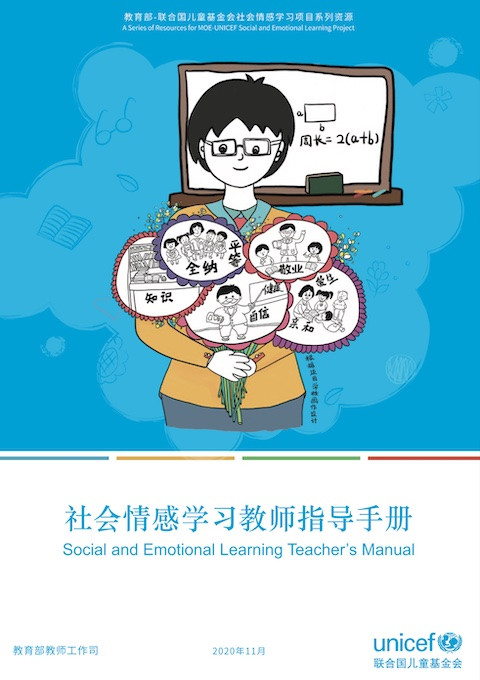 Social and Emotional Learning Teacher's Manual Année de publication: 2020 Auteur institutionnel: China. Ministry of Education | United Nations Children's Fund (UNICEF) This material provides an overview and guidance for teachers to carry out social and emotional learning. It discusses the role of teachers in social and emotional learning, and it also covers methods and tools that teachers can use to implement social and emotional learning.