
Ressources
Explorez une large gamme de ressources sur le GCED afin d’approfondir votre compréhension et de renforcer vos activités de recherche, de plaidoyer, d’enseignement et d’apprentissage.
1,951 résultats trouvés
 National Consultation on the Situation of Prisons in Senegal: Improvement of the Condition of Detention, Social Integration and Prevention of Violent Extremism through Education, 23-24 May 2017, Dakar, Senegal: Report Année de publication: 2017 Auteur institutionnel: UNESCO Dakar Sustainable Development Goal (SDG) 4 on education highlights the need to include our society’s most vulnerable and most margined members, such as prisoners, in order to ensure that all learners acquire the knowledge, skills, values and attitudes that are needed to build just, peaceful, and sustainable societies.The situation in Senegalese prisons is of a major concern given the overall condition of detention as well as the context of insecurity that characterizes the sector. In 2016, the country had 37 penal institutions for a total prison population of 9,422 prisoners (including pre-trial detainees and remand prisoners), of which approximately 200 were minors.1 Despite the efforts to humanize the prisons by adopting the name, “House of Arrest and Corrections” [Maison d'arrêt et de correction (MAC)] instead of the term "prison," and improving the living conditions in prisons, the fate of prisoners is not satisfactory. The reintegration promoted by Senegal's correctional facilities has largely consisted of a series of education programs, such as literacy and painting, developed by a number of organizations, but the space provided by prison administration, line Ministries, and NGOs are limited and the impact so far has been insufficient. A prison is not just a building, but it is also an instrument of rehabilitation to regain a place in society. This obviously requires the development of training, education and vocational guidance to support smooth reintegration into society.In this context, UNESCO's Dakar Regional Multi-Sectoral Office organized, in partnership with the Senegal National Commission for UNESCO and experts, a “National Consultation on the Situation of Prisons in Senegal: Improvement of the Condition of Detention, Social Integration, and Prevention of Violent Extremism through Education” in Dakar, Senegal, from 23 to 24 May 2017.
  Metadata for the Global and Thematic Indicators for the Follow-up and Review of SDG 4 and Education 2030 Année de publication: 2017 Auteur institutionnel: UNESCO Institute for Statistics (UIS) This document contains standardised metadata for each of the proposed global and thematic indicators for monitoring Sustainable Development Goal 4 (SDG 4) and the Education 2030 Agenda.The metadata included in this document have been developed by the UIS and are based on the set of thematic indicators approved by the Technical Cooperation Group on SDG 4–Education 2030 Indicators, a group set up in 2016 to provide the technical platform to support the implementation of the thematic indicator framework for the follow-up and review of SDG 4 and the Education 2030 Agenda. Метаданные глобальных и тематических показателей для сопровождения и обзора "ЦУР 4" и программы «Образование-2030" Année de publication: 2017 Auteur institutionnel: UNESCO Institute for Statistics (UIS) Этот документ содержит стандартизованные метаданные для каждого из предлагаемых глобальных и тематических показателей для мониторинга Цели 4 устойчивого развития (SDG 4) и Повестки дня "Образование-2030".Метаданные, включенные в этот документ, были разработаны Институтом статистики ЮНЕСКО и основаны на наборе тематических показателей, одобренных Группой технического сотрудничества по индикаторам ЦУР 4 - "Образование-2030", созданной в 2016 году для предоставления технической платформы по поддержке реализации структуры тематических показателей для последующей деятельности и обзора ЦУР 4 и Повестки дня "Образование-2030".
  La citoyenneté mondiale en Afrique subsaharienne Année de publication: 2015 Auteur: Akemi Yonemura Auteur institutionnel: Éducation des Adultes et Développement Les apprenants doivent aujourd’hui bien comprendre les défis locaux, nationaux et mondiaux afin de pouvoir exercer une infl uence sur le développement politique, social, culturel, économique et environnemental, tant au sein de leurs sociétés que dans la vie privée. L’UNESCO a fait la promotion de l’éducation pour la paix et le développement durable en tant qu’objectifs fondamentaux de son programme d’éducation, se concentrant pour cela sur une éducation transformatrice par le biais de l’éducation à la citoyenneté mondiale (ECM). Cet article se penche sur l’ECM en Afrique subsaharienne dans le contexte du calendrier de l’éducation pour l’après-2015, et s’intéresse tout particulièrement à l’éducation des adultes.
  How Networking Can Help Build Global Citizenship in Japan Année de publication: 2015 Auteur: Hideki Maruyama Auteur institutionnel: Éducation des Adultes et Développement The article explains and outlines some of the challenges facing schools in Japan when teaching about sustainable development. These challenges are many and diverse. Concrete examples are given, and some proposals for action are presented.
 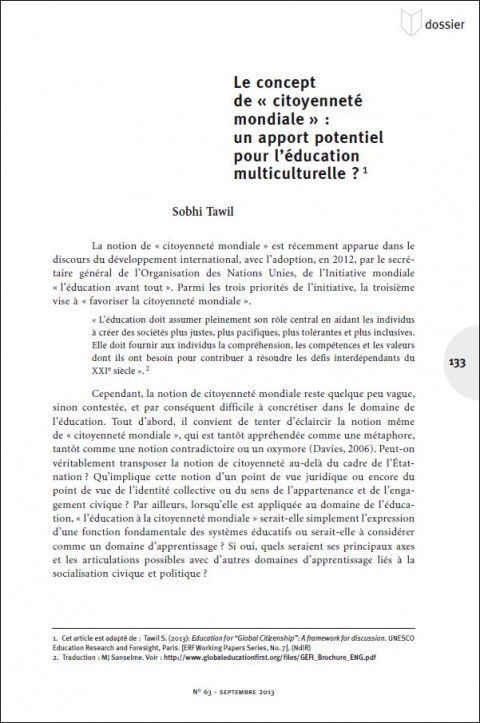 Does the Concept of ‘Global Citizenship’ Have the Potential to Input in Multicultural Education? Année de publication: 2013 Auteur: Sobhi Tawil Auteur institutionnel: Revue internationale d’éducation de Sèvres One of the three priorities of the Global Education First Initiative launched in 2012 by the United Nations is fostering global citizenship. However, this concept remains vague if left unchallenged, and as a result is difficult to implement in the field of education. It may be true that the growing globalisation and multiculturalism of contemporary societies is gradually transforming the concept and traditional role of citizenship, the legal reality of citizenship and its practises, but they still remain largely rooted in the idea of Nation-State. This article attempts to clarify the concept of global citizenship, its possible application in the field of citizenship education and its potential contribution to the enrichment of multicultural education. El concepto de “ciudadanía mundial” : ¿una posible aportación para la educación multicultural ? Année de publication: 2013 Auteur: Sobhi Tawil Auteur institutionnel: Revue internationale d’éducation de Sèvres Entre las tres prioridades de la iniciativa mundial “la educación ante todo” (Education first) lanzada en 2012 por las Naciones Unidas, podemos encontrar la idea según la cual conviene “favorecer la ciudadanía mundial”. Sin embargo, esta noción es de las más imprecisas, si no discutida y, por tanto, difícil de concretizar en el campo de la educación. Si no cabe duda de que la mundialización y la creciente multiculturalidad de las sociedades contemporáneas transforman paulatinamente la concepción y la práctica tradicional de la ciudadanía, la realidad jurídica de la ciudadanía así como su práctica, quedan establecidas fundamentalmente a nivel del Estado-Nación. Este artículo procura aclarar la noción de “ciudadanía mundial”, su posible aplicación en el dominio de la educación a la ciudadanía y su contribución potencial al enriquecimiento de la educación multicultural. Le concept de « citoyenneté mondiale » : un apport potentiel pour l’éducation multiculturelle ? Année de publication: 2013 Auteur: Sobhi Tawil Auteur institutionnel: Revue internationale d’éducation de Sèvres Parmi les trois priorités de l’initiative mondiale « l’éducation avant tout » (Education First) lancée en 2012 par les Nations-Unies, on trouve l’idée de « favoriser la citoyenneté mondiale ». Cependant, cette notion reste vague sinon contestée, et par conséquent difficile à concrétiser dans le domaine de l’éducation. S’il est vrai que la mondialisation et la multiculturalité croissante des sociétés contemporaines transforment progressivement la conception et la pratique traditionnelle de la citoyenneté, la réalité juridique de la citoyenneté, ainsi que sa pratique, restent encore largement ancrées au niveau de l’État-nation. Cet article tente de clarifier la notion de « citoyenneté mondiale », son application possible dans le domaine de l’éducation à la citoyenneté et sa contribution potentielle à l’enrichissement de l’éducation multiculturelle.
 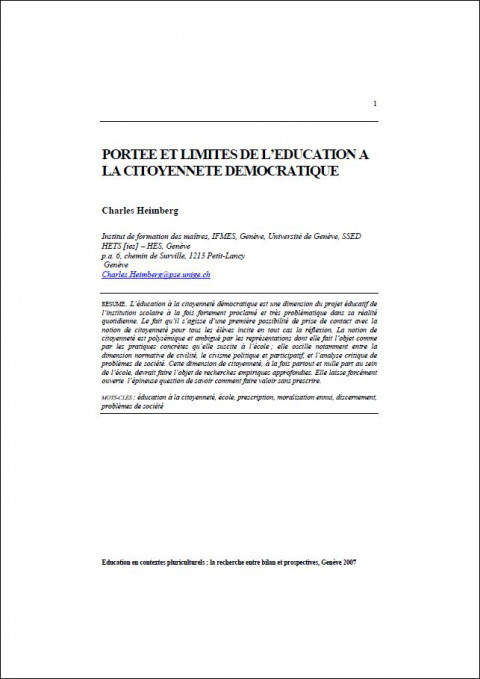 Portée et limites de l'éducation à la citoyenneté démocratique Année de publication: 2007 Auteur: Charles Heimberg Auteur institutionnel: Université de Genève L’éducation à la citoyenneté démocratique est une dimension du projet éducatif de l’institution scolaire à la fois fortement proclamé et très problématique dans sa réalité quotidienne. Le fait qu’il s’agisse d’une première possibilité de prise de contact avec la notion de citoyenneté pour tous les élèves incite en tout cas la réflexion. La notion de citoyenneté est polysémique et ambiguë par les représentations dont elle fait l’objet comme par les pratiques concrètes qu’elle suscite à l’école ; elle oscille notamment entre la dimension normative de civilité, le civisme politique et participatif, et l’analyse critique de problèmes de société. Cette dimension de citoyenneté, à la fois partout et nulle part au sein de l’école, devrait faire l’objet de recherches empiriques approfondies. Elle laisse forcément ouverte l’épineuse question de savoir comment faire valoir sans prescrire.
 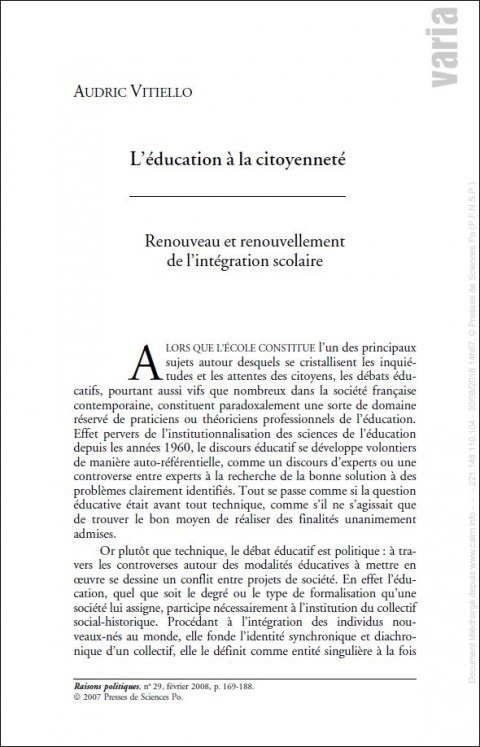 L'éducation à la citoyenneté Année de publication: 2008 Auteur: Audric Vitiello Auteur institutionnel: Raisons politiques Notion récente, l'éducation à la citoyenneté se présente comme une inflexion de la formation civique, visant un renouvellement de sa forme pour mieux assurer sa fonction institutionnelle d'intégration des individus au collectif. Mais, l'éducation ôtant une praxis où moyens et fins sont interdépendants, une modification des modalités de l'éducation induit logiquement celle de la finalité. De fait, l'éducation à la citoyenneté s'indexe à une conception originale du politique pensé non plus comme lieu, mais comme moment spécifique dédié à la régulation de tout collectif. Le mécanisme d'abstraction civique perdure, mais il s'effectue à partir des situations concrètes dans lesquelles l'individu est inscrit, et par une réflexion à fondement dialogique. Se dessine alors une forme de démocratie générale et dialogique, où le politique est déconcentré et démultiplié mais où la décision prise en commun après délibération reste le mode de structuration privilégié du collectif. Mais la démocratie procédurale et dialogique a des limites, dans la mesure où elle suppose d'être fondée dans un corpus substantiel de valeurs qui lui confère sa légitimité.