
Ressources
Explorez une large gamme de ressources sur le GCED afin d’approfondir votre compréhension et de renforcer vos activités de recherche, de plaidoyer, d’enseignement et d’apprentissage.
948 résultats trouvés
 Education, Extremism and Terrorism: What should be Taught in Citizenship Education and Why Année de publication: 2012 Auteur: Dianne Gereluk Should educators be exploring terrorism and extremism within their classrooms? If so, what should they be teaching, and how? Dianne Gereluk draws together the diverging opinions surrounding these debates, exploring and critiquing the justifications used for why these issues should be addressed in schools. She goes on to consider the ways in which educators should teach these topics, providing practical suggestions. Education, Extremism and Terrorism: What should be Taught in Citizenship Education and Why Année de publication: 2012 Auteur: Dianne Gereluk Les enseignants doivent-il aborder les questions du terrorisme et de l'extrémisme au sein des salles de classe ? Dans ce cas, que doivent-ils enseigner, et comment ? Dianne Gereluk réunit au sein d'un même ouvrage les opinions divergentes autour de ces débats, elle explore et interroge les arguments mis en avant pour démontrer de l’importance du traitement de ces thèmes par les écoles. Elle envisage la façon dont ces sujets devraient être enseignés, et propose quelques conseils pratiques.
  Smart Education Strategies for Teaching and Learning: Critical Analytical Framework and Case Studies Année de publication: 2022 Auteur: Shafika Isaacs | Sanjaya Mishra Auteur institutionnel: UNESCO Institute for Information Technologies in Education (IITE) | Beijing Normal University This electronic publication about smart education strategies for building the resilience of education and training systems in the postpandemic environment provides a framework to develop appropriate policy and strategy in existing and emerging forms of schooling, higher education, technical and vocational education, and training (TVET), adult education and lifelong learning, including formal, nonformal and informal educational environments. The publication reviews the status of smart education policies in 10 countries. It includes 15 case studies within the six policy themes: infrastructure, curriculum and pedagogy, digital education resources and platforms, skills and competencies, governance, management and administration, and partnership.
  Toward one world or many? A comparative analysis of OECD and UNESCO global education policy documents Année de publication: 2019 Auteur: Vaccari, Victoria | Gardinier, Meg P. Education policymaking has gone global. The 2030 Agenda for Sustainable Development aims to galvanize efforts to promote sustainable development, decrease global inequalities, and realize universal quality education. Supporting these efforts, two leading international organizations, UNESCO and the OECD, have set out normative frameworks for their vision of global education. This paper examines the policy discourses of these organizations in light of SDG 4–Education. Specifically, through a comparative analysis of selected terms and underlying concepts in key policy documents, the paper distinguishes between UNESCO's notion of global citizenship and the OECD's framework for global competence. Ultimately, the authors discuss whether the organizations' agendas are aimed at a common global vision, or, alternatively, towards two distinct and divergent conceptualizations of an imagined future.
 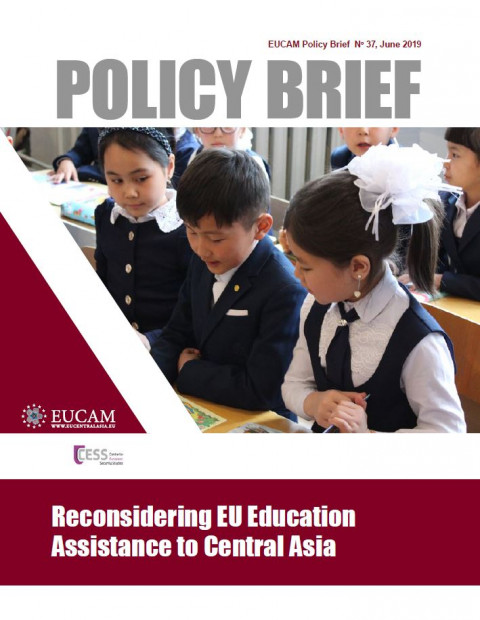 Reconsidering EU Education Assistance to Central Asia (EUCAM Policy Brief No. 37, June 2019) Année de publication: 2019 Auteur: Sebastien Peyrouse Auteur institutionnel: Europe-Central Asia Monitoring (EUCAM) This paper is based on broader research on education in Central Asia that includes interviews with local stakeholders (teachers, parents and students) in Kazakhstan, Kyrgyzstan and Uzbekistan. Some views were taken from Sebastien Peyrouse, ‘How to Strengthen Western Engagement in Central Asia: Spotlight on EU Education Assistance in Uzbekistan’, PONARS Policy Memo, no. 524, April 2018,http://www.ponarseurasia.org/memo/strengthen-western-engagement-central-asia-spotlight-eu-education-assistance-uzbekistan. Новый взгляд на содействие ЕС образовательному сектору в Центральной Азии (Брифинг EUCAM No. 37, сентябрь 2019) Année de publication: 2019 Auteur: Sebastien Peyrouse Auteur institutionnel: Europe-Central Asia Monitoring (EUCAM) Этот брифинг основан на более углубленном исследовании системы образования в Центральной Азии, которое включает интервью в регионе (с учителями, родителями и учащимися) в Казахстане, Кыргызстане и Узбекистане.Ряд выводов позаимствованы из работы Себастьяна Пейруза ‘How to Strengthen Western Engagement in Central Asia: Spotlight on EU Education Assistance in Uzbekistan’, PONARS Policy Memo, no. 524, апрель 2018,http://www.ponarseurasia.org/memo/strengthen-western-engagement-central-asia-spotlight-eu-education-assistance-uzbekistan.
  Learner-Centred Teaching in Technical and Vocational Education and Training: Perspectives and Reviews of Six Asia-Pacific Countries Année de publication: 2023 Auteur institutionnel: UNESCO Bangkok Learner-centred Teaching in Technical and Vocational Education and Training: Perspectives and Reviews of Six Asia-Pacific Countries A learner-centred approach to teaching in Technical and Vocational Education and Training (TVET) is based on learner engagement, autonomy and outcome-based activities to support professional development. This report analyses the status of learner-centred TVET teaching in six selected countries across Asia and the Pacific, including China, Republic of Korea, Samoa, Sri Lanka, Thailand, and Uzbekistan. The countries were selected because of their geographic diversity, access to national experts, and potential around learner-centred TVET.The first part of the study is a review of the theoretical background on the learner-centred approach and TVET teaching with an international scope. A total of 25 indicators were used to assess three components of TVET teaching in the region. The analysis includes 17 examples corresponding to the selected indicators. The findings showcase lessons learned and recommendations for countries to self-assess their TVET teaching strategies. These examples will help to inform future projects and capacity building in each sub-region of Asia-Pacific.As a result, seven proposals are identified and discussed to promote the development of learner-centred TVET teaching in the region. These proposals include: 1) supporting national reform of the pedagogy based on the results of pilot projects; 2) increasing two-way communication between students and teachers; 3) producing learning materials adapted to learner-centred methods; 4) using technology in the learning process; 5) implementing competency-based learning to support the learner-centred pedagogy; 6) integrating transversal and core skills; and 7) developing teachers’ capacities by employing a learner-centred approach. These proposals (on reform, teaching method, use of materials, etc.) also address gender dimensions throughout the planning, implementation and review process. Conclusions from the study provide lessons learned as well as proposals for further research and implementation of learner-centred TVET teaching in Asia-Pacific.
  Beyond commitments 2019: how countries implement SDG 4 Année de publication: 2019 Auteur institutionnel: Global Education Monitoring Report Team Almost one-third of the time set to achieve the Sustainable Development Goals (SDGs) has elapsed. The 2019 High-level Political Forum (HLPF), the global SDG follow-up and review mechanism, represents a major stock-taking moment for countries, especially as regards SDG 4, the education goal, which is being reviewed for the first time. The international community relies primarily on quantitative measures to assess progress towards the SDGs. Acompanion publication by the UNESCO Institute for Statistics and the Global Education Monitoring Report for the 2019 HLPF, titled ‘Meeting commitments: Are countries on track to achieve SDG 4?’, shows that there are major challenges ahead. But increasingly, member states demand more than quantitative information. They ask for guidance on how to respond when their education systems do not reach their targets. To respond to this demand, this publication has the following purposes: Understand countries’ perceptions of SDG 4 based on responses to a questionnaire prepared for this publication, which asked countries to report on their flagship SDG 4 policies Distil those perceptions into a framework of the types of national policies that are best aligned with SDG 4 and whose implementation should be monitored Communicate the framework succinctly and provide a complementary input for the review of SDG 4 at the 2019 HLPF Provide an opportunity for countries to engage in dialogue on how they approach SDG 4. An analysis of the questionnaires submitted by 72 governments shows that most countries refer to SDG 4 as a framework in which they place their education planning. A core recommendation is that countries should align their education plans and policies with their international commitments.
  Meeting commitments: are countries on track to achieve SDG 4? Année de publication: 2019 Auteur institutionnel: Global Education Monitoring Report Team | UNESCO Institute for Statistics (UIS) The world is a third of the way towards the deadline of the 2030 Agenda for Sustainable Development, which includes the fourth Sustainable Development Goal on education, SDG 4. But it is behind on its commitments. This joint publication by the UNESCO Institute for Statistics and the Global Education Monitoring Report for the 2019 High-level Political Forum on Sustainable Development captures concisely how far the world is from achieving its education targets. This is the year that the generation of students that should finish secondary school by 2030 should be entering school for the first time. Yet, in low-income countries, only 60% of children complete primary school, while in some regions the percentage of students who achieve minimum proficiency in reading is even falling. There is no denying that the world is off track. It is time to put an end to complacency. The international community relies on data to report on the SDG 4 monitoring framework to assess progress. While clear improvements have been made in data collection, data gaps remain a major concern. This publication makes a call for countries and their international development partners to coordinate and finance the collection of data to monitor and deliver on SDG 4. Respecter les engagements: les pays sont-ils en bonne voie d'atteindre l'ODD 4? Année de publication: 2019 Auteur institutionnel: Global Education Monitoring Report Team | UNESCO Institute for Statistics (UIS) Le monde a parcouru un tiers du chemin vers l’échéance de l’Agenda de développement durable 2030, qui inclut le quatrième Objectif de développement durable (ODD 4), mais il est en retard sur la réalisation de ses engagements. Cette publication conjointe de l’Institut de statistique de l’UNESCO et du Rapport mondial de suivi sur l’éducation pour le Forum politique de haut niveau sur le développement durable 2019 expose de manière concise le retard dans la réalisation des cibles de l’éducation. Cette année est celle où la génération d’élèves qui terminera l’enseignement secondaire d’ici 2030 doit commencer l’école pour la toute première fois. Pourtant, dans les pays à revenu faible, seuls 60 % des enfants achèvent l’enseignement primaire, tandis que dans certaines régions, le pourcentage d’élèves qui possèdent les compétences minimales en lecture est même en baisse. On ne peut nier le fait que le monde est en retard. Il est temps de cesser ce laxisme. La communauté internationale dépend des données pour établir les rapports sur le cadre de suivi de l’ODD 4 afin d’évaluer les progrès accomplis. Des améliorations ont clairement été accomplies en matière de collecte de données mais les déficits de données demeurent une préoccupation majeure. Cette publication exhorte les pays et leurs partenaires internationaux du développement à coordonner et à financer la collecte de données pour suivre et réaliser l’ODD 4.