
Ressources
Explorez une large gamme de ressources sur le GCED afin d’approfondir votre compréhension et de renforcer vos activités de recherche, de plaidoyer, d’enseignement et d’apprentissage.
2,255 résultats trouvés
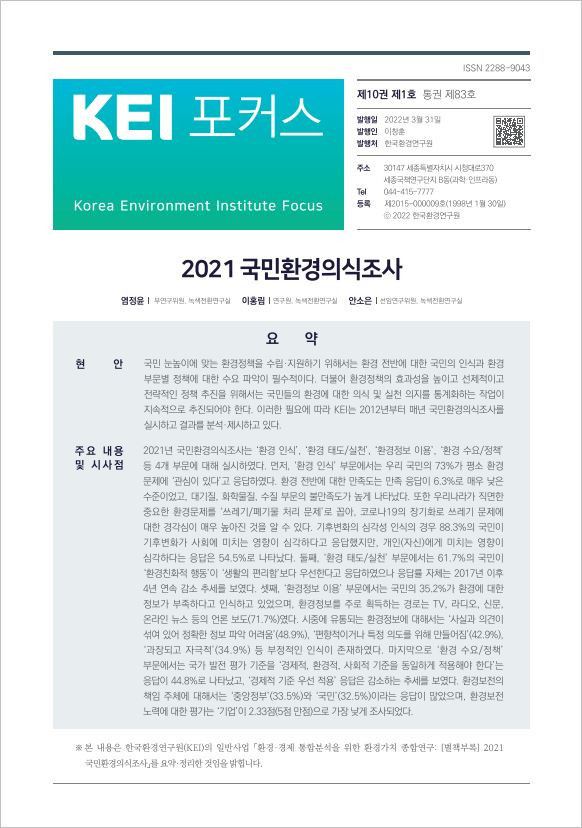 2021 국민환경의식조사 (KEI 포커스 제10권 통권 83호) Année de publication: 2022 Auteur: 염정윤 | 이홍림 | 안소은 Auteur institutionnel: 한국환경연구원 국민 눈높이에 맞는 환경정책을 수립·지원하기 위해서는 환경 전반에 대한 국민의 인식과 환경 부문별 정책에 대한 수요 파악이 필수적이다. 더불어 환경정책의 효과성을 높이고 선제적이고 전략적인 정책 추진을 위해서는 국민들의 환경에 대한 의식 및 실천 의지를 통계화하는 작업이 지속적으로 추진되어야 한다. 이러한 필요에 따라 KEI는 2012년부터 매년 국민환경의식조사를 실시하고 결과를 분석·제시하고 있다.2021년 국민환경의식조사는 '환경인식', '환경태도/실천', '환경정보 이용', '환경 수요/정책' 등 4개 부문에 대해 실시하였다. 본 저작물은 한국환경연구원에서 2022년 작성하여 공공누리 제4유형으로 개방한 '2021 국민환경의식조사(작성자: 염정윤, 이홍림, 안소은)'을 이용하였으며, 해당 저작물은 한국환경연구원 홈페이지(https://www.kei.re.kr/)에서 무료로 내려받으실 수 있습니다.
 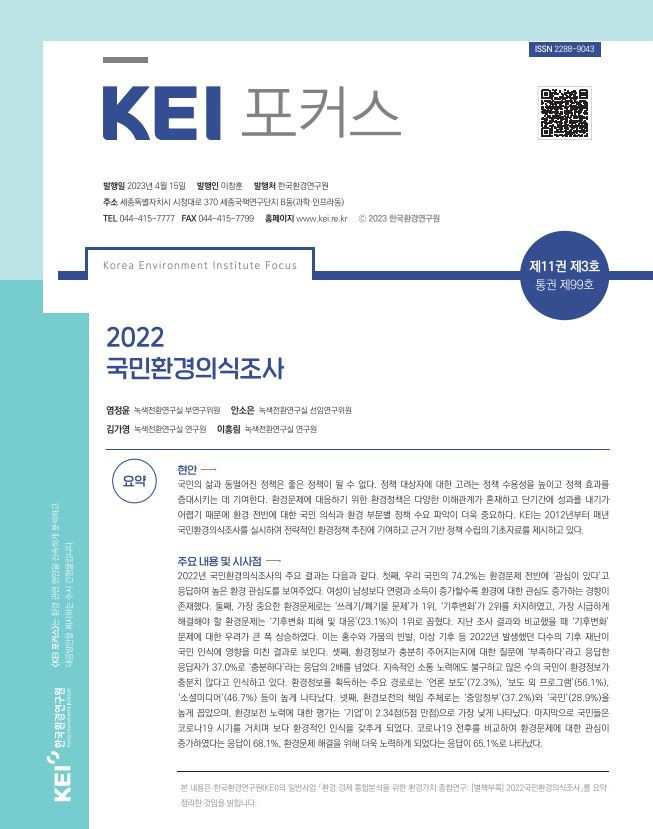 2022 국민환경의식조사 (KEI 포커스 제11권 통권 99호) Année de publication: 2023 Auteur: 염정윤 | 안소은 | 김가영 | 이홍림 Auteur institutionnel: 한국환경연구원 국민 눈높이에 맞는 환경정책을 수립·지원하기 위해서는 환경 전반에 대한 국민의 인식과 환경 부문별 정책에 대한 수요 파악이 필수적이다. 더불어 환경정책의 효과성을 높이고 선제적이고 전략적인 정책 추진을 위해서는 국민들의 환경에 대한 의식 및 실천 의지를 통계화하는 작업이 지속적으로 추진되어야 한다. 이러한 필요에 따라 KEI는 2012년부터 매년 국민환경의식조사를 실시하고 결과를 분석·제시하고 있다.2022년 국민환경의식조사는 '환경인식', '환경태도/실천', '환경정보 이용', '환경 수요/정책' 등 기본 분야 4개 부분과 '코로나19' 관련 특별 분야에 대해 온라인으로 설문을 시행하였다. 본 저작물은 한국환경연구원에서 2023년 작성하여 공공누리 제4유형으로 개방한 '2022 국민환경의식조사(작성자: 염정윤)'을 이용하였으며, 해당 저작물은 한국환경연구원 홈페이지(https://www.kei.re.kr/)에서 무료로 내려받으실 수 있습니다.
  Экологическое образование как составная часть содержания высшего образования (Международный журнал гуманитарных и естественных наук; № 5-2 (92), 2024) Année de publication: 2024 Auteur: Жээнбек Сейталиевич Абдиев В статье автор особо подчеркивает, что экологическое образование и воспитание не может быть эффективным, не формируя соответствующим образом экологического мировоззрения. В этом контексте главной парадигмой экологического образования и воспитания в Кыргызстане является формирование экологической культуры населения.
 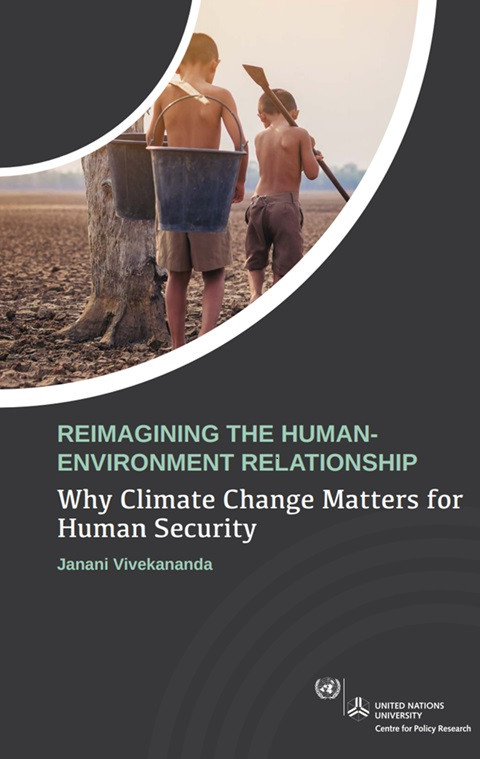 Why Climate Change Matters for Human Security Année de publication: 2022 Auteur: Janani Vivekananda Auteur institutionnel: United Nations University | United Nations Environment Programme (UNEP) This paper outlines the state of knowledge regarding security risks related to climate change, synthesizing the existing scientific evidence to set out five broad pathways of risk. Climate change itself is rarely a direct cause of conflict. Yet, there is ample evidence that its effects exacerbate important drivers and contextual factors of conflict and fragility, thereby challenging the stability of states and societies. Climate change impacts such as coral bleaching, diversity loss, and erratic rainfall can stress livelihoods and drive displacement, increase resource conflicts, and challenge the security and stability of people and states worldwide. Managing these security risks requires action across the entire impact chain: work to mitigate climate change; reducing its consequences on ecosystems; adapting socioeconomic systems; better management of climate-induced heightened resource competition; and strengthening governance and conflict management institutions. And every dimension of the response must be conflict-sensitive and climate proof. Without the right responses, climate change will mean more fragility, less peace and less security. But this paper sets out illustrative examples of how, with a greater understanding of how climate change interacts with social, political, economic and environmental drivers of conflict and fragility, we will be better placed to make the kind of risk-informed decisions is integral to achieving international peace and security.
 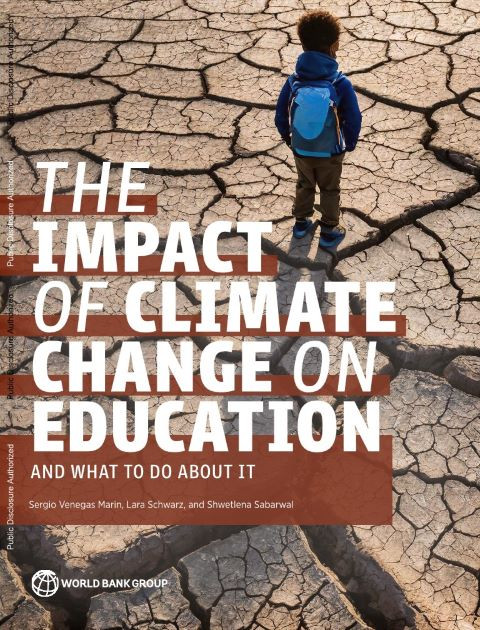 The Impact of Climate Change on Education and What to Do about It Année de publication: 2024 Auteur: Sergio Venegas Marin | Lara Schwarz | Shwetlena Sabarwal Auteur institutionnel: International Bank for Reconstruction and Development | World Bank Education can be the key to ending poverty in a livable planet, but governments must act now to protect it. Climate change is increasing the frequency and intensity of extreme weather events such as cyclones, floods, droughts, heatwaves and wildfires. These extreme weather events are in turn disrupting schooling; precipitating learning losses, dropouts, and long-term impacts. Even if the most drastic climate mitigation strategies were implemented, extreme weather events will continue to have detrimental impacts on education outcomes.
  Greening Education Partnership: Getting Every Learner Climate-Ready Année de publication: 2024 Auteur institutionnel: UNESCO Bangkok The UN Secretary-General calls the climate crisis ‘a battle for our lives’, as we still struggle to transform our societies to reach the 1.5°C-degree path recommended by the Paris Agreement. Rapid and radical transformation at all levels and in many aspects of our life is required, with education as a central and powerful means to support the adaptation and strengthening of the resilience of learners and societies. It is also important to ensure that education systems become more resilient to climate change to create safe and climate-proof schools. Building off of the knowledge and practice accumulated in Education for Sustainable Development (ESD), a new Greening Education Partnership aims to deliver strong, coordinated and comprehensive action which will prepare every learner to acquire the knowledge, skills, values, and attitudes to tackle climate change and to promote sustainable development.
  Diagnosing and Enhancing Environmental Literacy of Citizens to Raise Green Awareness Année de publication: 2021 Auteur: Jeongyoon Yeom | Namsoo Kim | Haengwoon Jeong | Woohyeon Jeong Auteur institutionnel: Korea Environment Institute (KEI) 1. Research purposeA nationwide consensus on the understanding on and necessity of the environmental policy is needed in order to successfully achieve the policy objectives.The necessity of environmental education is being highlighted but in reality, there is a lack of objectives and specific indicators to verify its effect.The goal of environmental education should be the expansion of environmental literacy and indicators to measure this should be developed. 2. Research scopeSummarize the concept of environmental literacy and develop the scales for adultsMeasure the level of environmental literacy of citizensConfirm the predictors and consequences of environmental literacyUnderstand citizen types via cluster analysis 시민 인식의 녹색 전환을 위한 환경 리터러시 진단 및 강화 방안 Année de publication: 2021 Auteur: 염정윤 | 김남수 | 정행운 | 정우현 Auteur institutionnel: 한국환경연구원 1. 연구의 필요성 및 목적 환경 정책이 성공적으로 정책 목표를 달성하기 위해서는 정책 이해와 필요성에 대한 범국민적 공감대가 필수 환경교육의 중요성을 강조하고 있지만 실질적으로 교육의 효과를 확인할 수 있는 객관적이고 구체적인 지표가 부재함 환경교육의 목표를 환경 리터러시의 증대로 설정하고 이를 측정할 지표 개발이 필요2. 연구의 범위 환경 리터러시 개념 정리 및 성인 대상의 측정 도구 개발 일반 시민의 환경 리터러시 수준 측정 환경 리터러시의 예측 요인과 결과 요인 확인 군집 분석을 통한 시민 유형 파악* 본 저작물은 한국환경연구원에서 '2021'년에 작성하여 공공누리 제'4'유형으로 개방한 ‘시민 인식의 녹색 전환을 위한 환경 리터러시 진단 및 강화 방안(작성자: 염정윤)’을 이용하였으며 해당 저작물은 한국환경연구원 홈페이지(http://www.kei.re.kr)’에서 무료로 다운받으실 수 있습니다.
  Envision 4.7: Bridge 47 Global Event; Helsinki, Finland 5–7 November 2019: Report Année de publication: 2019 Auteur institutionnel: Bridge 47 | Frinland. Ministry of Education and Culture | Finland. Ministry for Foreign Affairs Global event Envision 4.7 was held in Helsinki in November 2019. The event brought around 200 people together to discuss ways to take the SDG Target 4.7 forward. In this report you can find summaries of all the speeches, panel discussions, workshops and working groups that were held at the event, together with a summary of discussions around all the different topics. You can also find pictures and drawings from the event at the report.
  The Role of Digital Citizenship in the Use of Technology and Reducing the Risks Resulting from it (Alustath Journal for Human and Social Sciences; vol.59, no.3) Année de publication: 2020 Auteur: Amal Mohammed Abdullah Albado Auteur institutionnel: University of Baghdad. College of Education Ibn Rushd The current study aims to know the role of digital citizenship in the use of technology and reducing the risks resulting from it. The researcher uses the descriptive analytical approach and makes a questionnaire to know if there is a role for the digital citizenship in the use of technology and reducing the dangers caused by it. The study sample consists of (102) employees in the Ministry of Education Marka Brigade (the fourth Amman qasaba). The questionnaire consists of two main axes: the first axis, which is defined as the concept of digital citizenship, the second axis is the role of digital citizenship in the use of technology and reducing the dangers of technology. The results of the study show that the awareness of the sample of the study of the concept of digital citizenship is on a high level, on average that equals (3.887) of the Likert quinary scale and the standard deviation is equal to (0.97). The results also show a strong role for citizens in reducing the dangers caused by technology where the arithmetic mean equals (4.2) and the standard deviation was (0.94).