
Ressources
Explorez une large gamme de ressources sur le GCED afin d’approfondir votre compréhension et de renforcer vos activités de recherche, de plaidoyer, d’enseignement et d’apprentissage.
1,725 résultats trouvés
 La educación transformadora para la ciudadanía global en el sistema educativo español: Recomendaciones para su incorporación y abordaje Année de publication: 2022 Auteur: Fabiola Fares Sade | Carolina Del Río Usábel | Yénifer López Ramos | Marta Martín Pastor | Elisabet Santpere Baro Auteur institutionnel: Movement for Transformative Education and Global Citizenship El presente documento es el Informe correspondiente a la investigación encargada por el Movimiento por la Educación Transformadora y la Ciudadanía Global a la Universidad de Santiago de Compostela en el marco del convenio “Por una educación transformadora y para la Ciudadanía Global comprometida con el cumplimiento de los ODS” liderado por las ONGD Alboan, Entreculturas, InteRed y Oxfam Intermón que ha sido aprobado y financiado por la Agencia Española de Cooperación Internacional para el Desarrollo, AECID. Esta publicación pretende destacar los elementos más significativos del análisis y de las conclusiones obtenidas en la investigación, cuyo objetivo último es enunciar recomendaciones para la inclusión de los enfoques de la Educación Transformadora para la Ciudadanía Global en el sistema educativo formal. Estas recomendaciones buscan ser un aporte para el diálogo intersectorial entre los diferentes agentes con responsabilidades en el ámbito educativo, ya sea a nivel estatal así como autonómico.
  Six ways to ensure higher education leaves no one behind Année de publication: 2017 Auteur institutionnel: UNESCO International Institute for Educational Planning (IIEP) This policy paper, written in partnership with the UNESCO International Institute for Education Planning (IIEP), makes policy recommendations for equitable and affordable higher education to better support the implementation of the SDG agenda. To do this, it reviews recent trends in higher education expansion, identifies disparities in student participation, examines policy tools and practices for fostering equity, and explores ways to target assistance at those who need it most. Six façons de garantir que l'enseignement supérieur ne laisse personne sur le carreau Année de publication: 2017 Auteur institutionnel: UNESCO International Institute for Educational Planning (IIEP) This policy paper, written in partnership with the UNESCO International Institute for Education Planning (IIEP), makes policy recommendations for equitable and affordable higher education to better support the implementation of the SDG agenda. To do this, it reviews recent trends in higher education expansion, identifies disparities in student participation, examines policy tools and practices for fostering equity, and explores ways to target assistance at those who need it most. Seis maneras de asegurar que la educación superior no deje a nadie atrás Année de publication: 2017 Auteur institutionnel: UNESCO International Institute for Educational Planning (IIEP) This policy paper, written in partnership with the UNESCO International Institute for Education Planning (IIEP), makes policy recommendations for equitable and affordable higher education to better support the implementation of the SDG agenda. To do this, it reviews recent trends in higher education expansion, identifies disparities in student participation, examines policy tools and practices for fostering equity, and explores ways to target assistance at those who need it most.
  SDG-4: Flexible Learning Pathways in Higher Education – from Policy to Practice: An International Comparative Analysis Année de publication: 2022 Auteur: Michaela Martin | Uliana Furiv Auteur institutionnel: UNESCO International Institute for Educational Planning (IIEP) Higher education systems across the world are currently faced with a massive influx of learners with more diverse needs. They are expected to respond to this growing diversity through a more flexible learning offer and pathways that allow all learners, including those from disadvantaged groups, to access, progress through, and complete, higher education.To enhance knowledge on how to provide increased flexibility in higher education, IIEP–UNESCO undertook an international research project on SDG-4: Planning for Flexible Learning Pathways (FLPs) in Higher Education. The project included a stocktaking of policies, instruments, and practices, an international survey among UNESCO Member States, and eight in-depth country studies on Chile, Finland, India, Jamaica, Malaysia, Morocco, South Africa, and the UK.This book presents the findings from the research, including a cross-country analysis of available FLP policies and practices, and how they enhance equitable higher education systems. It also presents a series of country experiences with innovative approaches to alternative entry, flexible progression, and governance systems in support of FLPs.
  Learning Counts: Spotlight on Basic Education Completion and Foundational Learning in Africa, 2024 Année de publication: 2024 Auteur institutionnel: Global Education Monitoring Report Team | Association for the Development of Education in Africa (ADEA) | African Union The African Union’s designation of 2024 as the Year of Education highlights the critical importance of education for equipping young Africans with the skills essential for their own and for the continent’s development. It is also a recognition of the multiple challenges ahead before every child can complete primary school having acquire the foundational skills that open the door for lifelong learning. Currently the out-of-school population is rising, one in five children do not complete primary school and, of those who do, only about one in five achieve minimum proficiency in reading and mathematics. African countries have set targets on primary completion and foundational learning but to effectively translate their ambitions into results, the 2024 Spotlight continental report emphasizes the importance of coherence between their curricula, textbooks, teacher guides and assessments. It evaluates the alignment of these policy documents with each other but also with a global standard of what students are expected to know and by when. It also assesses how these key documents are used in classrooms and what the implications are for children’s opportunities to learn. This report is the second in a series of three envisaged between 2022 and 2025, each covering some 12 countries of which a selection is examined in depth, in dialogue with education ministries and national stakeholders. The focus countries for this second Spotlight report cycle were Mauritania, Niger, South Africa, Uganda, and Zambia. The statistics and analysis presented in this publication aim to feed into the policy dialogue mechanism under the auspices of the African Union and its Continental Education Strategy for Africa. In particular, the Spotlight series aims to spark debate on foundational learning among African countries and encourage them to identify areas for joined action, given that they share a lot of policy challenges.
  Shared Responsibility, Global Solidarity: Responding to the Socio-Economic Impacts of COVID-19 Année de publication: 2020 Auteur institutionnel: United Nations (UN) We are facing a global health crisis unlike any in the 75-year history of the United Nations — one that is killing people, spreading human suffering, and upending people’s lives. But this is much more than a health crisis. It is a human crisis. The coronavirus disease (COVID-19) is attacking societies at their core. The IMF has just reassessed the prospect for growth for 2020 and 2021, declaring that we have entered a recession – as bad as or worse than in 2009. The IMF projects recovery in 2021 only if the world succeeds in containing the virus and take the necessary economic measures.In the face of such an unprecedented situation in recent history, the creativity of the response must match the unique nature of the crisis – and the magnitude of the response must match its scale. No country will be able to exit this crisis alone.This report is a call to action, for the immediate health response required to suppress transmission of the virus to end the pandemic; and to tackle the many social and economic dimensions of this crisis. It is, above all, a call to focus on people – women, youth, low-wage workers, small and medium enterprises, the informal sector and on vulnerable groups who are already at risk.
 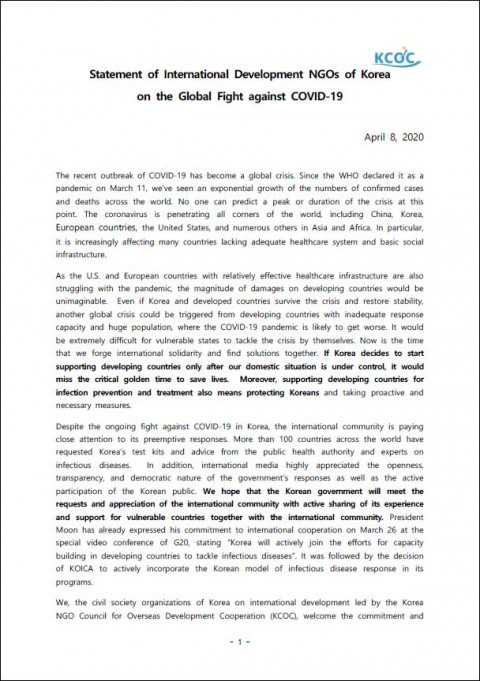 Statement of International Development NGOs of Korea on the Global Fight against COVID-19 Année de publication: 2020 Auteur institutionnel: Korea NGO Council for Overseas Development Cooperation (KCOC) The recent outbreak of COVID-19 has become a global crisis. Since the WHO declared it as a pandemic on March 11, we’ve seen an exponential growth of the numbers of confirmed cases and deaths across the world. No one can predict a peak or duration of the crisis at this point.As the U.S. and European countries with relatively effective healthcare infrastructure are also struggling with the pandemic, the magnitude of damages on developing countries would be unimaginable. It would be extremely difficult for vulnerable states to tackle the crisis by themselves. Now is the time that we forge international solidarity and find solutions together. 국제사회의 코로나19 퇴치를 위한 한국 국제개발협력 시민사회단체들의 호소문 Année de publication: 2020 Auteur institutionnel: Korea NGO Council for Overseas Development Cooperation (KCOC) 코로나19가 전 지구적 위기로 다가왔습니다. 지난 3월 11일 세계보건기구(WHO)가 팬데믹을 선언한 이래, 전 세계 확진자 및 사망자의 수가 기하급수적으로 증가하고 있고, 그 정점이 어디인지, 언제까지 이 사태가 계속될지 누구도 예측하지 못하는 상황입니다.보건 의료 인프라가 잘 갖춰진 미국과 유럽에서조차 팬데믹의 영향이 심각한 상황임을 감안할 때, 향후 개발도상국(이하 개도국)이 받게 될 피해의 정도를 가늠하기 어렵습니다. 취약한 나라일수록 스스로의 노력만으로 현 위기 상황을 타개하기란 매우 어렵기에 우리는 지금부터 국제적으로 연대하고 공동으로 해결방안을 모색해야 합니다. 또한 개도국의 감염예방 및 치료를 돕는 것이 곧 우리의 안전을 지키는 일이며, 필수적이고도 선제적인 예방책이 될 것이라는 점을 기억해야 합니다.
 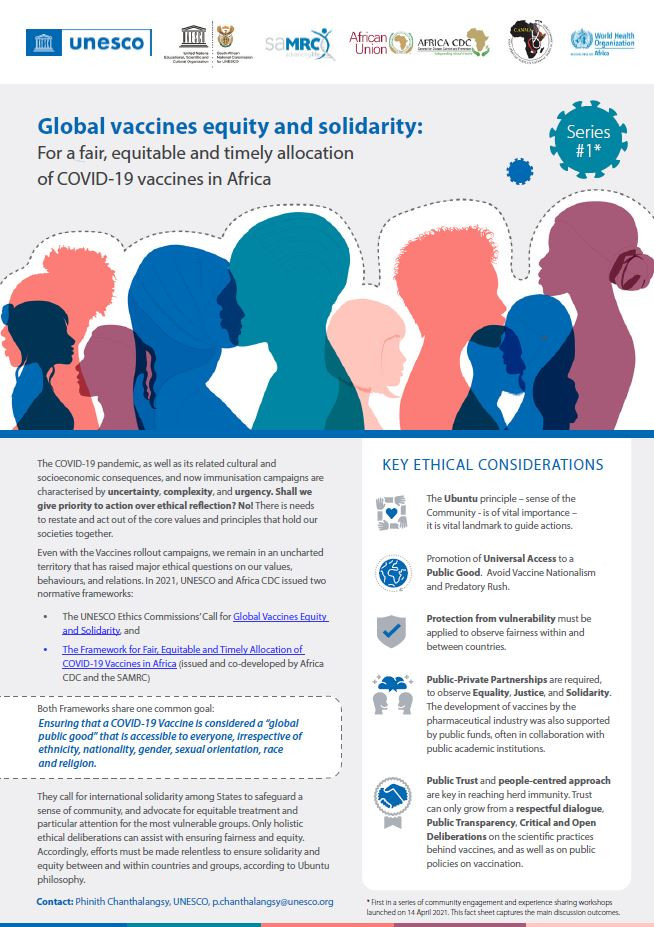 Global Vaccines Equity and Solidarity: For a Fair, Equitable and Timely Allocation of COVID-19 Vaccines in Africa; Series #1 Année de publication: 2021 Auteur institutionnel: UNESCO Harare African populations have been side-lined through the COVID-19 Vaccination roll-out process. A vaccination timeline taking Africa into 2023 would be unethical. African countries need to invest in their own structures and stop relying on colonial structures. There is a moral obligation to safeguard the population through equal distribution. This not only makes moral and ethical sense but also scientific and economic sense as a slow roll out in Africa will impact the rest of the world. First in a series of community engagement and experience sharing workshops launched on 14 April 2021. This fact sheet captures the main discussion outcomes.