
Ressources
Explorez une large gamme de ressources sur le GCED afin d’approfondir votre compréhension et de renforcer vos activités de recherche, de plaidoyer, d’enseignement et d’apprentissage.
1,725 résultats trouvés
 Addressing Hate Speech Through Education: A Guide for Policy-Makers Année de publication: 2023 Auteur institutionnel: UNESCO | UN. Office on Genocide Prevention and the Responsibility to Protect Hate speech is spreading faster and further than ever before as a result of social media user growth and the rise of populism. Both online and offline, hate speech targets people and groups based on who they are. It has the potential to ignite and fuel violence, spawn violent extremist ideologies, including atrocity crimes and genocide. It discriminates and infringes on individual and collective human rights, and undermines social cohesion. Education can play a central role in countering hateful narratives and the emergence of group-targeted violence. Educational responses to hate speech and all forms of hateful communication include:• Training teachers and learners on the values and practices related to being respectful global and digital citizens;• Adopting pedagogical and whole-school approaches to strengthening social and emotional learning;• Revising and reviewing curricula and educational materials to make them culturally responsive and to include content that identifies hate speech and promotes the right to freedom of expression;This policy guide developed by UNESCO and the United Nations’ Office on Genocide Prevention and the Responsibility to Protect explores these educational responses and provides guidance and recommendations to policy-makers on how to strengthen education systems to counter hate speech.
  Combatir el discurso de odio a través de la educación: una guía para los responsables de la formulación de políticas Année de publication: 2024 Auteur institutionnel: UNESCO | UN. Office on Genocide Prevention and the Responsibility to Protect Como producto de las redes sociales y del aumento del populismo, el discurso de odio se está difundiendo más rápido y con mayor alcance que nunca. Ya sea en línea o no, se dirige a las personas sobre la base de quiénes son y tiene el potencial de incitar a la violencia, así como engendrar ideologías extremistas y violentas, crímenes atroces e incluso el genocidio. Además, discrimina, infringe derechos humanos individuales y colectivos y socava la cohesión social.La educación puede cumplir un papel fundamental en la lucha contra los discursos de odio y el surgimiento de la violencia dirigida a grupos específicos. Las respuestas educativas al discurso de odio y a todas las formas de comunicación relacionadas incluyen:• La capacitación de docentes y estudiantes sobre los valores y las prácticas que necesitan para ser ciudadanos y ciudadanas respetuosos a nivel global y en el ámbito digital;• La adopción de pedagogías y enfoques escolares integrales para el fortalecimiento del aprendizaje social y emocional;• La adopción y revisión del currículo y de los materiales educativos para que sean culturalmente sensibles e incluyan contenido que identifique la presencia del discurso de odio y promueva el derecho a la libertad de expresión.Esta guía para la formulación de políticas, elaborada por la Oficina de las Naciones Unidas para la Prevención del Genocidio y la Responsabilidad de Proteger (OSAPG) y la UNESCO, analiza en detalle estas y otras respuestas educativas con la intención de brindar a las y los formuladores de políticas las orientaciones y recomendaciones sobre cómo fortalecer los sistemas educativos para combatir el discurso de odio.
  Lutter contre les discours de haine par l’éducation Année de publication: 2025 Auteur institutionnel: UNESCO | United Nations Office on Genocide Prevention and the Responsibility to Protect Lutter contre les discours de haine par l’éducationLes discours de haine se propagent plus vite et plus loin que jamais du fait de l’augmentation du nombre d’utilisateurs des médias sociaux et de la montée du populisme. En ligne comme hors ligne, les discours de haine ciblent des personnes et des groupes sur la base de ce qu’ils sont. Ces discours sont susceptibles d'inciter et d’attiser la violence et d’engendrer des idéologies extrémistes violentes, pouvant mener à des atrocités criminelles et des génocides. Ils sont discriminatoires, portent atteinte aux droits humains individuels et collectifs et menacent la cohésion sociale.L’éducation peut jouer un rôle essentiel dans la lutte contre les discours de haine et l’émergence de violences visant des groupes particuliers. Les réponses éducatives aux discours de haine et à toutes les formes de communication haineuse comprennent :• la formation des enseignants et des apprenants aux valeurs et aux pratiques permettant d’être des citoyens du monde et des citoyens numériques respectueux ;• l'adoption d'approches scolaires globales et pédagogiques pour renforcer l’apprentissage social et émotionnel ;• l'examen et la révision des programmes scolaires et des supports pédagogiques pour les rendre culturellement adaptés et inclure des contenus qui permettent d'identifier les discours de haine et promeuvent le droit à la liberté d’expression.Ce guide stratégique, élaboré par l’UNESCO et le Bureau de la prévention du génocide et de la responsabilité de protéger des Nations Unies, analyse ces réponses éducatives et fournit des conseils et des recommandations aux décideurs politiques sur la manière de renforcer les systèmes éducatifs pour lutter contre les discours de haine.
 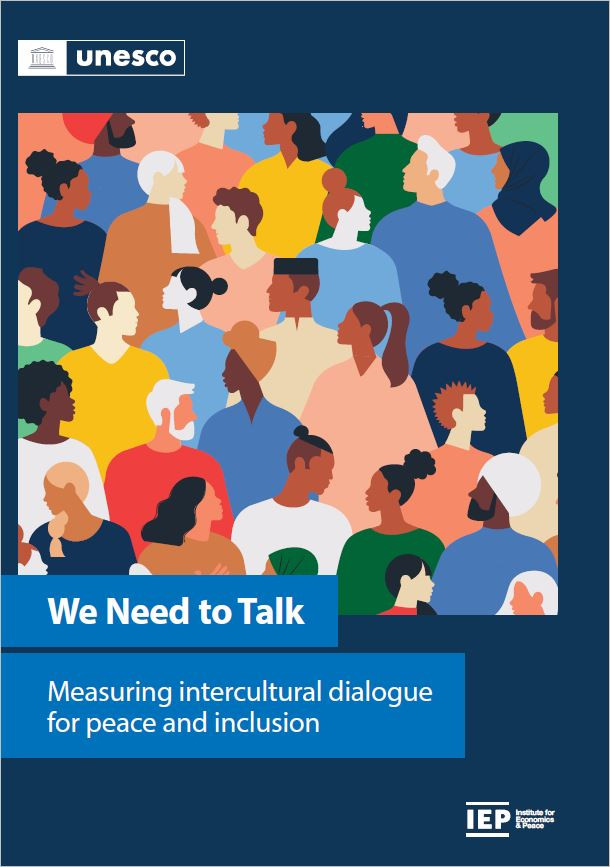 We Need to Talk: Measuring Intercultural Dialogue for Peace and Inclusion Année de publication: 2022 Auteur institutionnel: UNESCO | Institute for Economics and Peace An analysis into the power of intercultural dialogue and the new UNESCO Framework for Enabling Intercultural Dialogue, We Need to Talk presents the first evidence of the link between intercultural dialogue and peace, conflict prevention and non-fragility, and human rights. Using data covering over 160 countries in all regions, the report presents a framework of the structures, processes and values needed to support intercultural dialogue, examining the dynamics and interlinkages between them to reveal substantial policy opportunities with broad spanning benefits. Providing policy support and guidance, the report also includes information on regional trends as well as deep diving case studies.The data, case studies, and think pieces contained in this report highlight key policy and intervention opportunities for intercultural dialogue as an instrument for inclusion, peace and wider societal benefits. Policy makers, development workers, peace and security actors, academics and more are invited to leverage the analysis in this report and findings of the Framework to strengthen intercultural dialogue around the world. Parlons-en : mesurer le dialogue interculturel pour la paix et l’inclusion Année de publication: 2022 Auteur institutionnel: Organisation des Nations Unies pour l'éducation, la science et la culture (UNESCO) | Institute for Economics and Peace Parlons-en ! Alors que le monde devient de plus en plus interconnecté, l’amélioration des capacités à engager et à mener un dialogue efficace est nécessaire afin de relever les défis mondiaux. Actuellement, 1,5 milliard de personnes vivent dans des pays où le dialogue interculturel est faible et où les enjeux mondiaux tels que la pauvreté absolue, le terrorisme et les déplacements forcés de population sont plus répandus. Pour forger une coopération efficace et maintenir la paix, le renforcement du dialogue interculturel doit être une priorité.Pour la première fois, Parlons-en présente des preuves empiriques du lien entre le dialogue interculturel et la paix, la prévention de conflits, la non-fragilité, ainsi que les droits de l'Homme. En s'appuyant sur les données innovantes du nouveau Cadre de l'UNESCO pour favoriser le dialogue interculturel, ce rapport met en évidence les principales politiques et opportunités d'intervention pour le dialogue interculturel en tant qu'instrument d'inclusion et de paix.À l'aide de données couvrant plus de 160 pays dans toutes les régions, le rapport présente un cadre des structures, des processus et des valeurs nécessaires pour soutenir le dialogue interculturel, en examinant les dynamiques et les liens entre eux pour révéler des opportunités politiques substantielles aux avantages étendus.Les décideurs politiques, les agents de développement, les acteurs de la paix et de la sécurité, les universitaires et bien d'autres sont invités à tirer parti de l'analyse de ce rapport et des conclusions du Cadre pour renforcer le dialogue interculturel à travers le monde.Ensemble, parlons-en !
  Social Media 4 Peace Année de publication: 2021 Auteur institutionnel: UNESCO | European Union (EU) The overall objective of the UNESCO project 'Social Media 4 Peace' funded by the European Union is to strengthen the resilience of societies to potentially harmful content spread online, in particular hate speech inciting violence while protecting freedom of expression and enhancing the promotion of peace through digital technologies, notably social media. For more information, please visit:https://en.unesco.org/social-media-4-peace
  Reimaginar juntos nuestros futuros: un nuevo contrato social para la educación Année de publication: 2021 Auteur institutionnel: International Commission on the Futures of Education | UNESCO Nuestra humanidad y el planeta Tierra están bajo amenaza. La pandemia solo ha servido para demostrar nuestra fragilidad y nuestra interconexión. Ahora se necesita una acción urgente, tomada en conjunto, para cambiar el rumbo y reimaginar nuestro futuro. Este informe de la Comisión Internacional sobre el Futuro de La educación reconoce el poder de la educación para generar cambios profundos. Nos enfrentamos al doble desafío de cumplir la promesa incumplida de garantizar el derecho a una educación de calidad para todos los niños, niñas, jóvenes y adultos y realizar plenamente el potencial transformador de la educación como vía para futuros colectivos sostenibles Para ello, necesitamos un nuevo contrato social para la educación que pueda reparar las injusticias mientras transforma el futuro. Este nuevo contrato social debe fundamentarse en los derechos humanos y basarse en los principios de no discriminación, justicia social, respeto por la vida, la dignidad humana y la diversidad cultural. Debe abarcar una ética del cuidado, la reciprocidad y la solidaridad. Debe fortalecer la educación como un esfuerzo público y un bien común. Este informe, que se preparó durante dos años y se basó en un proceso de consulta global en el que participaron alrededor de un millón de personas, invita a los gobiernos, instituciones, organizaciones y ciudadanos de todo el mundo a forjar un nuevo contrato social para la educación que nos ayudará a construir un futuro pacífico, justo y futuros sostenibles para todos. Las visiones, principios y propuestas que aquí se presentan son meramente un punto de partida. Traducirlos y contextualizarlos es un esfuerzo colectivo. Ya existen muchos puntos brillantes. Este informe intenta capturarlos y construir sobre ellos. No es ni un manual ni un anteproyecto, sino la apertura de una conversación vital. Repenser nos futurs ensemble: Un nouveau contrat social pour l'éducation Année de publication: 2021 Auteur institutionnel: International Commission on the Futures of Education | UNESCO L’avenir de l’humanité sur la planète est, nous le savons aujourd’hui, compromis. La pandémie a eu au moins le mérite de démontrer combien nos existences sont fragiles et combien nos destins sont inextricablement liés. Il est nécessaire et urgent désormais, d’agir collectivement pour changer de cap et réinventer notre avenir. Dans ce tournant, l’éducation jouera un rôle crucial pour sa capacité, universellement reconnue, à provoquer le changement. Mais pour jouer son rôle, elle devra surmonter un double défi : honorer, d’une part, sa plus vieille promesse, c’est-à-dire d’être effective et d’assurer le droit à une éducation de qualité pour chaque enfant, chaque jeune, chaque adulte partout à travers le monde ; et, d’autre part, assumer entièrement son potentiel transformateur, afin d’ouvrir la voie vers un avenir collectif durable. Pour y parvenir, il convient de s’engager dans un nouveau contrat social pour l’éducation, qui permette de corriger les injustices tout en transformant l’avenir.Ce nouveau contrat social doit être enraciné dans les droits humains et être fondé sur les principes de non- discrimination, de justice sociale, de respect de la vie, de la dignité humaine et de la diversité culturelle ; il doit aussi s’appuyer sur une éthique de la sollicitude, de la réciprocité et de la solidarité ; il doit enfin renforcer l’éducation comme projet public et un bien commun de l’humanité.Le présent rapport, préparé durant deux ans et qui a pu s’appuyer sur une consultation mondiale de près d’un million de personnes, invite les gouvernements, les partenaires et les citoyens du monde entier à élaborer un nouveau contrat social en faveur de l’éducation, pour construire un avenir pacifique, juste et durable pour toutes et tous.Les conceptions, les principes et les propositions avancés ici ne constituent qu’un point de départ. Seul un effort collectif pourra les traduire en actes et les adapter aux situations locales. Il existe en effet de vraies lueurs d’espoir. Ce rapport essaie de les ressaisir afin que l’avenir se construise sur ces fondations. Qu’on n’y voit donc pas un manuel ou un plan directeur : c’est le début d’une conversation vitale.
  Inclusive Early Childhood Care and Education: From Commitment to Action Année de publication: 2023 Auteur institutionnel: UNESCO The development of inclusive programmes and services for early childhood care and education is a priority of Sustainable Development Goal 4 on education to which the international community has committed itself to achieve by 2030.This publication calls for a renewed global commitment to early childhood inclusion through the presentation of qualitative and quantitative data and action-oriented thinking. It presents lessons from country practices and recent research to provide policy-makers, partners, and ECCD practitioners with guidelines for action.The publication contains key messages that stakeholders can draw upon for actions that address the diversity and trajectory of each child. Pour une inclusion dans l’éducation dès la petite enfance: De l’engagement à l’action Année de publication: 2023 Auteur institutionnel: Organisation des Nations Unies pour l'éducation, la science et la culture (UNESCO) Développer des programmes et offrir des services inclusifs pour l’éducation et la protection de la petite enfance est une priorité de l’Objectif de développement 4 sur l’éducation que la communauté internationale s’est engagée à atteindre en 2030.Cette publication appelle à un engagement mondial renouvelé en faveur de l’inclusion dès la petite enfance par la présentation de données qualitatives et quantitatives et des réflexions orientées vers l’action. Elle présente des leçons tirées de pratiques de divers pays, ainsi que des travaux de recherche récents, afin d’offrir aux décideurs politiques, aux partenaires et aux praticiens de la petite enfance des repères pour l’action.La publication contient des messages clés que les parties prenantes pourront s’approprier pour mener des actions qui tiennent compte de la diversité et du parcours de chaque enfant.