
Ressources
Explorez une large gamme de ressources sur le GCED afin d’approfondir votre compréhension et de renforcer vos activités de recherche, de plaidoyer, d’enseignement et d’apprentissage.
3,446 résultats trouvés
 服务型政府建设中公民参与问题研究——以仪陇县为例 Année de publication: 2020 Auteur: Luo Jian 本文以中国某县为案例,讨论中国地方政府转型过程中公民参与的作用以及存在问题,并提出了相应对策,尤其是需要加强公民参与教育。
  The Idea and Innovation of Digitized Public Participation Année de publication: 2016 Auteur: Ji Yuanyuan This paper analyses the existing problems of public participation in public affairs through digitial tools and provides suggestions for improvement. 数字化公众参与的理念与创新 Année de publication: 2016 Auteur: Ji Yuanyuan 本文分析了当前中国民众通过数字方式参与政务的现状,探讨了现存为题,并为民主型政府转型提出了相关改善建议。
  Democratic Elections and Meritocracy in the Perspective of Public Choice Theory Année de publication: 2020 Auteur: Meng Lingguang This paper analyses the the pros and cons of two political systems based on the idea of democracy and meritocracy respectivey, and discusses the possibility of combining the two. 公共选择理论视角下的民主选举与贤能政治 Année de publication: 2020 Auteur: Meng Lingguang 本文探讨了民主政治和贤能政治两种政治体制的优缺点,并探讨二者的有机结合。
  The Forms and Continuing Challenges of Citizens E-Participation from the View of E-Governance Année de publication: 2013 Auteur: Xiong Li This paper discusses civic participation through ICT in the context of e-governance and analyses the chanllenges to a form of e-democracy. 电子治理视角下公民电子政治参与形式及持续挑战 Année de publication: 2013 Auteur: Xiong Li 本文探讨电子治理背景下公民通过电子信息技术参与政治,实现电子信息民主化的形式,以及这一过程所面临的挑战。
 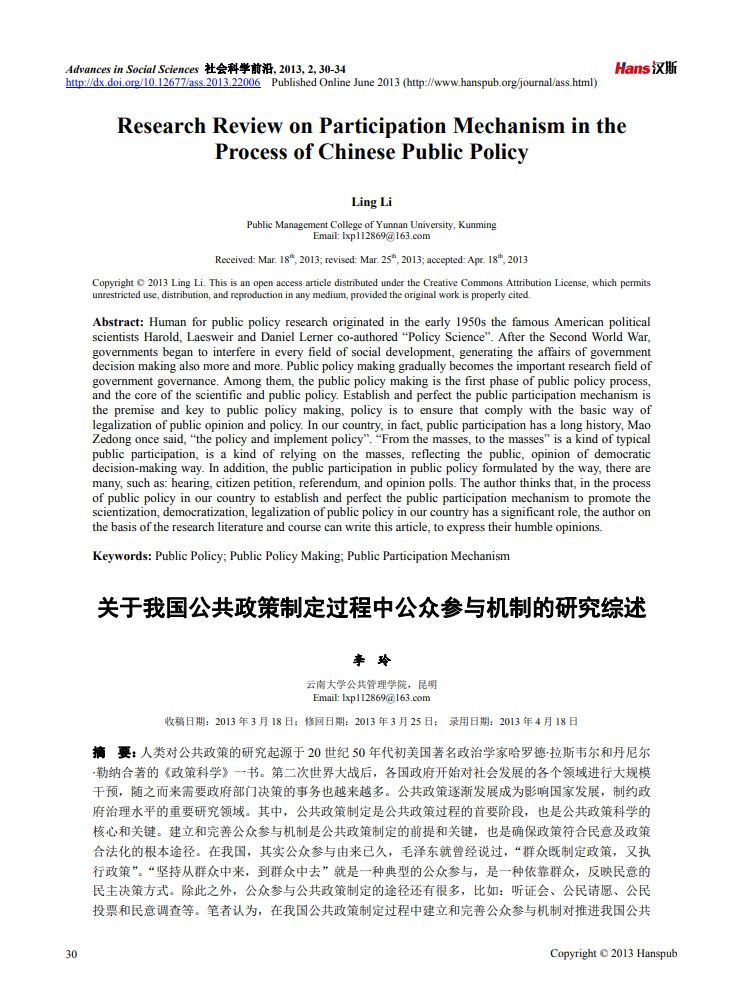 Research Review on Participation Mechanism in the Process of Chinese Public Policy Année de publication: 2013 Auteur: Li Ling This paper discusses the mechanism of public participation in public policy-making, and analyses the existing problems as well as possible solutions.
 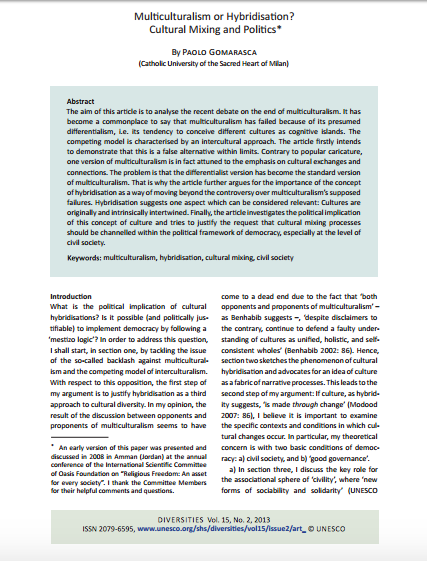 Multiculturalism or Hybridisation?: Cultural Mixing and Politics Année de publication: 2013 Auteur: Paolo Gomarasca The aim of this article is to analyse the recent debate on the end of multiculturalism. It has become a commonplace to say that multiculturalism has failed because of its presumed differentialism, i.e. its tendency to conceive different cultures as cognitive islands. The competing model is characterised by an intercultural approach. The article firstly intends to demonstrate that this is a false alternative within limits. Contrary to popular caricature, one version of multiculturalism is in fact attuned to the emphasis on cultural exchanges and connections. The problem is that the differentialist version has become the standard version of multiculturalism. That is why the article further argues for the importance of the concept of hybridisation as a way of moving beyond the controversy over multiculturalism’s supposed failures. Hybridisation suggests one aspect which can be considered relevant: Cultures are originally and intrinsically intertwined. Finally, the article investigates the political implication of this concept of culture and tries to justify the request that cultural mixing processes should be channelled within the political framework of democracy, especially at the level of civil society. 关于我国公共政策制定过程中公众参与机制的研究综述 Année de publication: 2013 Auteur: Li Ling 本文探讨中国公共政策制定过程中的公共参与机制,并分析了存在的问题以及改进措施。