
Ressources
Explorez une large gamme de ressources sur le GCED afin d’approfondir votre compréhension et de renforcer vos activités de recherche, de plaidoyer, d’enseignement et d’apprentissage.
1,180 résultats trouvés
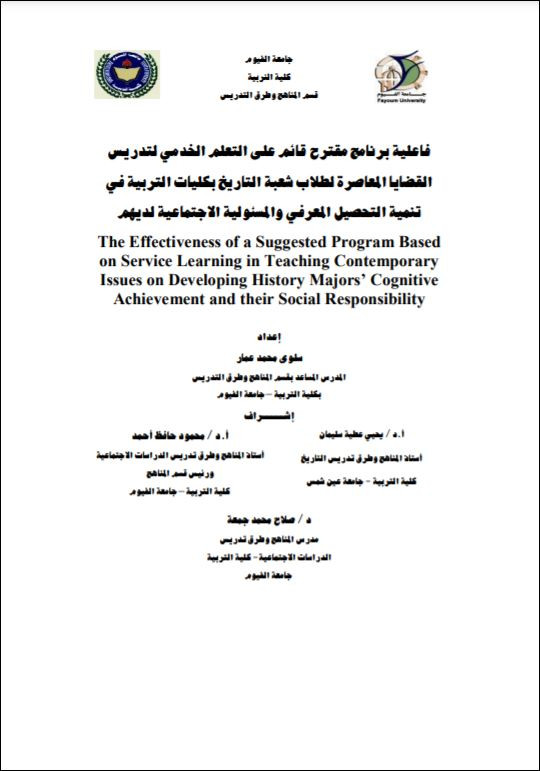 فاعلية برنامج مقترح قائم على التعلم الخدمي لتدريس القضايا المعاصرة لطلاب شعبة التأريخ بكليات التربية في تنمية التحصيل المعرفي والمسؤولة الاجتماعية لديهم Année de publication: 2016 Auteur: Salwa Ammar | Yahya Sulaiman | Mahmoud Ahmed | Salah Juma Auteur institutionnel: Fayoum University تسعى هذه الدراسة لتقييم فاعلية برنامج قائم على التعلم الخدمي لتدريس القضايا المعاصرة لطلاب شعبة التأريخ. وتبحث في تأثير هذا البرنامج في تنمية التحصيل المعرفي والمسؤولية الاجتماعية. وتبدأ الدراسة بوصف أسس ومكونات البرنامج التدريبي. The Effectiveness of a Proposed Program Based on Service Learning for Teaching Contemporary Issues to Students of the History Division in the Faculties of Education in Developing Their Cognitive Achievement and Social Responsibility Année de publication: 2016 Auteur: Salwa Ammar | Yahya Sulaiman | Mahmoud Ahmed | Salah Juma Auteur institutionnel: Fayoum University This study seeks to evaluate the effectiveness of a service-based learning program for teaching contemporary issues to students of the history department. It examines the impact of this program on the development of cognitive achievement and social responsibility. The study begins with a description of the foundations and components of the training program.
 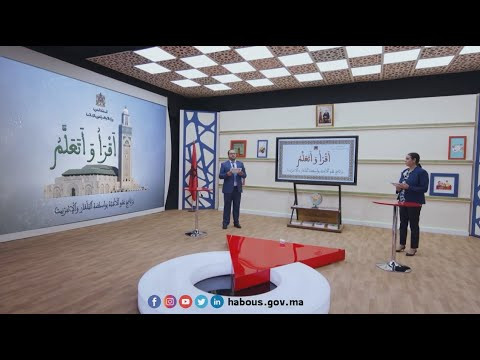 محو الأمية بواسطة التلفازوالانترنت Année de publication: 2020 Auteur institutionnel: Morocco. Ministry of Awqaf and Islamic Affairs يتضمن الفيديو تعريف ببرنامج محو الأمية بواسطة التلفاز والأنترنيت ودوره في تعلم المواطنات والمواطنين في دولة المغرب. وقد انطلق برنامج محو الأمية بالمساجد منذ سنة 2000. ويتضمن مستويين المستوى الأول والمستوى الثاني ويستفيد منه كل سنة حوالي 300000 مواطن ومواطنة في دولة المغرب. Literacy through Television and the Internet Année de publication: 2020 Auteur institutionnel: Morocco. Ministry of Awqaf and Islamic Affairs The video includes a definition of the literacy program through television and the Internet and its role in the education of citizens in the State of Morocco. The literacy program in mosques was launched in the year 2000. It includes two levels, the first and the second, and every year about 300,000 citizens in the State of Morocco benefit from it.
 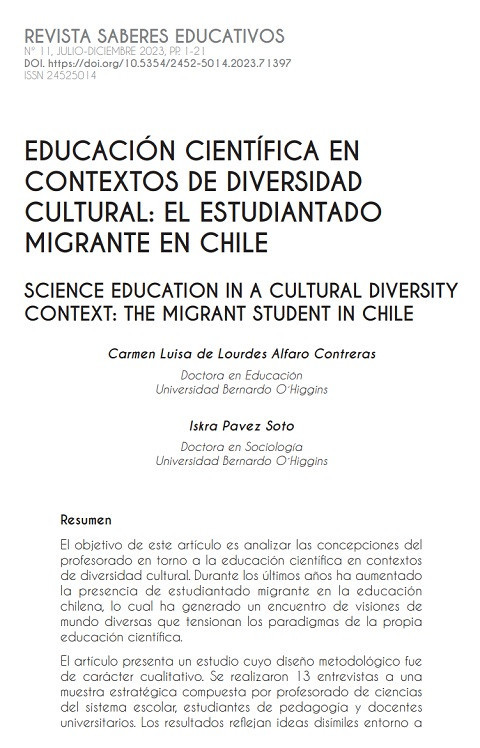 Science Education in a Cultural Diversity Context: The Migrant Student in Chile (Revista Saberes Educativos; July-Decembe, No.11) Année de publication: 2023 Auteur: Carmen Luisa Alfaro Contreras | Iskra Pavez Soto The aim of this article is to analyze teachers' conceptions of science education in contexts of cultural diversity. In recent years, the presence of migrant students in Chilean education has increased, which has generated a meeting of diverse world views that stress the paradigms of scientific education itself. The article presents a study whose methodological design was of a qualitative nature. 13 interviews were conducted with a strategic sample made up of science teachers from the school system, pedagogy students, and university professors. The results reflect dissimilar ideas about the relationship between science and culture, generating, on the one hand, a kind of invisibility or denial of diversity and, on the other, a recognition of a multiplicity of ways of building knowledge, approaching an intercultural view of science. Stereotyped ideas about the student body and the lack of training to deal with cultural diversity are recognized. The main difficulties are associated with the characteristics of the school system and the hegemonic and monocultural nature of the curriculum. It concludes with recommendations on the need for a postcolonial scientific education and to democratize knowledge, with a focus on student learning that allows the development of critical individuals. Educación científica en contextos de diversidad cultural: El estudiantado migrante en chile Année de publication: 2023 Auteur: Carmen Luisa Alfaro Contreras | Iskra Pavez Soto El objetivo de este artículo es analizar las concepciones del profesorado en torno a la educación científica en contextos de diversidad cultural. Durante los últimos años ha aumentado la presencia de estudiantado migrante en la educación chilena, lo cual ha generado un encuentro de visiones de mundo diversas que tensionan los paradigmas de la propia educación científica.
  Localización de los recursos de la INEE sobre PSS-SEL Année de publication: 2024 Auteur institutionnel: Harvard Graduate School of Education (HGSE) | Inter-agency Network for Education in Emergencies (INEE) En estos talleres, los participantes aprendieron cómo localizar los recursos de PSS-SEL de la INEE, incluyendo el Documento de referencia de la INEE sobre Apoyo psicosocial y psicoeducación en niños, niñas y jóvenes en situaciones de emergencia, la nota de orientación de la INEE sobre PSS, la Caja de herramientas de PSS-SEL, y la nota de orientación sobre bienestar docente en situaciones de emergencia, y cómo adaptarlos eficazmente a los distintos contextos.
 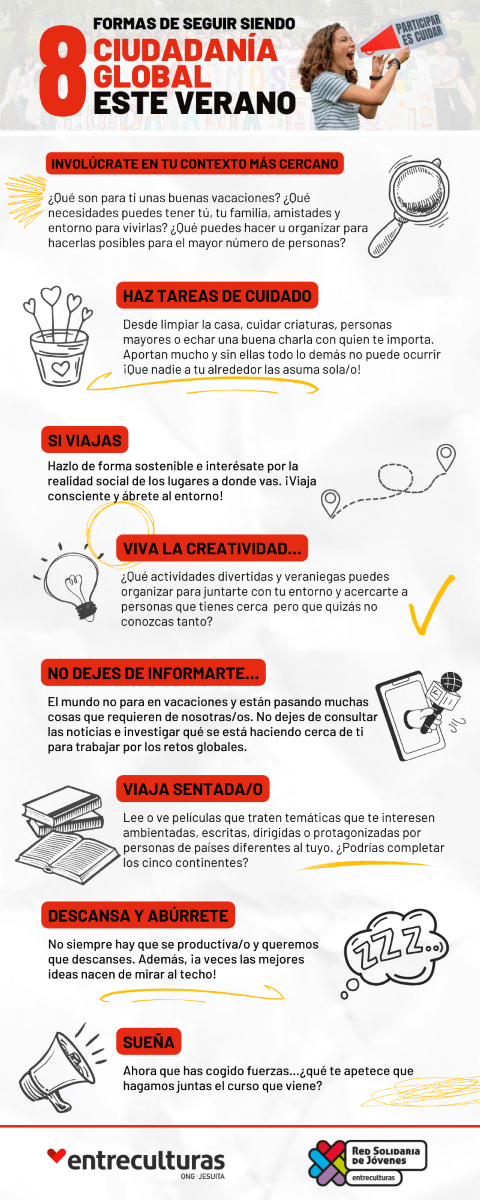 A Conscious Summer: 8 Ways to Remain a Global Citizen Année de publication: 2024 Auteur institutionnel: Entreculturas The holidays are here, and with them new ways of building global citizenship. Don't underestimate all that we can continue to do during the summer, through enjoyment, meeting and relaxation. In this infographic we present ideas to continue being global citizens. Go ahead and work on it with your groups and your environment! Un verano consciente: 8 formas de seguir siendo ciudadanía global Année de publication: 2024 Auteur institutionnel: Entreculturas Llegan las vacaciones, y con ellas nuevas maneras de construir ciudadanía global. No subestimes todo lo que, desde el disfrute, el encuentro y el descanso, podemos seguir haciendo durante el verano. En esta infografía presentamos ideas para seguir siendo ciudadanos globales. ¡Anímate a trabajarlo con tus grupos y tu entorno!
 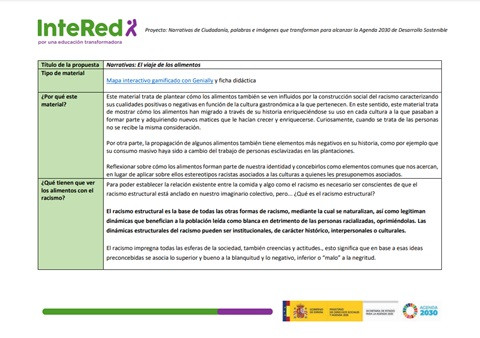 Narratives: The Journey of Food Année de publication: 2024 Auteur institutionnel: InteRed This is an interactive game that raises the question of how food is also influenced by the social construction of racism, characterising its positive or negative qualities, depending on the gastronomic culture to which it belongs. In this sense, this material tries to show how food has migrated throughout history, enriching its use in each culture it became part of and acquiring new nuances that made it grow and become richer. Curiously, when it comes to people, the same consideration is not given. On the other hand, the spread of some foods also has more negative elements in their history, such as the fact that their mass consumption has been in exchange for the work of enslaved people on plantations.