
Ressources
Explorez une large gamme de ressources sur le GCED afin d’approfondir votre compréhension et de renforcer vos activités de recherche, de plaidoyer, d’enseignement et d’apprentissage.
3,790 résultats trouvés
 Democratic Elections and Meritocracy in the Perspective of Public Choice Theory Année de publication: 2020 Auteur: Meng Lingguang This paper analyses the the pros and cons of two political systems based on the idea of democracy and meritocracy respectivey, and discusses the possibility of combining the two. 公共选择理论视角下的民主选举与贤能政治 Année de publication: 2020 Auteur: Meng Lingguang 本文探讨了民主政治和贤能政治两种政治体制的优缺点,并探讨二者的有机结合。
  The Forms and Continuing Challenges of Citizens E-Participation from the View of E-Governance Année de publication: 2013 Auteur: Xiong Li This paper discusses civic participation through ICT in the context of e-governance and analyses the chanllenges to a form of e-democracy. 电子治理视角下公民电子政治参与形式及持续挑战 Année de publication: 2013 Auteur: Xiong Li 本文探讨电子治理背景下公民通过电子信息技术参与政治,实现电子信息民主化的形式,以及这一过程所面临的挑战。
  Research Review on Participation Mechanism in the Process of Chinese Public Policy Année de publication: 2013 Auteur: Li Ling This paper discusses the mechanism of public participation in public policy-making, and analyses the existing problems as well as possible solutions.
  Development Strategy of Uzbekistan: Civil Society; Training and Methodology Complex Année de publication: 2019 Auteur: M.N. Primov | T. Norboev Auteur institutionnel: Uzbekistan. Ministry of Higher and Secondary-Specialized Education | Tashkent Institute of Finance The document is a collection of training materials on the conditions and prospects for the development of civil society in Uzbekistan, as well as the implementation of the main directions of the Action Strategy. The document also the role of local governments of citizens, non-governmental non-profit organizations in improving institutions civil society.A major role in this is played by new socio-political disciplines, which include the “Development Strategy of Uzbekistan. Civil society". This course reveals the basic scientific principles of the formation of civil society and the development strategy of Uzbekistan, analyzes the main stages of transformation, shows the irreversibility of the reforms carried out in the country, and helps to build the civic position of each member of the society. It is organically woven into the humanities system, forming a common logical chain with it; It helps to answer questions of modern policy of our state and to determine the place and role of each person in the grandiose transformations carried out in the country. Стратегия развития Узбекистана. Гражданское общество: Учебно-методический комплекс Année de publication: 2019 Auteur: M.N. Primov | T. Norboev Auteur institutionnel: Uzbekistan. Ministry of Higher and Secondary-Specialized Education | Tashkent Institute of Finance Документ является сборником учебных материалов, посвященных условиям и перспективам развития гражданского общества в Узбекистане, а также реализации основных направлений Стратегии действий. В документе также рассматривается роль органов местного самоуправления граждан, негосударственных некоммерческих организаций в совершенствовании институтов гражданского общества.Большую роль в этом играют новые социально-политические дисциплины, в число которых входит и «Стратегия развития Узбекистана. Гражданское общество». Данный курс раскрывает основные научные принципы формирования гражданского общества и стратегию развития Узбекистана, анализирует основные этапы преобразований, показывает необратимость проводимых в стране реформ, помогает формированию гражданской позиции каждого члена общества. Он органично вплетается в систему гуманитарных наук, образуя общую логическую цепь с ней; помогает ответить на вопросы современной политики нашего государства и определить место и роль каждого человека в грандиозных преобразованиях, проводимых в стране.
 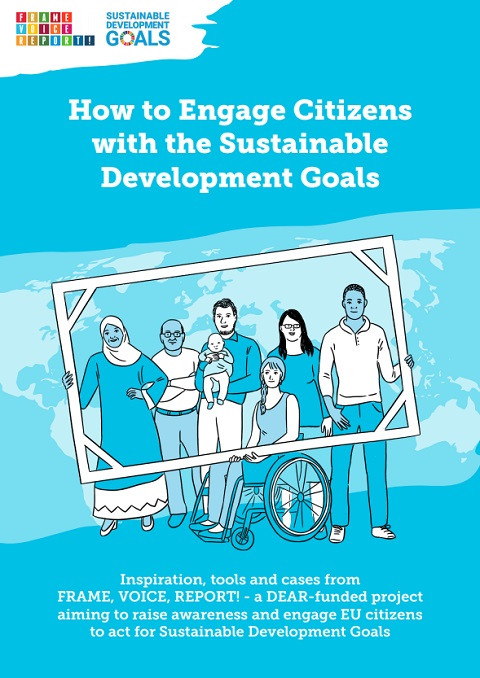 How to Engage Citizens with the Sustainable Development Goals Année de publication: 2020 Auteur institutionnel: Finnish Development NGOs Fingo The purpose of this booklet is to share reflections, successes and learning outcomes from the FRAME, VOICE, REPORT! (FVR) project.It can be used to find inspiration from other civil society organisations (CSOs) working on the same topics and themes you do, but also as a source for ideas for new ways of looking at old issues.This booklet covers both the more theoretical approaches and concrete cases from CSOs across Europe. These cases are examples of the many projects funded by the FVR.The project had its roots in the previous successes and tried and tested approaches of the partner organisations. The aim of FVR! was to secure resources and develop the value-based, high quality work of civil society organisations. The second aim was to enable smaller organisations to learn about EU project funding and to build capacity on how to conduct high quality global citizenship education and development communications. Finally, the overarching aim of the project was to engage EU citizens with the SDGs. 关于我国公共政策制定过程中公众参与机制的研究综述 Année de publication: 2013 Auteur: Li Ling 本文探讨中国公共政策制定过程中的公共参与机制,并分析了存在的问题以及改进措施。
  The Implications of the COVID-19 Pandemic on Fundamental Rights and Civic Space Année de publication: 2022 Auteur: Filip Pazderski | Giada Negri | Chayma Khazzani | Ivana Rosenzweigova | Boglarka Szalma | Luben Panov | Carlotta Besozzi Auteur institutionnel: European Economic and Social Committee (EESC) This report was compiled for the European Economic and Social Committee at the request of the Diversity Europe Group by a consortium of four partners - European Civic Forum, Civil Society Europe, European Center for Not-for-Profit Law and the Institute of Public Affairs. It examines how the COVID-19 pandemic has affected the work of civil society organisations (CSOs) across Europe. It also focuses on how solutions implemented in individual EU Member States have impacted CSOs' ability to exercise their fundamental rights and freedoms.The report is based on in-depth analysis of existing studies and reports, a survey, 29 expert interviews and three focus groups. It showcases a number of ways in which the pandemic has affected the functioning of civil society organisations in the EU. The observations emerging from the different stages of the research were characterised by a high degree of consistency, validating the picture depicted.