
Ressources
Explorez une large gamme de ressources sur le GCED afin d’approfondir votre compréhension et de renforcer vos activités de recherche, de plaidoyer, d’enseignement et d’apprentissage.
3,229 résultats trouvés
 UNESCO Green Citizens: Une voix globale pour des acteurs locaux du changement Année de publication: 2020 Auteur institutionnel: Organisation des Nations Unies pour l'éducation, la science et la culture (UNESCO) L’UNESCO lance l’initiative UNESCO Green Citizens, un projet phare visant à soutenir l’engagement des citoyens pour la planète. La campagne offre une voix globale aux acteurs locaux du changement, en mettant en lumière des projets citoyens innovants du monde entier.
  Changing Minds, Not the Climate: UNESCO Mobilizes to Address the Climate Crisis Année de publication: 2019 Auteur institutionnel: UNESCO The climate crisis is the challenge of the century. Scientific reports, including those of UNESCO, one after another describe increasingly pessimistic scenarios. All experts agree on one thing: we are in a race against time. A race to try to reserve our natural habitat in all of its beauty and diversity, to protect our ecosystems and natural resources and to pass them on to future generations. A race to mitigate the destructive effects of climate change and find the most appropriate innovative solutions.The disruptions caused by climate change are already part of our daily lives and trigger social, political, geopolitical and humanitarian upheavals. The climate crisis is not only threatening our ecosystems, it is also undermining fundamental rights, widening inequalities and creating new injustices. That is why ethical imperative must guide our action. Beyond the political and legal agreements essential to preparing for the future, change involves a shift in mindset, a different way of considering the place of humans in nature. This challenge mobilizes all resources, including education, research and creativity. It is an ethical and humanistic commitment. This is UNESCO’s mandate, and it is a matter of urgency. Changeons les esprits, pas le climat: l'UNESCO se mobilise face à la crise climatique Année de publication: 2019 Auteur institutionnel: Organisation des Nations Unies pour l'éducation, la science et la culture (UNESCO) La crise climatique est le défi du siècle. Les rapports scientifiques, dont ceux de l’UNESCO, se succèdent et dessinent des scénarios de plus en plus pessimistes. Tous les experts s’accordent sur une certitude : une course contre la montre est lancée. Une course pour tenter de préserver notre habitat naturel dans sa beauté et sa diversité, pour protéger nos ecosystèmes, nos ressources naturelles et les transmettre aux générations futures. Une course pour atténuer les effets destructeurs du changement climatique et trouver les solutions innovantes les plus appropriées.Ces dérèglements constituent déjà notre quotidien et provoquent des bouleversements sociaux, politiques, géopolitiques et humanitaires. La crise climatique ne met pas seulement en péril nos écosystèmes : elle ébranle certains droits fondamentaux, creuse des inégalités et crée de nouvelles injustices. C’est pourquoi l’exigence éthique doit orienter notre action. Bien au-delà des accords politiques et juridiques indispensables pour préparer l’avenir, le changement passe par une évolution des mentalités, une manière différente d’envisager la place de l’humain dans la nature. Ce défi mobilise toutes les ressources l’éducation, de la recherche, de la créativité. C’est un engagement éthique et humaniste.Tel est le mandat de l’UNESCO, et l’urgence aujourd’hui.
 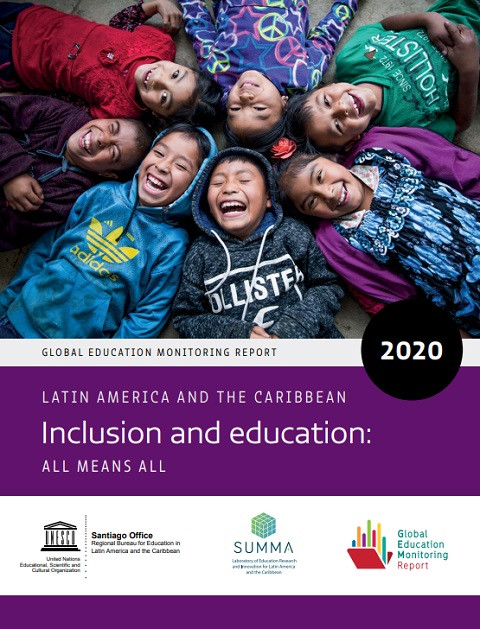 Latin America and the Caribbean 2020: Inclusion and Education; All Means All (Global Education Monitoring Report) Année de publication: 2020 Auteur institutionnel: Global Education Monitoring Report Team | UNESCO | Laboratory of Education Research and Innovation for Latin America and the Caribbean (SUMMA) Latin America and the Caribbean has the largest and most challenging socio-economic inequalities in the world, which have shaped its education systems over the decades. This report looks at everyone both in and excluded from education in the region, pinpointing barriers facing learners, especially when multiple disadvantages intersect. The report also explores challenges in education posed by COVID-19 and the need for urgent action to prevent an exacerbation of inequalities. Produced by the Global Education Monitoring (GEM) Report team, in partnership with the UNESCO Regional Bureau for Education in Latin America and the Caribbean (OREALC) and the Laboratory of Education Research and Innovation for Latin America and the Caribbean (SUMMA), the report assesses key solutions for greater inclusion through several case studies from the region. It provides in-depth analysis on challenges to inclusion in education arising from migration and displacement in Colombia and Costa Rica; remoteness in Brazil and Suriname; disability in Cuba and Nicaragua; gender in Peru and Jamaica; sexual orientation, gender identity and expression in Chile and Mexico; poverty in the Dominican Republic and Honduras; ethnicity in Bolivia and Ecuador; and incarceration in El Salvador and Uruguay. Building on the 2020 Global Education Monitoring Report, this regional edition concludes that strong laws and policies in Latin America and the Caribbean demonstrate a commitment to inclusion, but that the daily realities faced by learners suggest implementation is lagging. Recommendations are aimed at promoting more inclusive education systems to benefit all children and youth, no matter their background, identity or ability. The recommendations provide a systematic framework for identifying and dismantling barriers for vulnerable populations, according to the principle that ‘every learner matters and matters equally’. América Latina y el Caribe 2020: Inclusión y educación; Todos y todas sin excepción (Informe de seguimiento de la educación en el mundo) Année de publication: 2020 Auteur institutionnel: Global Education Monitoring Report Team | Organización de las Naciones Unidas para la Educación, la Ciencia y la Cultura (UNESCO) | Laboratory of Education Research and Innovation for Latin America and the Caribbean (SUMMA) América Latina y el Caribe es la región con las mayores y más tenaces desigualdades socioeconómicas del mundo. Durante decenios estas desigualdades se han reflejado en sus sistemas educativos. El presente informe examina a quiénes incluyen y a quiénes excluyen estos sistemas y llama la atención sobre las barreras que enfrentan los educandos, especialmente cuando están expuestos a múltiples desventajas. El informe también explora los nuevos retos educativos que plantea la pandemia de la Covid-19 y la necesidad de actuar sin dilación para evitar que se agraven las desigualdades. El informe, elaborado por el equipo del Informe de Seguimiento de la Educación en el Mundo (Informe GEM), en colaboración con la Oficina Regional de Educación para América Latina y el Caribe (OREALC/ UNESCO Santiago) y el Laboratorio de Investigación e Innovación en Educación para América Latina y el Caribe -SUMMA, evalúa algunas de las principales iniciativas emprendidas para mejorar la inclusión, basándose en varios estudios de casos de la región. Analiza en profundidad algunos ejemplos de los grandes desafíos que amenazan la inclusión en la educación: migración y desplazamiento en Colombia y Costa Rica; aislamiento rural en el Brasil y Suriname; discapacidad en Cuba y Nicaragua; discriminación de género en el Perú y Jamaica; orientación sexual e identidad y expresión de género en Chile y México; pobreza en la República Dominicana y Honduras; etnicidad en Bolivia y el Ecuador; y jóvenes en situación de privación de libertad en El Salvador y el Uruguay. Esta edición regional del Informe de Seguimiento de la Educación en el Mundo 2020 concluye que, si bien las leyes y políticas de América Latina y el Caribe demuestran la firme determinación de promover la inclusión, la realidad cotidiana de los alumnos y las alumnas sugiere que la aplicación práctica lleva retraso. Se formulan recomendaciones con el objeto de promover sistemas de educación más inclusivos en beneficio de todos los niños, niñas y jóvenes, sin distinción de origen, identidad o capacidad. Las recomendaciones brindan un marco sistemático que permite identificar y eliminar barreras para las poblaciones marginadas, conforme al principio de que “cada alumno es importante y todos los alumnos importan por igual”.
  Education for Sustainable Development: A Roadmap Année de publication: 2022 Auteur institutionnel: UNESCO This roadmap sets out the urgent challenges facing the planet and underlines the implementation of the new Education for Sustainable Development: Towards achieving the SDGs (ESD for 2030) framework, which was adopted with the aim of increasing the contribution of education to building a more just and sustainable world. ESD for 2030 will step up actions on five priority action areas on policy, education environments, building capacities of educators, youth and local level action, stressing further ESD’s key role for the successful achievement of the 17 SDGs and the great individual and societal transformation required to address the urgent sustainability challenges. The roadmap also underlines the key areas of implementation of the ESD for 2030 framework. ESD is widely recognized as an integral element of Agenda 2030, in particular Sustainable Development Goal 4 (SDG 4), and a key enabler of all the other SDGs. 지속가능발전교육(ESD): 로드맵 Année de publication: 2022 Auteur institutionnel: 유네스코 보다 공정하고 지속가능한 세상을 만드는 데 교육의 기여를 증진시키고자 채택한 이 로드맵은 세계가 직면한 긴급한 도전 과제를 설명하고, 새로이 수립된 체계인 ‘지속가능발전교육: 지속가능발전목표 달성을 향해’(Education for Sustainable Development: Towards achieving the SDGs), 즉 지속가능발전교육 2030의 이행을 강조한다. 지속가능발전교육 2030은 정책, 교육환경, 교육자 역량 구축, 청년 및 지역사회 차원의 실천이라는 5가지 우선 실천 영역에서의 이행을 강화시킬 것이다. 이들 활동은 17개 SDGs의 성공적인 달성과 더불어, 시급한 지속가능성 관련 도전과제들에 대응하는 데 필요한 개인과 사회의 큰 변혁을 위해 교육이 보다 핵심적인 역할을 담당할 것을 강조한다. 또한 이 로드맵은 지속가능발전교육 2030 체계 이행에서의 핵심 영역들을 강조한다. ESD는 2030 의제, 특히 SDG 4번 목표의 핵심요소이자 여타 SDGs의 핵심 추동력으로서 광범위하게 인식되고 있다.
  Reflect–Share–Act: A Guide to Community-based Education for Sustainable Development Année de publication: 2021 Auteur institutionnel: UNESCO | UNESCO Bangkok This guidebook aspires to build a community where learning for sustainable development takes place everywhere for everyone as an ongoing practice. It introduces you to Reflect-Share-Act, a process to discover and define sustainable development in your own contexts together with others in your community. The guide compiles resources that can support this learning process, including stories of various communities’ actual experiences of Reflect-Share-Act.
  Social and Psychological Determinants of Behavioral Changes in Girls and Women in STEM Education and STEM Employment Année de publication: 2023 Auteur: Victoria Alekseeva | Marietta Karamyan The objective of the research presented in the report is to examine the social and psychological determinants of behavioral change in girls and women in STEM professions to develop recommendations for engaging them in the professional field. Социальные и психологические детерминанты поведенческих изменений у девушек и женщин в STEM-образовании и STEM-занятости Année de publication: 2023 Auteur: Victoria Alekseeva | Marietta Karamyan The objective of the research presented in the report is to examine the social and psychological determinants of behavioral change in girls and women in STEM professions to develop recommendations for engaging them in the professional field.