
Ressources
Explorez une large gamme de ressources sur le GCED afin d’approfondir votre compréhension et de renforcer vos activités de recherche, de plaidoyer, d’enseignement et d’apprentissage.
884 résultats trouvés
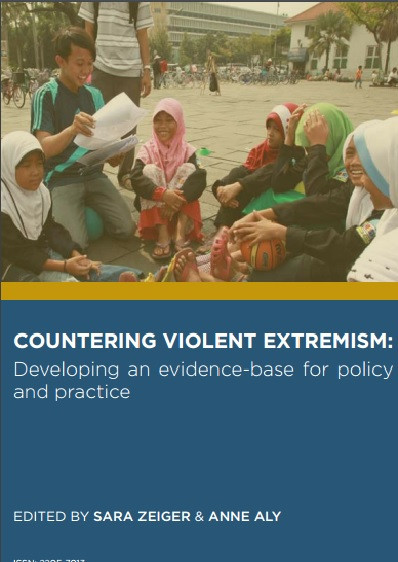 COUNTERING VIOLENT EXTREMISM: Developing an evidence-base for policy and practice Année de publication: 2015 Auteur: Sara Zeiger | Anne Aly Auteur institutionnel: Hedayah and Curtin University This volume reports on the range of papers presented at the Annual Countering Violent Extremism (CVE) Research Conference 2014 from 7-8 December 2014 in Abu Dhabi, United Arab Emirates. It presents two case studies on engaging with non-state actors within the community, namely families, community leaders and youth. COUNTERING VIOLENT EXTREMISM: Developing an evidence-base for policy and practice Année de publication: 2015 Auteur: Sara Zeiger | Anne Aly Auteur institutionnel: Hedayah | Curtin University Ce rapport présente une gamme des documents présentés à la Conférence annuelle de recherche sur la lutte contre l’extrémisme violent (CVE), qui a eu lieu du 7 au 8 décembre 2014 à Abou Dhabi, aux Emirats Arabes Unis. Il présente deux études de cas sur l’implication des acteurs non étatiques au sein de la communauté, à savoir les familles, les dirigeants communautaires et les jeunes.
  The SDGs and Cities INTERNATIONAL HUMAN MOBILITY Année de publication: 2018 Auteur institutionnel: International Centre for the Promotion of Human Rights | (ICPHR) The Handbook is to address new situations – and responses to these situations – generated by the global phenomenon of human mobility in urban spaces. Democracies are being threatened by the sustained growth of social gaps and the exclusion of vast sectors of the population from political systems and benefits of development, placing structural limits on the exercise of human rights. In this context, where new tensions and problems have arisen such as massive displacements of the population, the appearance of diverse types of extremism, of wars and conflicts and climate change in turn place these social sectors under conditions of structural inequality, exclusion and discrimination, as the main victims of human rights violations. This Handbook was prepared and published with the support and assistance of the UNESCO Sector for Social and Human Sciences through its Regional Science Bureau in Montevideo and the Latin American and Caribbean Coalition of Cities against Racism, Discrimination and Xenophobia.
 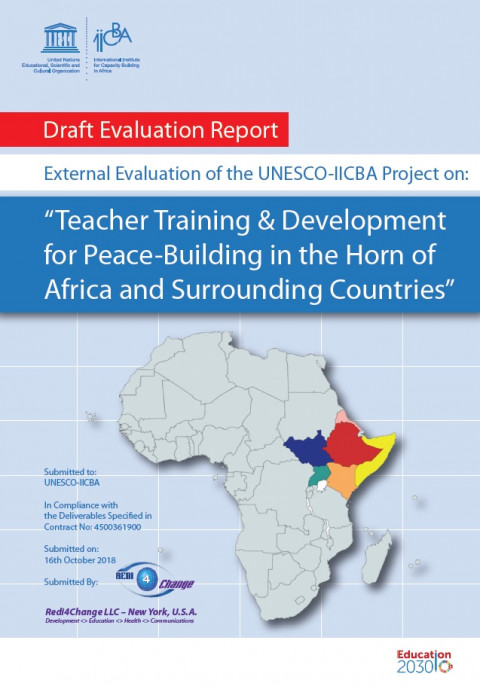 [Draft Evaluation Report] External Evaluation of the UNESCO-IICBA Project on: “Teacher Training & Development for Peace-Building in the Horn of Africa and Surrounding Countries” Année de publication: 2018 Auteur institutionnel: UNESCO International Institute for Capacity-Building in Africa (IICBA) The project on “Teacher Training and Development for Peace-Building in the Horn of Africa and Surrounding Countries” was designed by UNESCO-IICBA and financed by the Government of Japan. The project benefitted six conflict-affected countries; Ethiopia, Eritrea, Somalia, Kenya, Uganda, and South Sudan by building on the mandate and niche expertise of UNESCO-IICBA in teacher education, as well as benefiting from the empathetic insights and financing of the Government of Japan.This evaluation report analyses the design, implementation, and consolidation of the project to assess the likelihood that it can facilitate peace education as an effective and integral part of the national education systems. The project’s short timeframe and modest financing mean that the evaluation could not credibly deal with its outcomes and impact; but efforts are made to gauge the uptake and sustainability of this project as a vehicle for promoting peace education and so help to prevent violent conflict and cultivate a culture of peace in the countries concerned.
  The SDGs AND CITIES INTERNATIONAL HUMAN MOBILITY Année de publication: 2018 Auteur institutionnel: International Centre for the Promotion of Human Rights | (ICPHR) The Handbook is to address new situations – and responses to these situations – generated by the global phenomenon of human mobility in urban spaces. Democracies are being threatened by the sustained growth of social gaps and the exclusion of vast sectors of the population from political systems and benefits of development, placing structural limits on the exercise of human rights. In this context, where new tensions and problems have arisen such as massive displacements of the population, the appearance of diverse types of extremism, of wars and conflicts and climate change in turn place these social sectors under conditions of structural inequality, exclusion and discrimination, as the main victims of human rights violations. This Handbook was prepared and published with the support and assistance of the UNESCO Sector for Social and Human Sciences through its Regional Science Bureau in Montevideo and the Latin American and Caribbean Coalition of Cities against Racism, Discrimination and Xenophobia.
  Address by Irina Bokova, Director-General of UNESCO, on the occasion of the reception hosted by Ambassador Ronald Lauder, President of the World Jewish Congress Année de publication: 2017 Auteur institutionnel: UNESCO. Director-General, 2009-2017 (Bokova, I.G.) This address was delivered by Irina Bokova, Director-General of UNESCO, on the occasion of the reception hosted by Ambassador Ronald Lauder, President of the World Jewish Congress; New York, 17 September 2017.
  Before the Fire is Extinguished: The Commemoration Work at Nazi Memorial Sites as a Project of Political Learning Année de publication: 2003 Auteur: Peter Gstettner The original title: Bevor die Glut verlöscht: Die Erinnerungsarbeit an NS-Tatorten als ein Politisches Lernprojekt(In Jahrbuch für Pädagogik 2003)The author reflects upon his experience of reconstructing Nazi history in Germany. All efforts to spread light upon the dark sides of this history end up in the attempt to break the collective silence and to retune the song from “the good old times.” Memorial sites pedagogy and educational policies must decide the relevance of the past for the present, expose local Nazi history, and set the gaze, across the wall of silence, on the future. Tangible memory work and personal experiences of pain are steps towards makingxsubmerged memories, obliterated traces and forgotten places useful again for an education for democracy and tolerance. (Written by publisher) The above abstract is taken from the International Holocaust Remembrance Alliance Education Research Project. Please also consult the full list of abstracts in 15 languages and the accompanying publication Research in Teaching and Learning about the Holocaust: A Dialogue Beyond Borders. Ed: IHRA, Monique Eckmann, Doyle Stevick, Jolanta Ambrosewicz-Jacobs, 2017, Metropol Verlag at www.holocaustremembrance.com/resources/publications.
  Between Distanced Textual Analysis and Moral Judgment – an Excerpt from Mein Kampf in History Class Année de publication: 2002 Auteur: Oliver Hollstein The original title: Zwischen Distanzierter Textanalyse und Moralischer Verurteilung – ein Auszug aus Mein Kampf im Geschichtsunterricht(Pädagogische Korrespondenz, 29, pp. 70–87)This case study analyses how students in a German Upper Secondary class works with an excerpt from Mein Kampf in a thematic block about the Nazi state’s racist ideology and propaganda.The above abstract is taken from the International Holocaust Remembrance Alliance Education Research Project. Please also consult the full list of abstracts in 15 languages and the accompanying publication Research in Teaching and Learning about the Holocaust: A Dialogue Beyond Borders. Ed: IHRA, Monique Eckmann, Doyle Stevick, Jolanta Ambrosewicz-Jacobs, 2017, Metropol Verlag at www.holocaustremembrance.com/resources/publications.
 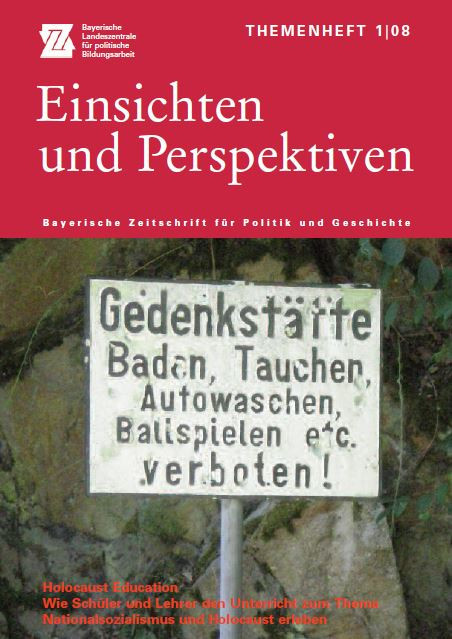 Holocaust Education: How Students and Teachers Experience Teaching and Learning about National Socialism and the Holocaust Année de publication: 2008 Auteur institutionnel: Bayerische Landeszentrale fürpolitische Bildungsarbeit The original title: Holocaust Education: Wie Schüler und Lehrer den Unterricht zum Thema Nationalsozialismus und Holocaust Erleben(Bayerische Zeitschrift für Politik und Geschichte, 1(8) [Themenheft Einsichten und Perspektiven]) Special issue of a Journal presenting several articles of a pilot study carried out in Bayern, focusing on the subjective experiences and representations of teachers and students when dealing with the Holocaust and with National Socialism. The above abstract is taken from the International Holocaust Remembrance Alliance Education Research Project. Please also consult the full list of abstracts in 15 languages and the accompanying publication Research in Teaching and Learning about the Holocaust: A Dialogue Beyond Borders. Ed: IHRA, Monique Eckmann, Doyle Stevick, Jolanta Ambrosewicz-Jacobs, 2017, Metropol Verlag at www.holocaustremembrance.com/resources/publications.
  Early Historical Learning about National Socialism and the Persecution of Jews: Family Conditions, Interests and Acquisition of Knowledge among Fourth Graders Année de publication: 2012 Auteur: Christina Klätte The original title: Frühes Historisches Lernen über Nationalsozialismus und Judenverfolgung: Familiäre Bedingungen, Interessen und Wissenserwerb bei Viertklässlern(Kinder und Zeitgeschichte: Jüdische Geschichte und Gegenwart, Nationalsozialismus und Antisemitismus Supplement 8, pp. 85–99) This is a quantitative study of German primary school children’s knowledge about the Holocaust. It demonstrates the importance of family background, family discussion and a general interest in history. It also displays how teachers’ willingness to bring up the Nazi period at a comparatively early age, among other things, depends upon the socio-economic status of the school children’s parents. The above abstract is taken from the International Holocaust Remembrance Alliance Education Research Project. Please also consult the full list of abstracts in 15 languages and the accompanying publication Research in Teaching and Learning about the Holocaust: A Dialogue Beyond Borders. Ed: IHRA, Monique Eckmann, Doyle Stevick, Jolanta Ambrosewicz-Jacobs, 2017, Metropol Verlag at www.holocaustremembrance.com/resources/publications.