
Ressources
Explorez une large gamme de ressources sur le GCED afin d’approfondir votre compréhension et de renforcer vos activités de recherche, de plaidoyer, d’enseignement et d’apprentissage.
1,726 résultats trouvés
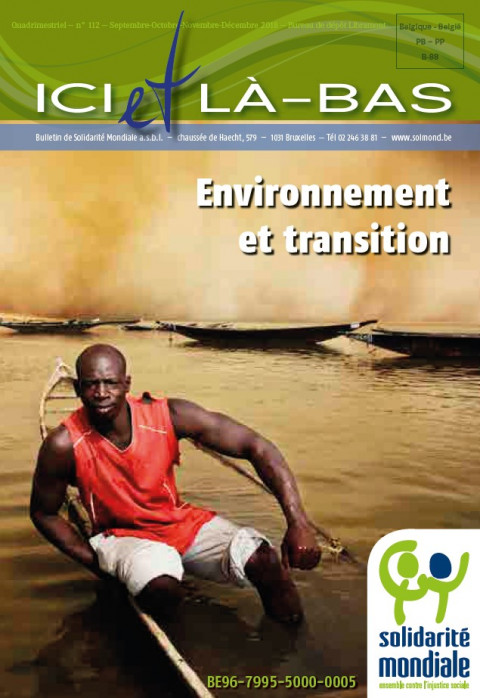 Environnement et transition (ici et là-bas) Année de publication: 2018 Auteur institutionnel: Solidarité mondiale Les « Objectifs de Développement Durable » (ODD), adoptés en 2015 par les Nations unies, nous obligent à transformer notre monde. Nous devons prendre d’urgence des mesures pour lutter contre les changements climatiques et leurs répercussions. Si l’action humaine est à la base de ces changements climatiques, elle doit aussi être à la base des solutions. Cette prise de conscience est un fil rouge dans le travail de notre organisation. Les mouvements des travailleurs et travailleuses ont l’obligation d’intégrer le respect de l’environnement dans leurs stratégies, car la planète fixe les limites de tout développement durable ! J’espère que les actions concrètes de nos collègues en Afrique, Amérique latine et en Asie présentées dans notre revue, vous serviront de source de motivation et d’inspiration. Ces bonnes pratiques illustrent que le monde du travail est en train de bâtir, pas à pas, le chemin vers des économies à faibles émissions de carbone. Les personnes en situation pré- caire sont les plus touchées par les changements climatiques. Face à ce constat, nous défendons aussi que les politiques de protection sociale peuvent à la fois contribuer au renforcement des capacités individuelles pour s’adapter, et à l’atténuation des effets dévastateurs de ces changements.
  Égalité hommes-femmes vs conscience environnementale: Scène de ménage inéluctable ou convergence des luttes ? Année de publication: 2018 Auteur: Solène Houzé Réduire son empreinte environnementale est un souci qui gagne chaque jour davantage de citoyens. On essaye de faire de son mieux, pour soi et pour la planète. Cela demande une adaptation pour toute une série de tâches domestiques et de gestes quotidiens (choix de l’alimentation, moyens de transports, zéro déchet, produits d’entretiens naturels, etc.). À l’heure où la répartition des tâches domestiques est encore bien souvent inégalement partagée entre hommes et femmes, il est légitime de s’interroger sur la pression qu’exerce la conscience écologique sur le quotidien des femmes au sein de la sphère privée. Les enjeux des rapports de genre se mêlent alors aux enjeux environnementaux. L’écoféminisme est un courant de pensée qui veut analyser le rapprochement entre ces deux combats. Quels sont donc les fondements de ce mouvement et comment l’action au quotidien pour la nature et le climat s’inscrit-elle dans les analyses écoféministes ? Cette analyse invite donc à discuter des bases genrées nécessaires à une transition verte et durable dans toutes ses dimensions.
 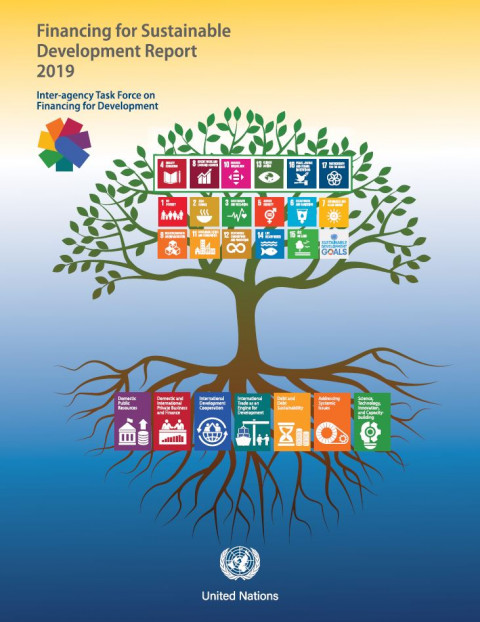 Financing for Sustainable Development Report 2019: Report of the Inter-agency Task Force on Financing for Development Année de publication: 2019 Auteur institutionnel: United Nations (UN) This report provides a comprehensive assessment of the state of sustainable finance. Prepared by more than 60 UN agencies, programmes and offices and other relevant international organizations, the report puts forward a set of policy recommendations for achieving tangible progress on financing for sustainable development in 2019 and beyond.The report warns that creating favorable conditions is becoming more challenging. Rapid changes in technology, geopolitics, and climate are remaking our economies and societies, and existing national and multilateral institutions -- which had helped lift billions out of poverty -- are now struggling to adapt. Confidence in the multilateral system has been undermined, in part because it has failed to deliver returns equitably, with most people in the world living in countries with increasing inequality.
 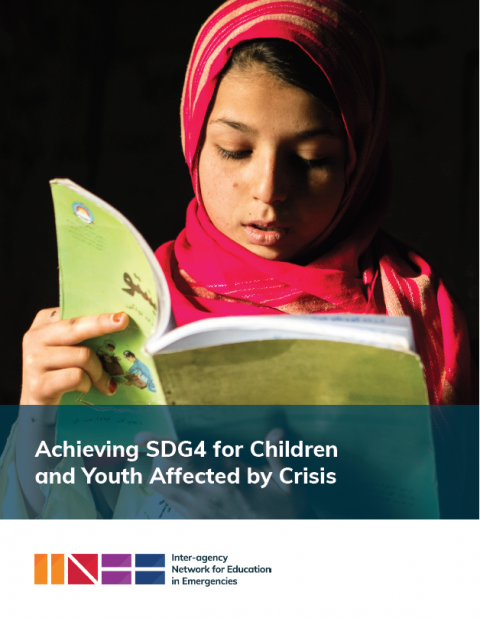 Achieving SDG4 for Children and Youth Affected by Crisis Année de publication: 2019 Auteur institutionnel: Inter-agency Network for Education in Emergencies (INEE) With the Sustainable Development Goal 4 (SDG4), the global community committed to ensuring a quality education for all children and youth. Despite this promise, children and youth in crisis contexts continue to be neglected. We will never achieve SDG4 unless all children and youth affected by conflict and crisis are able to access and attend school and learn in a quality, safe, relevant and inclusive education environment. There is an urgent need for governments and the international community to make and adhere to political, financial and legal commitments if we truly are to leave no child behind. This brief offers recommendations for addressing the disparities in safe, quality, inclusive education for children affected by crisis. It begins by highlighting key areas for policy and practice, and looks at ways to use the various tools developed by the Inter-agency Network of Education in Emergencies (INEE). It takes a look at overall themes and trends, as well as the specific issues of gender disparities, the importance of supporting teachers, children’s psycho-social wellbeing and the protection and safety of education in conflict.
 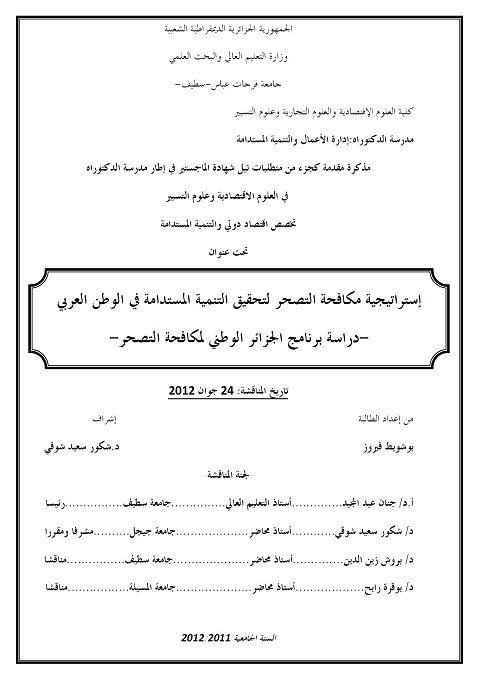 إستراتيجية مكافحة التصحر لتحقيق التنمية المستدامة في الوطن العربي : دراسة برنامج الجزائر الوطني لمكافحة التصحر Année de publication: 2019 Auteur: Boshwait Qairouz إن البحث عن استراتيجيات مستدامة لمكافحة التصحر تحترم البيئة الطبيعية وتحقق العدالة الاجتماعية إضافة إلى تحقيق الفعالية الاقتصادية في المناطق المتضررة من العالم أصبحت من القضايا الهامة التي تخص كل الدول خاصة الدول العربية، لما لمشكلة التصحر من عواقب وخيمة تعود بالضرر على اتمعات البشرية من الناحية الاقتصادية والاجتماعية وكذا البيئية، وبالتالي عدم تحقق التنمية المستدامة التي أصبحت من متطلبات العصر والرامية إلى تحسين الجانب الاجتماعي والاقتصادي تحت إطار حماية البيئة. ومنه نطرح التساؤل التالي: هل تتبع الدول العربية إستراتيجية واحدة لمكافحة التصحر والتي تأخذ في الاعتبار مبادئ التنمية المستدامة؟ وما هو واقع ذلك في الجزائر من خلال البرنامج الوطني لمكافحة التصحر؟ Strategy to Combat Desertification to Achieve Sustainable Development in the Arab World: A Study of Algeria 's National Program to Combat Desertification Année de publication: 2019 Auteur: Boshwait Qairouz Regarding to its impacts on the economic, social and environnemental levels, desertification became one of critical environnemental issue that disturbs the international community. Especially in the dry land, semi dry land and semi humid dry lands. Desertification is the great durable development challenge based on three dimensions: economical efficiency, social justice and nature protection. Viewing the international trends towards achieving durable development, the Arab countries must create new durable strategies and methods, in order to face the phenomenon, these strategies should include the following dimensions: economical, social and environnemental one. Accounting the different reasons of desertification, its intensity and considering the financing capacity, it so difficult to expect one typical strategy that suits each Arab countries. To face such problem, Algeria like the other damaged countries takes needful procedures to combat this problem following a national programme which started in the sixteenth oh last century. To sum up, now days desertification till now a global issue, but the question which rest posing, If may we remove definitely such problem?
 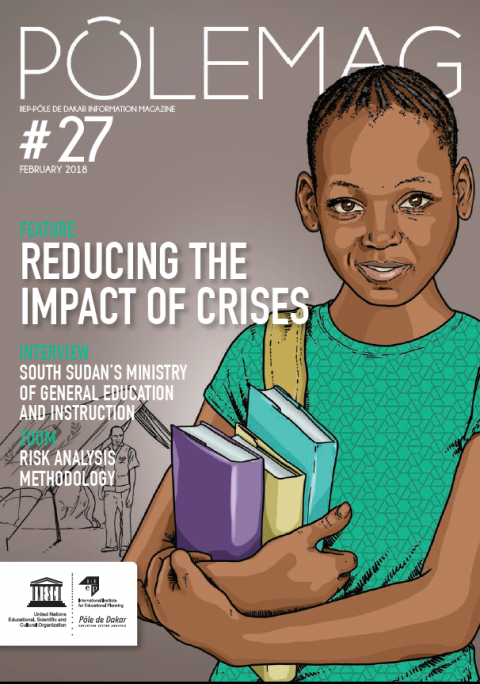 PôleMag n° 27: IIEP Pôle de Dakar information magazine, February 2018 Année de publication: 2018 Auteur institutionnel: UNESCO IIEP Regional Office for Africa Strengthening the resilience of education systems through planning that is adapted for crisis situations is a priority for IIEP. Together with our main partners, the institute has developed strategic orientations and tools dedicated to educational planning that is adapted to crisis situations. Based on our experience on this theme in Africa, we are also working with UNICEF to develop a new methodology to analyse risks and vulnerabilities. Mitigating the impact of crises calls for strengthening relationships with partners. Planning adapted to vulnerabilities should facilitate dialogue between development and humanitarian actors so that intervention plans are coordinated and aligned with government priorities. A dollar invested in risk reduction could save up to seven dollars in rebuilding costs. Taking the risks into account in the analysis and planning of education systems is therefore a wise investment. PôleMag: la lettre d'information du Pôle de Dakar Année de publication: 2018 Auteur institutionnel: UNESCO IIEP Regional Office for Africa Crise politique, crise sanitaire, crise climatique, les systèmes éducatifs sont rarement suffisamment préparés à faire face aux situations d’urgence.Et si la fréquence des menaces est inconnue, les effets sont généralement dévastateurs pour l’école, conduisant à une rupture des apprentissages, voire à l’abandon scolaire pur et simple. Dans le monde, 75 millions d’enfants vivant dans un pays affecté par une crise ont besoin d’un soutien éducatif1.Comment faire face aux crises ? Comment améliorer les capacités des systèmes à réduire leurs impacts ? Renforcer la résilience des systèmes éducatifs par une planification adaptée aux situations de crise est une priorité de l’IIPE. Notre institut a développé, avec ses principaux partenaires, des orientations stratégiques et des outils dédiés à la planification de l’éducation adaptés aux situations de crises. Forts de notre expérience sur cette thématique en Afrique, nous travaillons également en collaboration avec l’UNICEF au développement d’une nouvelle méthodologie dédiée à l’analyse des risques et vulnérabilités.Atténuer l’impact des crises appelle à renforcer les relations avec les partenaires. Une planification adaptée aux vulnérabilités doit faciliter le dialogue entre les acteurs du développement et ceux de l’humanitaire afin que les plans d’interventions soient coordonnés et alignés sur les priorités gouvernementales des plans sectoriels. Un dollar investi dans la réduction des risques pourrait épargner jusqu’à 7 dollars en coût de reconstruction. Prendre en compte les risques dans l’analyse et la planification des systèmes éducatifs est donc un investissement judicieux.
 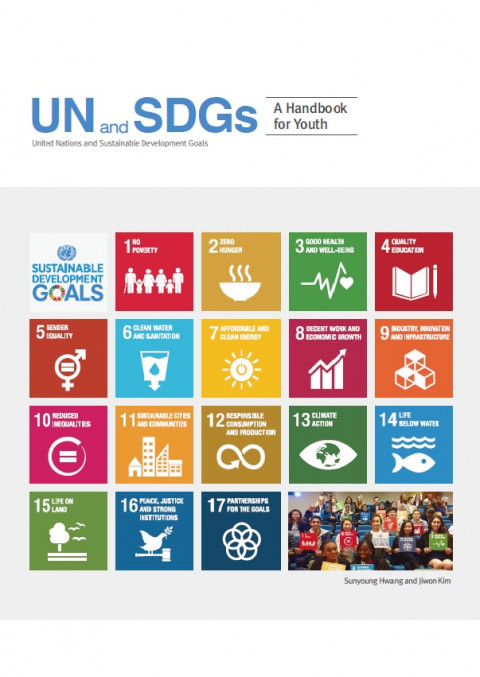 UN and SDGs: A Handbook for Youth Année de publication: 2017 Auteur: Sunyoung Hwang | Jiwon Kim Auteur institutionnel: UN. Economic and Social Commission for Asia and the Pacific (UN. ESCAP) | Asian Development Bank (ADB) | United Nations Development Programme (UNDP) "UN and SDGs: A Handbook for Youth" is an outcome of ESCAP East and North-East Asia’s internship program that brings young people closer to the work of the United Nations, as well as to the achievement of the ambitious set of Sustainable Development Goals (SDGs). As young leaders of tomorrow, it is pivotal that youth are informed and engaged with the global vision for the future. Over the next fifteen years, youth will not only directly experience the outcome of SDGs and plans, but will also be the key driver for their successful implementation. For this reason, it is vital to raise awareness about the recently adopted 17 SDGs and the 2030 Agenda for Sustainable Development among youth, build a platform for discussion, and create the conditions for active engagement. This Handbook explores SDGs and the 2030 Agenda from a youth perspective. In the first chapter, it introduces the concept of sustainable development and outlines its historical development through the transition from Millennium Development Goals (MDGs) to SDGs. The second chapter discusses how youth can be harnessed as a major agent of change in achieving sustainable development, focusing on several pertinent youth issues in Asia and the Pacific. The final chapter introduces the UN system and its regional arm, ESCAP, explaining their role in the successful implementation of SDGs. 청년을 위한 UN과 SDGs 핸드북 Année de publication: 2017 Auteur: Sunyoung Hwang | Jiwon Kim Auteur institutionnel: UN. Economic and Social Commission for Asia and the Pacific (UN. ESCAP) | Asian Development Bank (ADB) | United Nations Development Programme (UNDP) 이 핸드북은 유엔의 업무와 지속가능발전목표(SDGs)에 대해 배울 수 있는 유엔 인턴십 프로그램을 통해 만들어졌습니다. 청년들이 내일의 리더로써 미래 글로벌 비전을 인식하고, 이에 적극 동참하는 일은 매우 중요합니다. 그들은 향후 15년간 SDGs의 결과를 체험하고, 목표를 성공적으로 이행할 핵심 주체가 될 것입니다. 그러므로 지속가능발전을 위한 2030 의제와 SDGs에 대한 청년들의 인식을 함양하고, 논의의 장을 늘리고, 적극적인 참여를 유도하기 위한 환경을 조성하는 것이 중요합니다. '청년을 위한 UN과 SDGs 핸드북'은 청년들의 관점에서 2030 의제와 SDGs를 개괄합니다. 제1장에서는 지속가능발전에 대한 개념을 소개하고 새천년개발목표 (MDGs)에서 SDGs로의 이행을 통한 역사적인 발전에 대해 알아보며, 제2장에서는 아시아태평양지역 내 청년과 관련된 여러가지 사안에 초점을 맞춰 청년들이 지속가능발전을 실현하기 위해 어떤 역할을 할 수 있는지에 대해 논의합니다. 제3장에서는 유엔 시스템과 지역기구인 ESCAP에 대해 소개하면서 SDGs의 성공적 이행 과정에 있어서의 청년들의 역할에 대해 알아봅니다.