
Ressources
Explorez une large gamme de ressources sur le GCED afin d’approfondir votre compréhension et de renforcer vos activités de recherche, de plaidoyer, d’enseignement et d’apprentissage.
1,445 résultats trouvés
 Putting the Voice of Young People at the Heart of Global Citizenship Education Année de publication: 2014 Auteur: Douglas Bourn Auteur institutionnel: UCL Institute of Education | Erasmus+ This briefing is aimed at policy-makers across Europe who are engaged with, or interested in ensuring that education and international development programmes give consideration to the voices of young people. It also aims to contribute to policy-makers responses to how they are implementing the Sustainable Development Goals.
 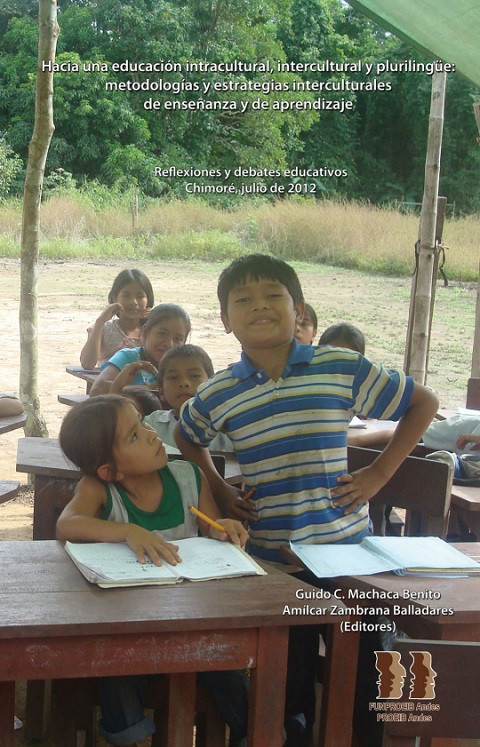 Towards an Intracultural, Intercultural and Multilingual Education: Intercultural Teaching and Learning Methodologies and Strategies Année de publication: 2013 Auteur: Guido C. Machaca Benito | Amílcar Zambrana Balladares Auteur institutionnel: FUNPROEIB Andes This document presents the memories of the seminar - workshop "Towards an intracultural, intercultural and multilingual education: intercultural teaching and learning methodologies and strategies" held in Chimoré, Cochabamba in July 2012. Hacia una educación intracultural, intercultural y plurilingüe: metodologías y estrategias interculturales de enseñanza y de aprendizaje Année de publication: 2013 Auteur: Guido C. Machaca Benito | Amílcar Zambrana Balladares Auteur institutionnel: FUNPROEIB Andes Este documento presenta las memorias del seminario - taller con el "Hacia una educación intracultural, intercultural y plurilingüe: metodologías y estrategias interculturales de enseñanza y de aprendizaje" realizado en Chimoré, Cochabamba en julio de 2012.
  The Effect of Integration in Kindergarten in Improving Verbal and Non-Verbal Communication among Children with Autism spectrum Disorder Année de publication: 2023 Auteur: Bin Fatima Maryam Auteur institutionnel: University of Blida 2 This study aimed to identify the effect of integration in kindergartens on improving verbal and non-verbal communication among children with autism spectrum disorder by presenting the development of a group of seven children (3-4) years old who were diagnosed with autism spectrum disorder and then integrating them for a full year in kindergartens. The study, based on the Cars scale for estimating childhood autism, the verbal and non-verbal communication test, and the Brunet-Lèzine test, found that there are statistically significant differences between integration in kindergarten and both verbal and non-verbal communication, the degree of estimation of childhood autism, and the coefficient of the growth. أثر الدمج في رياض الأطفال في تحسين التواصل اللفظي و غير اللفظي لدى الأطفال المصابين باضطراب طيف التوحد Année de publication: 2023 Auteur: Bin Fatima Maryam Auteur institutionnel: University of Blida 2 هدفت هذه الدراسة إلى التعرف على أثر الدمج في رياض الأطفال على تحسين التواصل اللفظي وغير اللفظي لدى الأطفال المصابين باضطراب طيف التوحد بتقديم تطوُر لمجموعة من سبعة أطفال( 3- 4) سنوات تم تشخيصهم باضطراب طيف التوحد ثم دمجهم لمدة عام كامل في رياض الأطفال. و توصلت الدراسة بالاعتماد على مقياس كارز لتقدير التوحد الطفولي ، و اختبار التواصل اللفظي وغير اللفظي ، و اختبار بروني ليزين إلى وجود فروق دالة إحصائيا بين الدمج في رياض الأطفال و كل من التواصل اللفظي وغير اللفظي و درجة تقدير التوحد الطفولي و معامل النمو.
 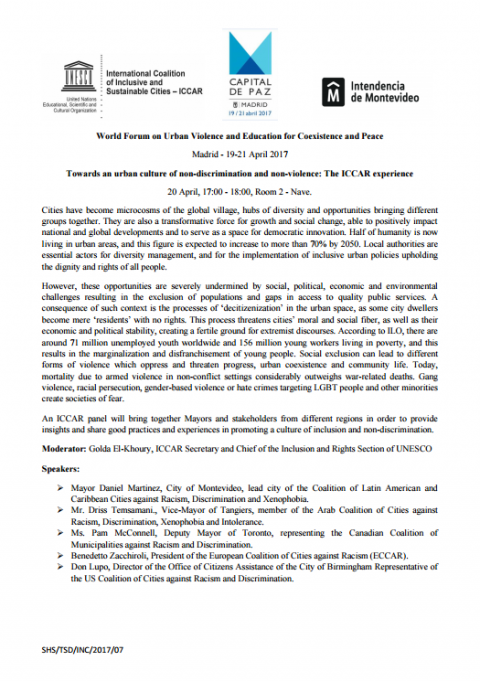 Towards an urban culture of non-discrimination and non-violence: The ICCAR experience Année de publication: 2017 Auteur institutionnel: International Coalition of Inclusive and Sustainable Cities This is a conference report for the World Forum on Urban Violence and Education for Coexistence and Peace.
  Ministerial Forum: Global Dialogue on ICT and Education Innovation – Towards Sustainable Development Goal for Education (SDG 4); Proceedings Année de publication: 2019 Auteur institutionnel: UNESCO Institute for Information Technologies in Education (IITE) The present publication contains articles based on the outcomes of the Ministerial Forum “Global Dialogue on ICT and Education Innovation – Towards Sustainable Development Goal for Education (SDG 4)”, organized by UNESCO IITE in cooperation with the Ministry of Education and Science of the Russian Federation in Moscow (Russia) on 18-19 March, within the Moscow International Education Fair 2018 (MIEF 2018).The publication covers the flagship topics such as ICT potential for future teachers and future schools, digital pedagogy and OER, collaboration between public and private sectors in the use of ICT in education, digital technologies for quality and equity in education.
 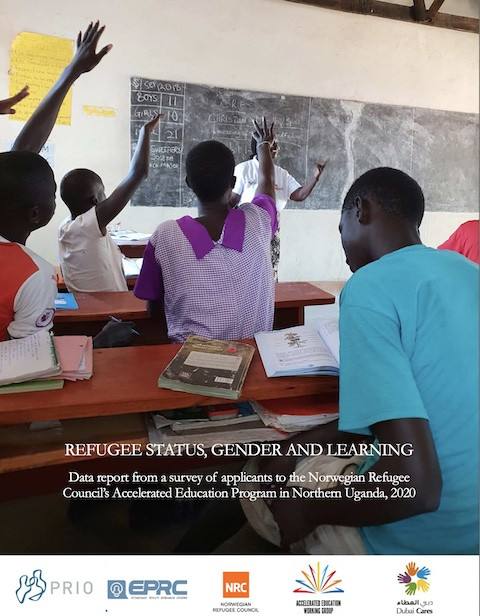 Refugee Status, Gender and Learning Année de publication: 2020 Auteur: Kendra Dupuy | Martin Flatø | Haakon Gjerløw | Andreas Kotsadam | Mette Løvgren | Francis Mwesigye | Siri Aas Rustad | Gudrun Østby Auteur institutionnel: Norwegian Refugee Council (NRC) | Dubai Cares | Accelerated Education Working Group (AEWG) | Economic Policy Research Center (EPRC) | Peace Research Institute Oslo (PRIO) This data report provides details from a survey of applicants to the Norwegian Refugee Council’s Accelerated Education Program in Northern Uganda, 2020. The surveys covered a range of topics, such as demographic and socioeconomic background, school attendance, academic skills, social control, feelings and perceptions on various topics, and future aspirations.
  The Role of Media Literacy in the Promotion Of Common Values and Social Inclusion: Position Paper Année de publication: 2017 Auteur institutionnel: All Digital While we live in an increasingly digital society, a significant number of European citizens continue to lack basic digital skills. Media practices have changed, and now we are not only receiving information passively. Anyone can be active in content creation and (re-)produce (dis)information. For example, mobile technology and ubiquitous Internet access allow citizens to produce real time information, including content for mass media (newspapers, TV channels).The production of information and news thus no longer remains in the capacity of journalists, but something within everyone’s capacity. Without the necessary skills, however, the creation of information and news is not always done in a responsible or professional manner. This is only one example of many, highlighting why media literacy is more important than ever.This position paper talks about:the role for media literacy in promoting common values and social inclusion in several ways: resilience, content creation, dissemination, social inclusionthe role of non-formal education in teaching media literacy andgives examples of media literacy programmes and projects across Europeprovides policy recommendations in terms of funding, recognition and promotion.
 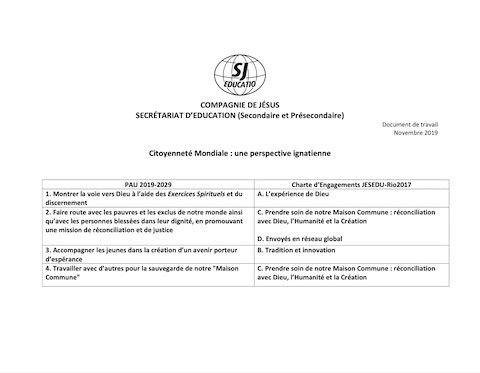 Citoyenneté mondiale: Une perspective ignatienne Année de publication: 2019 Auteur institutionnel: Educate Magis Ce tableau suit est un modèle qui présente des suggestions d’activités pour chaque région, province, établissement ou département éducatif, qui peuvent être utilisées comme exemples ou comme guides et qui peuvent être mises en œuvre et développées d’une manière adaptée à chaque situation ou besoin spécifique.