
Ressources
Explorez une large gamme de ressources sur le GCED afin d’approfondir votre compréhension et de renforcer vos activités de recherche, de plaidoyer, d’enseignement et d’apprentissage.
1,445 résultats trouvés
 Dialogue: cultural diversity and globalization, the Arab-Japanese experience; proceedings Année de publication: 2005 Auteur institutionnel: UNESCO The symposium on “Cultural Diversity and Globalization: the Arab-Japanese Experience, a Cross-Regional Dialogue”, organized on 6 - 7 May 2004 at UNESCO in Paris with the purpose of promoting dialogue and cooperation between the Arab world and Japan, gave its participants an opportunity to lay the groundwork for thinking about the key concepts enshrined in the UNESCO Universal Declaration on Cultural Diversity adopted by the General Conference at its 31st session, on 2 November 2001.
  La contribución de la educación inicial para una sociedad sustentable Année de publication: 2009 Auteur institutionnel: UNESCO This report originates from the international workshop, ‘The Role of Early Childhood Education for a Sustainable Society’, jointly organized in Göteborg, Sweden, by Göteborg University, Chalmers University of Technology and the City of Göteborg, from 2 to 4 May 2007. It was attended by thirty-five participants from sixteen different countries (see ‘List of Participants’). The workshop was a follow-up to the international conference on education for sustainable development, ‘Learning to Change Our World’, held in May 2004, in Göteborg. It was one of four preparatory workshops leading to another international conference on education for sustainable development, to be organized in 2008 or 2009, in the same city. The aim of the four workshops is to discuss promoters and barriers related to learning for sustainability, and to propose recommendations for the upcoming international conference. The present workshop was conceived for the following reasons. First, our societies urgently require new kinds of education that can help prevent further degradation of our planet, and that foster caring and responsible citizens genuinely concerned with and capable of contributing to a just and peaceful world. Second, these new kinds of education must be available to all – not only a handful of people – and take place in various settings, including families and communities. Third, they must begin in early childhood, as the values, attitudes, behaviours and skills acquired in this period may have a long-lasting impact in later life. Thus, early childhood education clearly has an important place in the efforts to bring about sustainable development.
  La contribution de l'éducation de la petite enfance à une société durable Année de publication: 2008 Auteur institutionnel: Organisation des Nations Unies pour l'éducation, la science et la culture (UNESCO) Ce rapport provient de l'atelier international, «Le rôle de l'éducation de la petite enfance pour une société durable», organisé conjointement à Göteborg, en Suède, par l'Université de Göteborg, Chalmers University of Technology et la ville de Göteborg, du 2 au 4 mai 2007. Il a réuni trente-cinq participants de seize pays différents (voir «Liste des participants»). L'atelier a été suivi à l'éducation de internationalconférenceon pour le développement durable, «Apprendre à changer notre monde», tenue en mai 2004, à Göteborg. Il était l'un des quatre ateliers préparatoires menant à une autre éducation internationalconférenceon pour le développement durable, qui sera organisée en 2008 ou 2009, dans la même ville. L'objectif des quatre ateliers est de discuter des promoteurs et des obstacles liés à l'apprentissage de la durabilité, et de proposer des recommandations pour la prochaine conférence internationale. Le présent atelier a été conçu pour les raisons suivantes. Tout d'abord, nos sociétés ont un besoin urgent de nouveaux types d'éducation qui peuvent aider à prévenir une nouvelle dégradation de notre planète, et qui favorisent les soins et les citoyens responsables véritablement concernés par et capables de contribuer à un monde juste et pacifique. Deuxièmement, ces nouvelles formes d'éducation doivent être aCECssibles à tous - non seulement une poignée de gens - et se déroulent dans divers milieux, y compris les familles et les communautés. Troisièmement, ils doivent commencer au début de l'enfance, comme les valeurs, les attitudes, les comportements et les compétences acquises dans cette période peuvent avoir un impact durable dans la vie plus tard. Ainsi, l'éducation de la petite enfance a clairement une place importante dans les efforts pour parvenir à un développement durable. 塑造我们希望的未来: 联合国可持续发展教育十年(2005-2014年); 最后报告; 概要 Année de publication: 2014 Auteur: Carolee Buckler | Heather Creech Auteur institutionnel: 联合国教科文组织 (UNESCO) This summary for policy- and decision-makers provides a brief overview of the key findings and trends, a synopsis of highlights, challenges and actions across all levels and areas of education, and steps for scaling up actions presented in the UNESCO 2014 Global Monitoring and Evaluation Final Report, Shaping the Future We Want – UN Decade of Education for Sustainable Development (2005-2014). The Final Report provides an assessment of progress towards embedding education for sustainable development (ESD) into education systems and into sustainable development efforts. Building on the findings of the past two DESD Global Monitoring and Evaluation reports, and based upon Member States’ and other stakeholders’ assessments of the current state of ESD, the Final Report maps the achievements and challenges of a decade of progress and action on ESD at the global, national, regional and local levels, and within all areas and levels of education. The Final Report concludes that a solid foundation has been laid for ESD at the end of the DESD, achieved by raising awareness, influencing policies and generating significant numbers of good practice projects in all areas of education and learning. At the end of 10 years of work, 10 key findings and trends have emerged that will guide ESD into the future. The report also shows that despite the successes, a full integration of ESD into education systems has yet to take place in most countries. عقد األمم املتحدة للتعليم من أجل التنمية املستدامة (2014-2005) التقرير الختامي رسم مالمح املستقبل الذي نصبو إليه الملخص Année de publication: 2014 Auteur: Carolee Buckler | Heather Creech Auteur institutionnel: منظمة الأمم المتحدة للتربية والعلم والثقافة (UNESCO) This summary for policy- and decision-makers provides a brief overview of the key findings and trends, a synopsis of highlights, challenges and actions across all levels and areas of education, and steps for scaling up actions presented in the UNESCO 2014 Global Monitoring and Evaluation Final Report, Shaping the Future We Want – UN Decade of Education for Sustainable Development (2005-2014). The Final Report provides an assessment of progress towards embedding education for sustainable development (ESD) into education systems and into sustainable development efforts. Building on the findings of the past two DESD Global Monitoring and Evaluation reports, and based upon Member States’ and other stakeholders’ assessments of the current state of ESD, the Final Report maps the achievements and challenges of a decade of progress and action on ESD at the global, national, regional and local levels, and within all areas and levels of education. The Final Report concludes that a solid foundation has been laid for ESD at the end of the DESD, achieved by raising awareness, influencing policies and generating significant numbers of good practice projects in all areas of education and learning. At the end of 10 years of work, 10 key findings and trends have emerged that will guide ESD into the future. The report also shows that despite the successes, a full integration of ESD into education systems has yet to take place in most countries.
 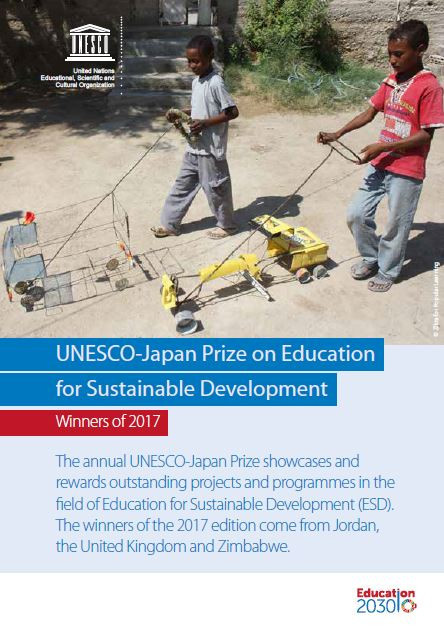 UNESCO-Japan Prize on Education for Sustainable Development: Winners of 2017 Année de publication: 2017 Auteur institutionnel: UNESCO The annual UNESCO-Japan Prize showcases and rewards outstanding projects and programmes in the field of Education for Sustainable Development (ESD).The winners of the 2017 edition come from Jordan, the United Kingdom and Zimbabwe.Among this year’s winners are a school, business and a non-profit organization, promoting ESD, respectively, at the local, regional and global level: Sihlengeni Primary School from the Republic of Zimbabwe; the social enterprise Zikra from the Hashemite Kingdom of Jordan; and the Hard Rain Project from the United Kingdom of Great Britain and Northern Ireland. Each of them will receive an award of USD 50,000.The Director-General of UNESCO and the Japanese Minister of Education will award the Prize to the three laureates in a ceremony at UNESCO Headquarters in Paris on 3 November 2017, during the 39th session of the General Conference. UNESCO's global/regional coordination of and support for the implementation of SDG 4-Education 2030 Année de publication: 2017 Auteur institutionnel: UNESCO Pursuant to 200 EX/7, the Director-General submits to the Executive Board the report on UNESCO’s contribution to the coordination of and support for SDG 4 – Education 2030.The financial and administrative implications of this document have been covered in document 38 C/5.Action expected of the Executive Board: Proposed decision in paragraph 18. UNESCO's global/regional coordination of and support for the implementation of SDG 4-Education 2030 Année de publication: 2017 Auteur institutionnel: Organisation des Nations Unies pour l'éducation, la science et la culture (UNESCO) Pursuant to 200 EX/7, the Director-General submits to the Executive Board the report on UNESCO’s contribution to the coordination of and support for SDG 4 – Education 2030.The financial and administrative implications of this document have been covered in document 38 C/5.Action expected of the Executive Board: Proposed decision in paragraph 18. UNESCO's global/regional coordination of and support for the implementation of SDG 4-Education 2030 Année de publication: 2017 Auteur institutionnel: 유네스코 Pursuant to 200 EX/7, the Director-General submits to the Executive Board the report on UNESCO’s contribution to the coordination of and support for SDG 4 – Education 2030.The financial and administrative implications of this document have been covered in document 38 C/5.Action expected of the Executive Board: Proposed decision in paragraph 18.
  Education for Sustainable Development: Partners in Action Année de publication: 2017 Auteur institutionnel: UNESCO This brochure illustrates key findings and achievements from a monitoring exercise conducted by UNESCO at the halfway point of the initial phase of the GAP. Key partners reported on their progress as of 2016 for 10 indicators -- two in each Priority Action Area -- and toward their target for 2019 which was set as part of their initial commitment.The data summarised here show remarkable progress and suggest that GAP Key Partners and other stakeholders are acting as catalysts for a wide range of ESD efforts. A clear learning agenda has emerged that will inform the second part of the programme and help ensure that ESD evolves, stays relevant and adds value to the full spectrum of Sustainable Development Goals.