
ESD Implementation in Learning Cities
This publication aims to share the best practice cases from nine cities on ESD implementation (policy and practice) following a lifelong learning approach. These cases showcase innovative local initiatives that have embedded ESD into lifelong learning systems through policy/ strategy development or project implementation, focusing on the following priority areas of action and local activities laid down in the ESD for 2030 roadmap:
- Local policy/strategy development on ESD: The development of an action plan that determines how the community as a whole can become a learning laboratory for sustainable development.
- Capacity-building for educators and local authorities: Lifelong learning initiatives for systematic and comprehensive ESD capacity development for educators in the formal and non-formal education sectors, and for local government officials.
- Efforts to foster engagement with local communities, including: • formal education institutions’ engagement with local communities for the promotion of ESD; • non-formal education institutions (e.g. community learning centres) serving as a hub for lifelong learning on ESD in their communities.
- Empowerment and mobilization of youth: Lifelong learning initiatives for ESD that focus on young people.
- Innovative use of local spaces for ESD: Designated areas or spaces that inspire learning and host projects that promote sustainability. In addition to the five priority areas listed above, the case studies share one cross-cutting theme: • Multi-stakeholder approach: How people from different walks of life or professional sectors come together to contribute to local ESD initiatives at either the policy or the project level.
관련 자료
-
 Envisioning the Future of Assessment in Transformative Education: A Synthesis Report of the Expert Meeting on Evaluation and Assessment for Transformative Education: Towards and Beyond 2030
 -
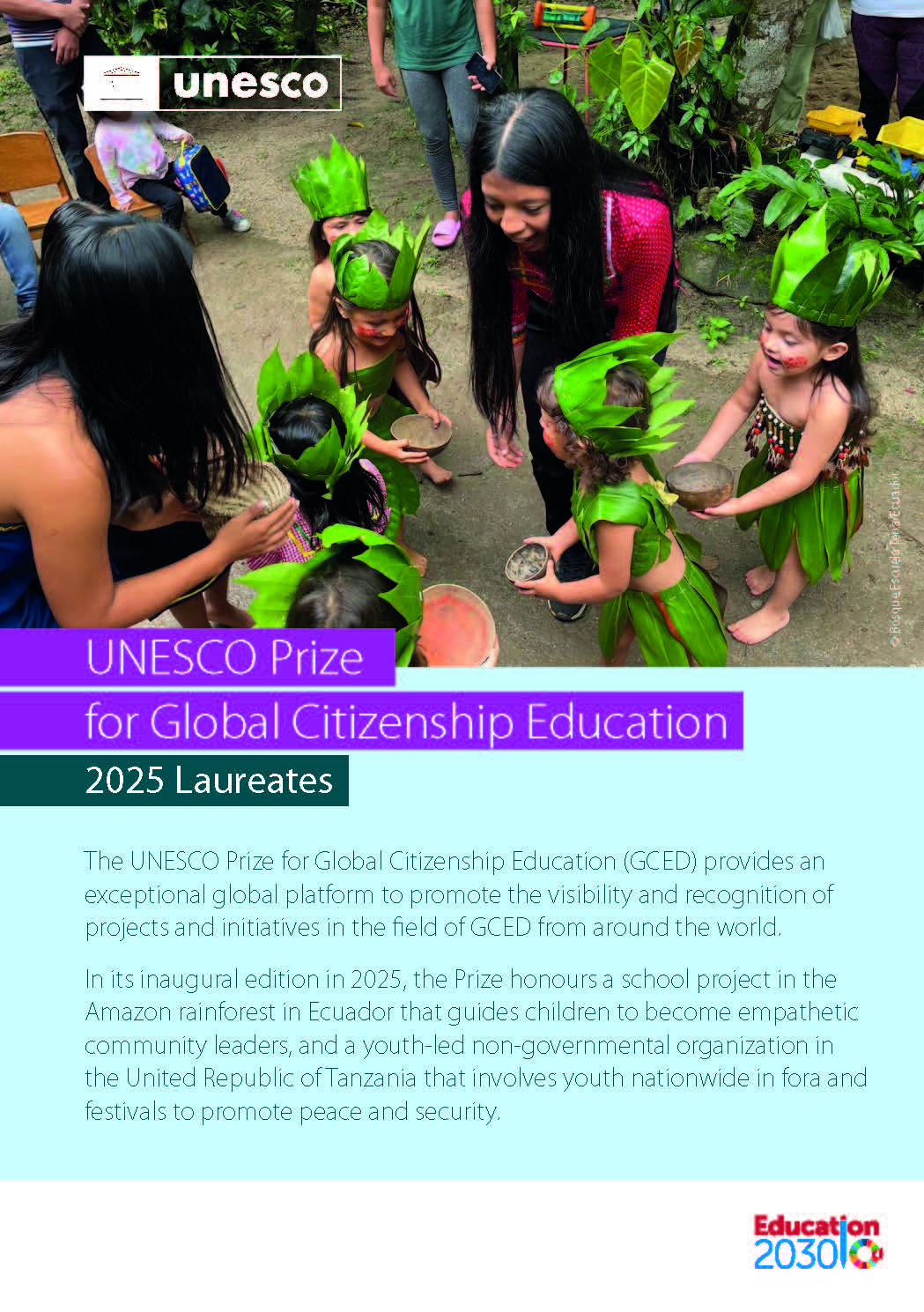 UNESCO Prize for Global Citizenship Education 2025 Laureates
 -
 Confronting Inequality through GCED: Toward Justice, Inclusion, and Transformation (SangSaeng; No.65, 2025)
 -
 Educator's Guide to Global Citizenship Education: From Asia-Pacific Perspectives