
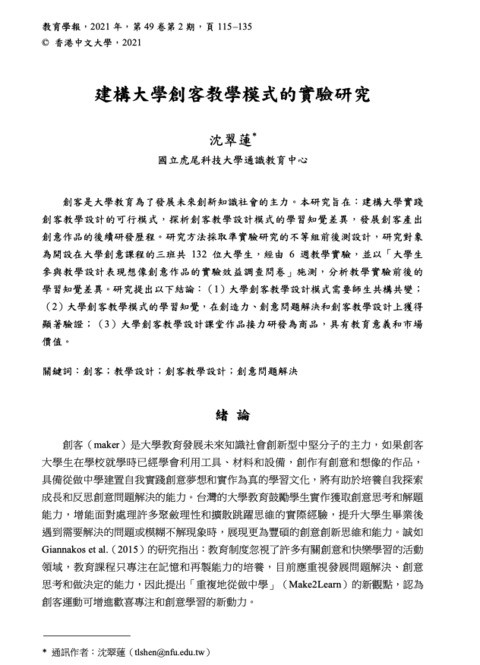
An Experimental Study of Constructing Maker Teaching Model (Educational Journal ; Vol.49, No.2)
Makers studying at university are the main powerful pioneers for developing innovative knowledge society. This research aimed to construct a feasible model of maker teaching, to explore the differences of learning perception of the maker instructional model, and to develop the subsequent process of product creation. Nonequivalent pretest-posttest designs of the quasi-experimental research was employed. Research participants included 132 college students from three classes of creativity-related courses, who participated a 6-week experiment. They were divided into the experimental group and two control groups. A questionnaire was employed to test their differences of learning perception. Results found that: (a) for the maker instructional model, CEO-I2M2E2-SF, a collaborative constructive relationship should be built between instructor and makers; (b) in terms of the performances of learning perception under the maker instructional model, significant differences were found in the dimensions of creativity, creative problem solving, and maker instructional design; (c) there were educational and marketing values in the subsequent process of product creation by makers.
관련 자료
-
 IIEP-UNESCO 12th Medium-Term Strategy: 2026–2029
 -
 Digital Empowerment for Lifelong Learning and Transformative Andragogy (DELTA) for Adult Educators: Introduction to the DELTA Framework and Resources
 -
 Envisioning the Future of Assessment in Transformative Education: A Synthesis Report of the Expert Meeting on Evaluation and Assessment for Transformative Education: Towards and Beyond 2030
 -
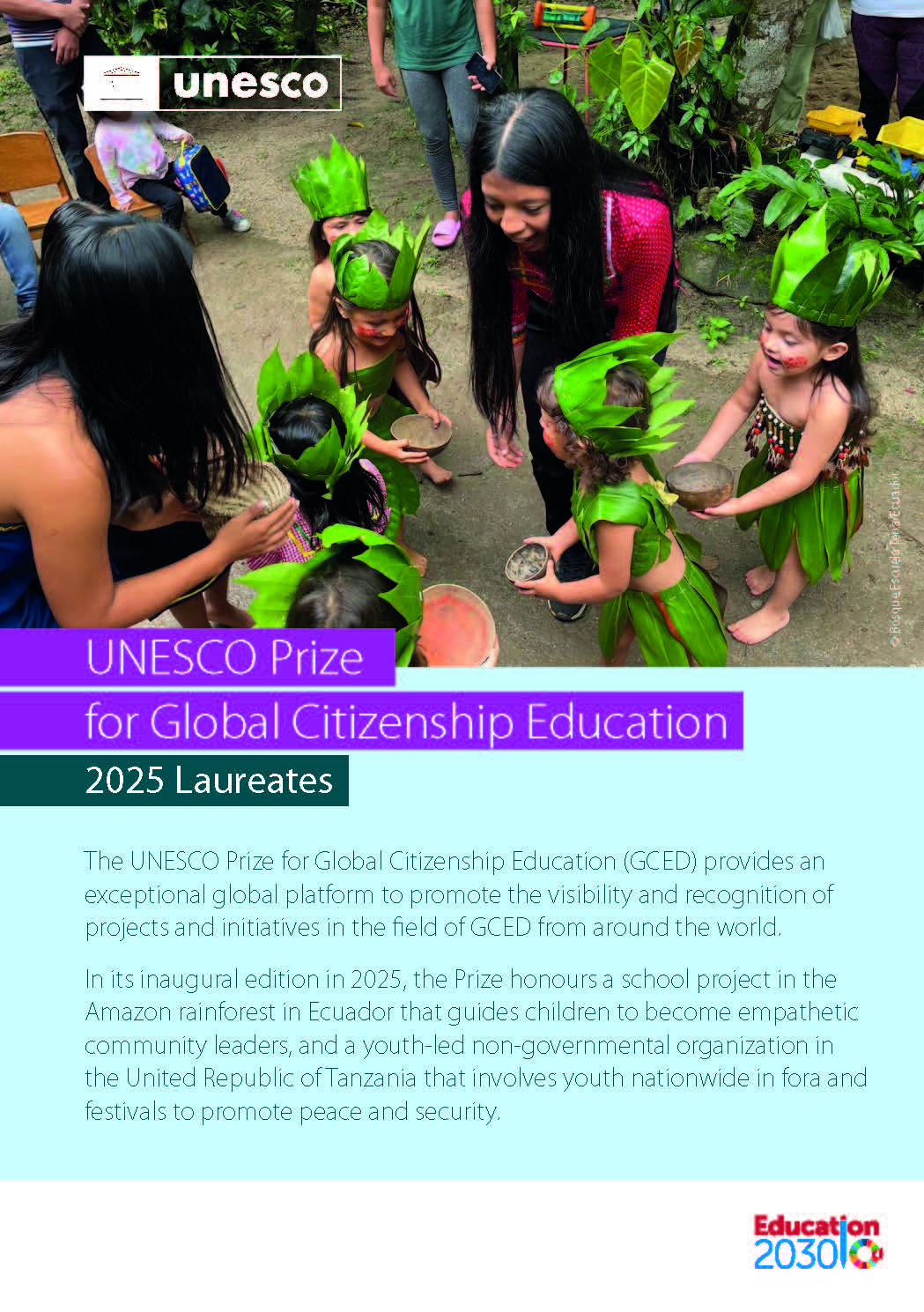 UNESCO Prize for Global Citizenship Education 2025 Laureates