
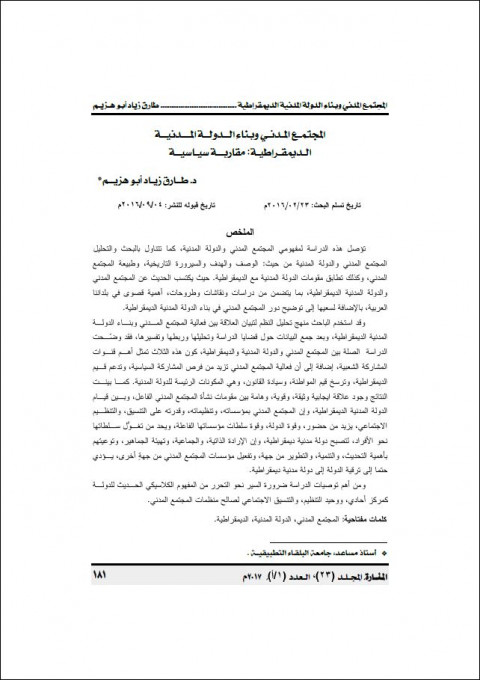
Civil Society and Building a Democratic Civil State: A Political Approach
- 원래 언어
- 아랍어
- 발행 연도
- 2016
The purpose of this study is to find a foundation for the concepts of the 'civil society' and the 'civil state'. It examines and compares both from different dimensions: description, purpose, objectives, history, the reality of the civil society and finally, to what extent they are similar. Most discussion is about civil society and civil democratic state, including studies, discussions and arguments, because of their importance in the Arab countries. In addition, this discussion seeks to clarify the role of civil society in building a democratic civil state. The researcher uses the systems analysis to point out the relationship between how active the civil society is and the establishment of the democratic civil state. After collecting and analyzing related statistics, this study has shown how much the civil society, the concept of democracy, and the state are related. The three represent the most important channels of public participation. In addition, the activeness of the civil society increases opportunities of political participation, supports the values of democracy and citizenship, and enhances the sovereignty of law.
The three are the major components of the civil state. The results have revealed a number of facts: (1) there is a strong positive relation between the reasons behind the establishment of an active civil society and the establishment of the democratic civil society. Furthermore, (2) the civil society, its institutions and organized units, its ability of social coordination have created a strong state with powerful active institutions and limited the dominance of the society's powers over individuals. This has created a democratic civil state. (3) Individual and communicative will, increasing the public awareness of the importance of modernization and development, as well as stimulating the role of the active civil society lead to the development of a simple state to a democratic one. The study concludes with a major recommendation: the classical concept of the modern state as an independent uni-center of an isolated social coordination should be abandoned for the civil social organizations.
관련 자료
-
 IIEP-UNESCO 12th Medium-Term Strategy: 2026–2029
 -
 Advancing Intergenerational Learning: Identifying Challenges and Opportunities for Older Adults; Integrated Case Study Report
 -
 Digital Empowerment for Lifelong Learning and Transformative Andragogy (DELTA) for Adult Educators: Introduction to the DELTA Framework and Resources
 -
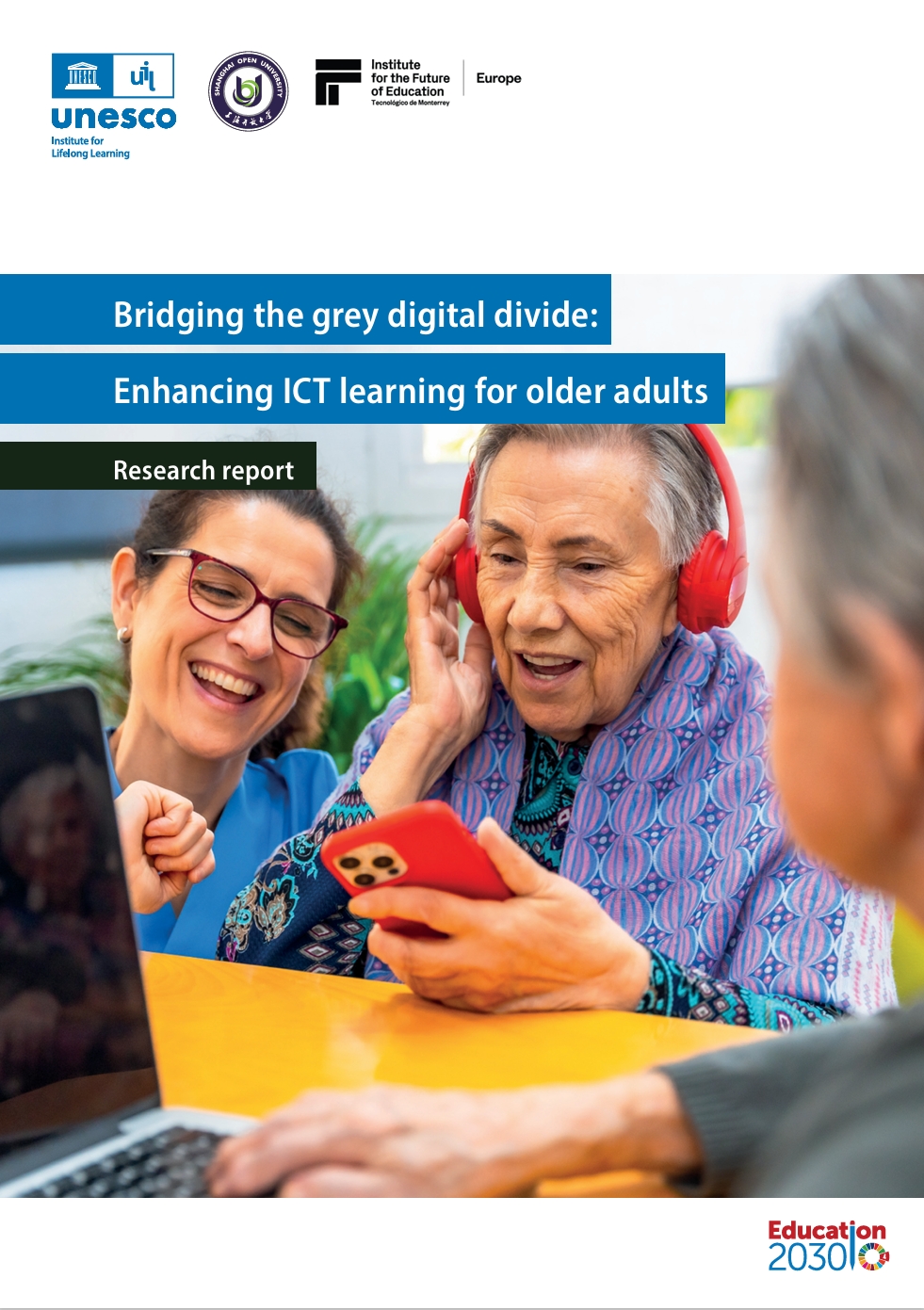 Bridging the Grey Digital Divide: Enhancing ICT Learning for Older Adults; Research Report