
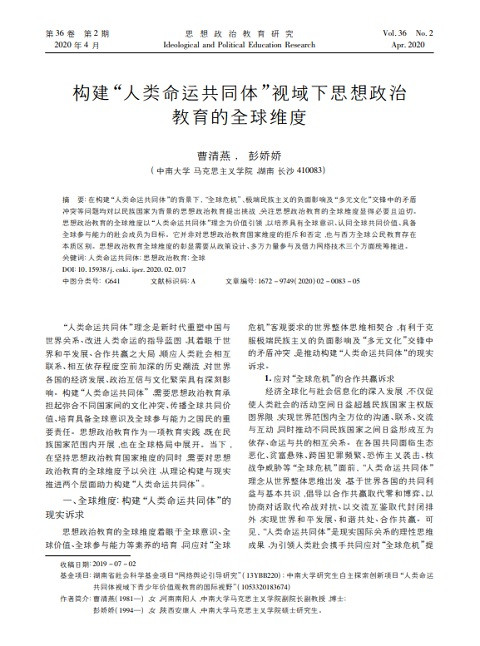
Constructing the Global Dimension of Ideological and Political Education From the Perspective of “Community With a Shared Future for Mankind” (Ideological and Political Education Research; Vol. 36, No. 2)
- ISBN
- ISSN 1672-9749
- 형태사항
- p. 83-87
- 원래 언어
- 중국어
- 발행 연도
- 2020
In the context of building a community with a shared future for mankind, issues such as “global crisis”, the negative impact of ultra-nationalism and the conflicts in the confrontation of “multi-cultures” all challenge the ideological and political education in the context of nation-states. Therefore, it is necessary and urgent to pay attention to the global dimension of ideological and political education. The global dimension of ideological and political education is guided by the concept of “a community with a shared future for mankind” and aims to cultivate social members with global awareness, recognition of global common values and global participation ability. It is not the rejection and denial of the national dimension of ideological and political education, and it is also different from the western global citizenship education in essence. The global dimension of ideological and political education needs to be promoted from three aspects: policy design, multi-force participation and network technology.
관련 자료
-
 Voices Against Violence: Middle Years
 -
 Study on the Historical Impact of the 1974 Recommendation concerning Education for International Understanding, Cooperation and Peace and Education relating to Human Rights and Fundamental Freedoms
 -
 IIEP-UNESCO 12th Medium-Term Strategy: 2026–2029
 -
 Youth Lens on the Silk Roads: Best Photos from the International Silk Roads Photo Contest; 6th Edition