
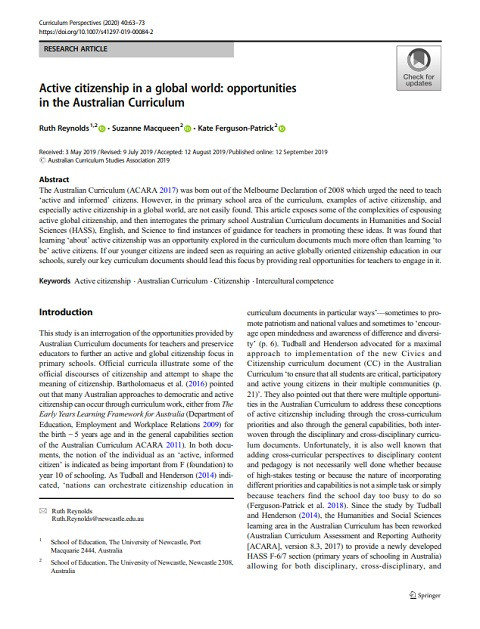
Active Citizenship in a Global World: Opportunities in the Australian Curriculum (Curriculum Perspectives; Vol. 40)
- ISBN
- ISSN 0159-7868 (print); ISSN 2367-1793 (online)
- 형태사항
- p. 63-73
- 원래 언어
- 영어
- 발행 연도
- 2019
The Australian Curriculum (ACARA 2017) was born out of the Melbourne Declaration of 2008 which urged the need to teach ‘active and informed’ citizens. However, in the primary school area of the curriculum, examples of active citizenship, and especially active citizenship in a global world, are not easily found. This article exposes some of the complexities of espousing active global citizenship, and then interrogates the primary school Australian Curriculum documents in Humanities and Social Sciences (HASS), English, and Science to find instances of guidance for teachers in promoting these ideas. It was found that learning ‘about’ active citizenship was an opportunity explored in the curriculum documents much more often than learning ‘to be’ active citizens. If our younger citizens are indeed seen as requiring an active globally oriented citizenship education in our schools, surely our key curriculum documents should lead this focus by providing real opportunities for teachers to engage in it.
관련 자료
-
 Addressing Violent Pasts Through Education: A Policy Guide
 -
 Where Learners Meet History: Reaffirming the Role of History Education in the 21st Century
 -
 Voices Against Violence: Middle Years
 -
 Study on the Historical Impact of the 1974 Recommendation concerning Education for International Understanding, Cooperation and Peace and Education relating to Human Rights and Fundamental Freedoms