
자료
세계시민교육에 대한 이해를 넓히고 연구, 옹호 활동, 교수, 학습 등을 향상시킬 수 있는 다양하고 유용한 자료를 찾아보세요.
1,187 건의 결과가 검색되었습니다
 Digital Empowerment for Lifelong Learning and Transformative Andragogy (DELTA) for Adult Educators: Introduction to the DELTA Framework and Resources 발행 연도: 2025 단체 저자: UNESCO Institute for Lifelong Learning (UIL) | Shanghai Open University (SOU) The UNESCO Institute for Lifelong Learning (UIL), in partnership with Shanghai Open University (SOU), has unveiled the DELTA Framework — Digital Empowerment for Lifelong Learning and Transformative Andragogy. This global initiative aims to enhance adult educators’ digital competencies and foster inclusive, lifelong learning opportunities for all.
  사회경제 변화에 대응하는 평생교육 확대 방안 (KEDI Brief, 2020년 제7호) 발행 연도: 2020 저자: 박병영 | 이정우 단체 저자: 한국교육개발원 2019년 한국교육개발원 기본연구로 수행된 「사회적 형평성 제고를 위한 평생교육 확대 방안」 (박병영 외, 2019)의 일부 내용을 발췌하여 재구성한 자료로서 한국 사회에서 평생교육의 필요성을 짚어보고 그에 따른 평생학습 확대를 위한 정책 과제를 제시한다.
  The Tasks for Future Education through the Analysis of Educational Innovation Cases 발행 연도: 2019 저자: Eunhee Hwang | Sujin Choi | Jongheon Lim | Heejin Park | Jaeduck Lee | Sungki Kim | Giljae Lee | Hunho Kim | Ammi Jang 단체 저자: Korean Educational Development Institute (KEDI) It is predicted that the future society will be low populated of the school-age but high populated of the elderly, intelligent information centered, and multicultural society. According to these changes of the society, it is time for education to shift to preparing for a future education system rather than growth from competition. Based on this perspectives, this study aims to explore the tasks of the future education by analyzing domestic and international cases of educational innovations. Specifically, this study suggests several practical tasks that general high schools can implement for the future education, analyzing the selected cases contributed to the educational innovation. This is because the cases of educational innovation are the stepping stones for general high school to move forward to the future education, although the cases are not perfect examples. 교육 혁신 사례 분석을 통한 미래교육 실천 과제 발행 연도: 2019 저자: 최수진 | 임종헌 | 박희진 | 이재덕 | 김성기 | 이길재 | 김훈호 | 장암미 단체 저자: 한국교육개발원 미래사회의 특징으로 학생 수 감소 및 고령화, 지능정보사회, 다문화 사회 등이 언급되고 있다. 이러한 미래사회의 변화에 따라 우리나라의 교육도 경쟁을 통한 성장보다는 미래를 대비하는 체제로 전환해야 할 시점에 놓여있다. 이 연구는 국내・외에서 이루어진 교육 혁신의 사례를 통해 미래교육의 실천 과제를 탐색하기 위한 것이다. 미래교육의 수준이나 내용은 미래의 범위를 어디로 설정하는가에 따라 다양할 수 있다. 이 연구에서는 일반 고등학교의 실천 가능성에 중요성을 두고 현재 완벽한 미래교육 시스템을 구축하고 있다고는 할 수 없지만 현재의 일반학교보다 한 발 앞서 미래교육을 준비하며 다양한 시행착오를 거쳐 성과를 거두고 있는 교육 혁신의 사례를 현재의 학교교육과 미래의 학교교육의 연결고리로 보고, 이들 사례에서 도출된 미래교육 실천 과제를 현재 학교들이 미래교육의 방향을 향해 나아가야할 실천 과제로 제안하였다.
  뉴 노멀 시대의 민주시민교육 실행 방안 연구 발행 연도: 2021 저자: 김현진 | 이선호 | 이선영 | 김진희 | 양희준 | 조윤정 | 조혜진 단체 저자: 한국교육개발원 이 연구는 뉴노멀 시대 민주시민교육의 실행 전략을 도출하기 위해 학교 운영 전반의 현황뿐만 아니라, 정책 추진에 대한 인식 등 민주시민교육 전반에 대한 실증적 자료를 수집하여, 이를 기반으로 뉴노멀 시대의 민주시민교육을 위한 실행 전략을 도출하였다. 이 연구를 통해 민주시민교육은 교육목표 수립부터 학교구성원이 함께 공유하고 학교 전반의 교육 활동에서 민주성을 지향하는 것이라는 점을 확인하였다. 본 저작물은 한국교육개발원에서 2021년 작성하여 공공누리 제4유형으로 개방한 ‘뉴 노멀 시대의 민주시민교육 실행 방안 연구(김현진 외)’를 이용하였으며 해당 저작물은 한국교육개발원 홈페이지 (www.kedi.re.kr)에서 무료로 다운받으실 수 있습니다.
 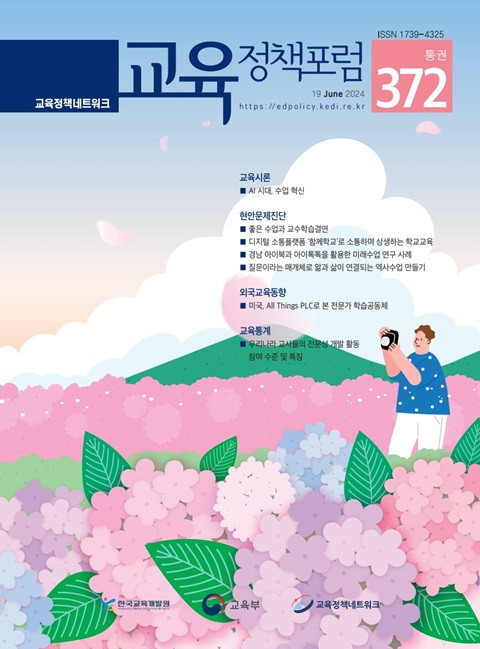 AI 시대, 수업 혁신 (교육정책포럼; 2024년 6월, Vol. 372) 발행 연도: 2024 단체 저자: 한국교육개발원 교육시론ㅁ AI 시대, 수업 혁신 현안문제진단ㅁ 좋은 수업과 교수학습결연ㅁ 디지털 소통플랫폼 '함께학교'로 소통하며 상생하는 학교교육ㅁ 경남 아이북과 아이톡톡을 활용한 미래수업 연구 사례ㅁ 질문이라는 매개체로 앎과 삶이 연결되는 역사수업 만들기 외국교육동향ㅁ All Things PLC로 본 전문가 학습공동체 교육통계ㅁ 우리나라 교사들의 전문성 개발 활동 참여 수준 및 특징
 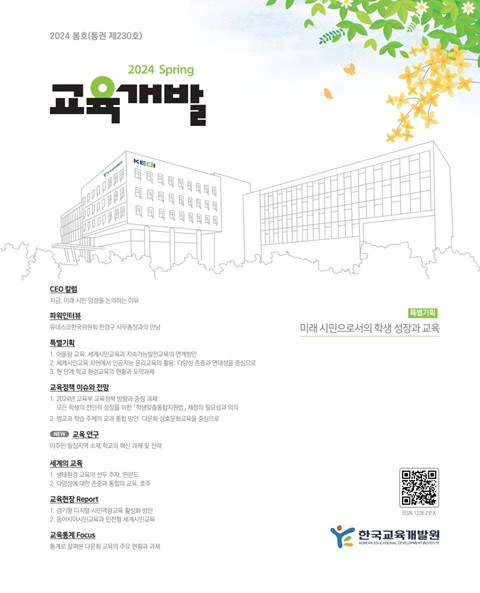 미래 시민으로서의 학생 성장과 교육 (교육개발; 2024년 봄호, Vol. 230) 발행 연도: 2024 단체 저자: 한국교육개발원 CEO 칼럼지금, 미래 시민 양성을 논의하는 이유 파워인터뷰유네스코한국위원회 한경구 사무총장과의 만남 특별기획미래 시민으로서의 학생 성장과 교육1.어울림 교육: 세계시민교육과 지속가능발전교육의 연계방안2.세계시민교육 차원에서 인공지능 윤리교육의 활용: 다양성 존중과 연대성을 중심으로3.현 단계 학교 환경교육의 현황과 도약과제 교육정책 이슈와 전망1. 2024년 교육부 교육정책 방향과 중점 과제: 모든 학생의 전인적 성장을 위한 「학생맞춤통합지원법」제정의 필요성과 의의2. 범교과 학습 주제의 교과 통합 방안: 다문화·상호문화교육을 중심으로 NEW 교육 연구이주민 밀집지역 소재 학교의 혁신 과제 및 전략 세계의 교육1.생태환경 교육의 선두 주자, 핀란드2.다양성에 대한 존중과 통합의 교육, 호주 교육현장 Report1.경기형 디지털 시민역량 교육 활성화 방안2.동아시아시민교육과 인천형 세계시민교육 교육통계 Focus통계로 살펴본 다문화 교육의 주요 현황과 과제
 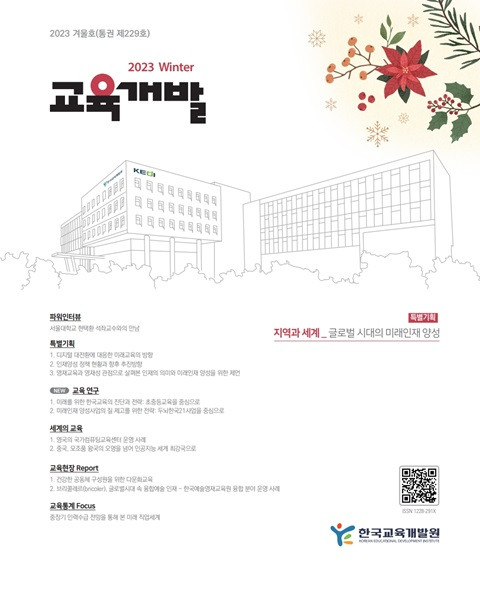 지역과 세계: 글로벌 시대의 미래인재 양성 (교육개발; 2023년 겨울호, Vol. 229) 발행 연도: 2023 단체 저자: 한국교육개발원 파워인터뷰서울대학교 현택환 석좌교수와의 만남 특별기획지역과 세계 _ 글로벌 시대의 미래인재 양성1.디지털 대전환에 대응한 미래교육의 방향2.인재양성 정책 현황과 향후 추진방향3.영재교육과 영재성 관점으로 살펴본 인재의 의미와 미래인재 양성을 위한 제언 NEW 교육 연구1. 미래를 위한 한국교육의 진단과 전략: 초중등교육을 중심으로2. 미래인재 양성사업의 질 제고를 위한 전략: 두뇌한국21사업을 중심으로 세계의 교육1. 영국의 국가컴퓨팅교육센터 운영 사례2. 중국, 모조품 왕국의 오명을 넘어 인공지능 세계 최강국으로 교육현장 Report 1. 건강한 공동체 구성원을 위한 다문화교육2. 브리콜레르(bricoler), 글로벌시대 속 융합예술 인재 - 한국예술영재교육원 융합 분야 운영 사례 교육통계 Focus중장기 인력수급 전망을 통해 본 미래 직업세계
 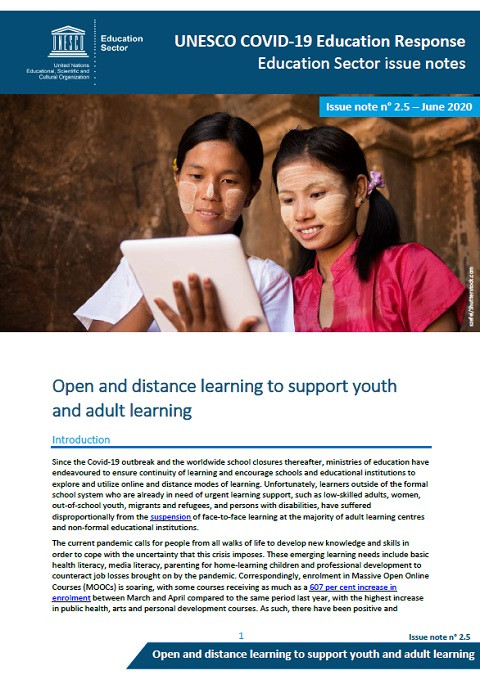 UNESCO COVID-19 Education Response: Open and Distance Learning to Support Youth and Adult Learning (Education Sector Issue Note; No. 2.5 – June 2020) 발행 연도: 2020 단체 저자: UNESCO Institute for Lifelong Learning (UIL) A new UNESCO issue note, produced by the UNESCO Institute for Lifelong Learning (UIL), aims to support education policy-makers and planners in ensuring open and distance learning to support youth and adult learning in the context of the current pandemic, now and in its aftermath.Since the COVID-19 outbreak and the worldwide school closures that followed, ministries of education have endeavoured to ensure continuity of learning and encourage schools and educational institutions to explore and utilize online and distance modes of learning. Unfortunately, learners outside of the formal school system who are already in need of urgent learning support, such as low-skilled adults, women, out-of-school youth, migrants and refugees, and persons with disabilities, have suffered disproportionally from the suspension of face-to-face learning at the majority of adult learning centres and non-formal educational institutions.The current pandemic calls for people from people from all socio-economic backgrounds, wherever they live in the world, to develop new knowledge and skills in order to cope with the uncertainty that this crisis imposes. These learning needs include basic health literacy, media literacy, parenting for home-schooling children and professional development to counteract job losses brought on by the pandemic. Correspondingly, enrolment in massive open online courses (MOOCs) is soaring. As such, there have been positive and demand-driven trends in exploring alternative options, such as open and distance learning (ODL), to ensure the continuity and expansion of non-formal education and adult learning.This issue note takes stock of opportunities and challenges in using ODL, both online and offline as defined in the UNESCO Issue Note on Distance Learning Strategies, for youth and adult learners outside the formal education system. After examining key issues and illustrating promising cases from public and private sectors, it provides key messages for policy interventions to support inclusive lifelong learning for youth and adults during and after the current pandemic.UNESCO Education Sector’s issue notes cover key topics related to the COVID-19 education response.
  Implementation of the Sustainable Development Goal 4 in Korea 발행 연도: 2019 단체 저자: Korean National Commission for UNESCO | Korean Educational Development Institute (KEDI) This report takes stock of progress made in Korea towards achieving SDGs and sheds light on major policy implications for its further implementation. The first chapter will touch on the background and objectives, the second on the monitoring of SDG4-Education 2030 at the global level, the third on the implementation structure of SDG4-Education 2030 in Korea, the fourth on the progress made toward meeting SDG4, and the fifth on the conclusion.