
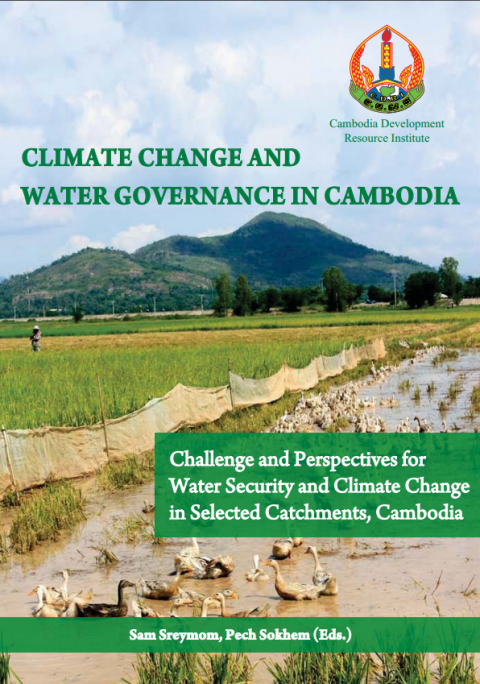
Climate Change and Water Governance in Cambodia: Challenge and Perspectives for Water Security and Climate Change in Selected Catchments, Cambodia
- Автор
- Sam Sreymom, Pech Sokhem
- Корпоративный автор
- Cambodia Development Resource Institute (CDRI)
- ISBN
- ISBN 978-9924-500-04-9
- Язык ресурса
- Английский
- Год публикации
- 2015
- Ключевые слова
- Устойчивое развитие
- Тип ресурса
- Исследовательские работы / журнальные статьи
- Регион
- Азия и Тихоокеанский регион
- Место публикации
- Phnom Penh
This book is the major output of a three-year research project titled “Climate Change and Water Governance in Cambodia”, supported by the International Development Research Centre (IDRC) of Canada. The book is the result of close collaboration between the Cambodia Development Resource Institute (CDRI), a lead institute, and project partners: the Ministry of Water Resources and Meteorology (MOWRAM), Ministry of Environment (MOE), Tonle Sap Authority (TSA), Royal University of Agriculture (RUA), Institute of Technology of Cambodia (ITC) and the Mekong Programme on Water, Environment and Resilience(M-POWER).
The project focussed on three river catchments around the Tonle Sap Lake: Stung Chrey Bak in Kompong Chhnang province, Stung Chinit in Kompong Thom province and Stung Pursat in Pursat province. The main research outcomes encompass (1) better understanding among decision makers, researchers and students of the livelihood implications of hydrological and ecosystem changes caused by changes in climate and human systems in the Tonle Sap Basin, and (2) improved methods of integrating local knowledge and scientific empirical evidence into Cambodia’s policy and planning framework.
Связанные ресурсы
-
 IIEP-UNESCO 12th Medium-Term Strategy: 2026–2029
 -
 Advancing Intergenerational Learning: Identifying Challenges and Opportunities for Older Adults; Integrated Case Study Report
 -
 Digital Empowerment for Lifelong Learning and Transformative Andragogy (DELTA) for Adult Educators: Introduction to the DELTA Framework and Resources
 -
 Bridging the Grey Digital Divide: Enhancing ICT Learning for Older Adults; Research Report