
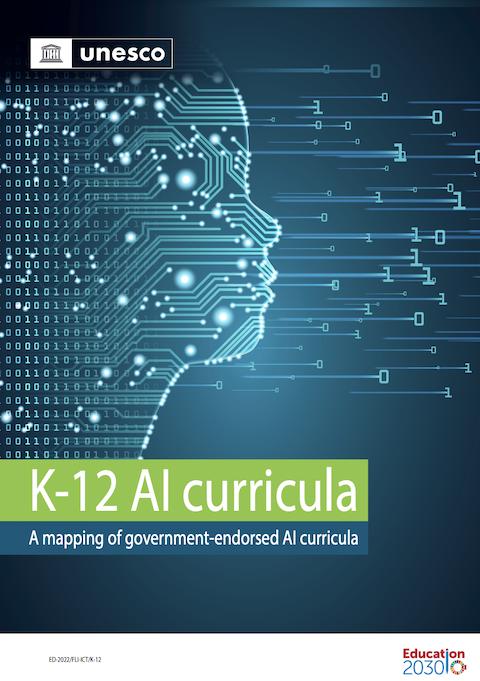
K-12 AI Curricula: A Mapping of Government-Endorsed AI Curricula
- Corporate Author
- UNESCO
- Collation
- 60 p.
- Resource Language
- English
- Year of publication
- 2022
- Level of education
- Early childhood care and educationPrimary educationSecondary education
- Region
- Global
- Place of publication
- Paris
Regulations on their own are insufficient to ensure AI as a common good for education and for humanity. All citizens need to be equipped with some level of AI literacy covering the values, knowledge and skills relating to AI. This report features key findings and recommendations of UNESCO’s global survey on AI curricula for K-12. It reveals that only 11 countries have developed and endorsed K-12 AI curricula and another four countries have AI curricula in development. This is a strong call for Member States to develop AI curricula for K-12 students, and to build stronger mechanisms to validate non-governmental AI curricula offered to balance the private-driven approach. The report also reveals that the learning outcomes of AI curricula need to be more focused on fostering creativity in crafting AI technologies and on contextual ethics. Teacher training is key to ensure the implementation of AI curricula, and teachers need to be trained on designing and facilitating project-based learning which is the most commonly used pedagogical methodology in existing AI curricula. The report also advises an ‘agnostic approach’ towards AI brands and products when introducing domain-specific AI technologies.
Related Resources
-
 Digital Empowerment for Lifelong Learning and Transformative Andragogy (DELTA) for Adult Educators: Introduction to the DELTA Framework and Resources
 -
 Bridging the Grey Digital Divide: Enhancing ICT Learning for Older Adults; Research Report
 -
 Confronting Inequality through GCED: Toward Justice, Inclusion, and Transformation (SangSaeng; No.65, 2025)
 -
 Recommendation on Education for Peace, Human Rights and Sustainable Development: An Implementation Guide