
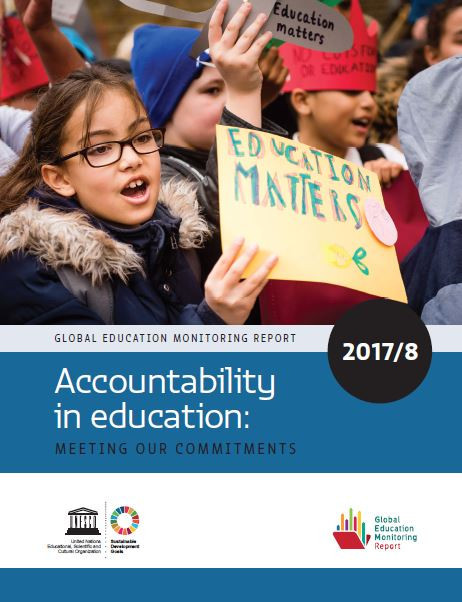
Accountability in Education: Meeting Our Commitments: Global Education Monitoring Report, 2017/8
- Corporate Author
- UNESCO
- ISBN
- ISBN 978-92-3-100239-7
- Collation
- 486 p.
- Resource Language
- English
- Year of publication
- 2017
- Topic
- Civic / Citizenship / DemocracyGlobalisation and social justice / International understandingSustainable development / Sustainability
- Resource Type
- Research papers / journal articles
- Level of education
- Early childhood care and educationPrimary educationSecondary educationHigher educationLifelong learningTechnical and vocational education and training
- Region
- Global
- Place of publication
- Paris
The second edition of the Global Education Monitoring Report (GEM Report) presents the latest evidence on global progress towards the education targets of the UN Sustainable Development Goals.
With hundreds of millions of people still not going to school, and many not achieving minimum skills at school, it is clear education systems are off track to achieve global goals. The marginalized currently bear the most consequences but also stand to benefit the most if policy-makers pay sufficient attention to their needs. Faced with these challenges, along with tight budgets and increased emphasis on results-oriented value for money, countries are searching for solutions. Increased accountability often tops the list.
The 2017/8 GEM Report shows the entire array of approaches to accountability in education. It ranges from countries unused to the concept, where violations of the right to education go unchallenged, to countries where accountability has become an end in itself instead of a means to inclusive, equitable and high-quality education and lifelong learning for all.
The report emphasizes that education is a shared responsibility. While governments have primary responsibility, all actors – schools, teachers, parents, students, international organizations, private sector providers, civil society and the media – have a role in improving education systems.
The report emphasizes the importance of transparency and availability of information but urges caution in how data are used. It makes the case for avoiding accountability systems with a disproportionate focus on narrowly defined results and punitive sanctions. In an era of multiple accountability tools, the report provides clear evidence on those that are working and those that are not.
Related Resources
-
 Study on the Historical Impact of the 1974 Recommendation concerning Education for International Understanding, Cooperation and Peace and Education relating to Human Rights and Fundamental Freedoms
 -
 IIEP-UNESCO 12th Medium-Term Strategy: 2026–2029
 -
 More than Welcome: Intercultural Integration of Migrants in and Through Higher Education
 -
 Advancing Intergenerational Learning: Identifying Challenges and Opportunities for Older Adults; Integrated Case Study Report