
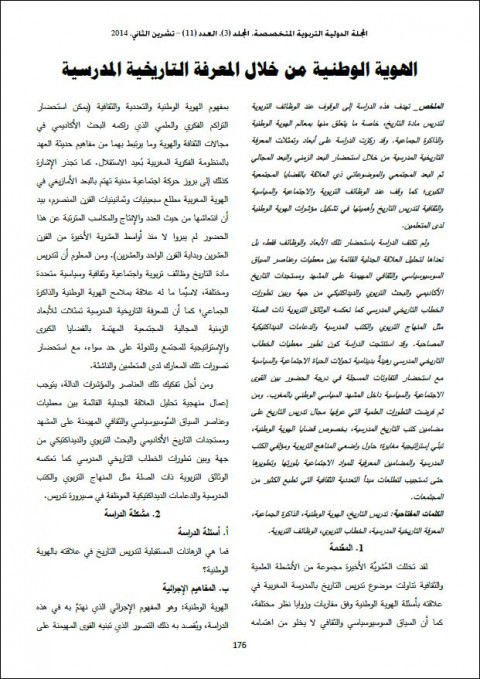
National Identity through Historical Knowledge of School
- Author
- وريف، علي
- Corporate Author
- International Group for Consulting and Training (IGCT)
- ISBN
- ISSN 2226-3500
- Collation
- p. 175-189
- Resource Language
- Arabic
- Year of publication
- 2014
- Level of education
- Primary educationSecondary education
- Region
- Arab States
- Place of publication
- عمان
The aim of this article is to shed light on educational functions of teaching history, especially with regard to the features of national identity and collective memory. The article focuses on the dimensions and representations of historical knowledge related to history presented in school. It makes use of time and space dimensions. It continues to cover dimensions of community and issues related to its main questions. It also tackles the educational, social, poltitical and cultural functions of teaching history and its importance in constructing learners indicators of national identity. The article tries also to analyse the dialectical relationship between two main aspects: the first one is the elements of sociopolitical and cultural context that dominate the scene, and the developments in academic history and educational and didactic research. The second one is the developments in the speech of school history declared in the educational documents, such as educational curriculum, textbooks and didactic supports. The study concluded that the school's historic speech data hostage dynamic transformations of social and political view with evoke disparities recorded in the degree of attendance between the social and political forces within the national political scene in Morocco. The scientific developments that the teaching of history field has known impose on the contents of history textbook, specifically the national identity issues, to adopt a different strategy; the curriculum makers, the textbook and cognitive contents writers of social materials have tried to elaborate and develop it to respond to the aspirations of the principle of cultural pluralism, which is printed a lot of communities.
Related Resources
-
 IIEP-UNESCO 12th Medium-Term Strategy: 2026–2029
 -
 Youth Lens on the Silk Roads: Best Photos from the International Silk Roads Photo Contest; 6th Edition
 -
 Advancing Intergenerational Learning: Identifying Challenges and Opportunities for Older Adults; Integrated Case Study Report
 -
 Digital Empowerment for Lifelong Learning and Transformative Andragogy (DELTA) for Adult Educators: Introduction to the DELTA Framework and Resources