
Resources
Explore a wide range of valuable resources on GCED to deepen your understanding and enhance your research, advocacy, teaching, and learning.
8 Results found
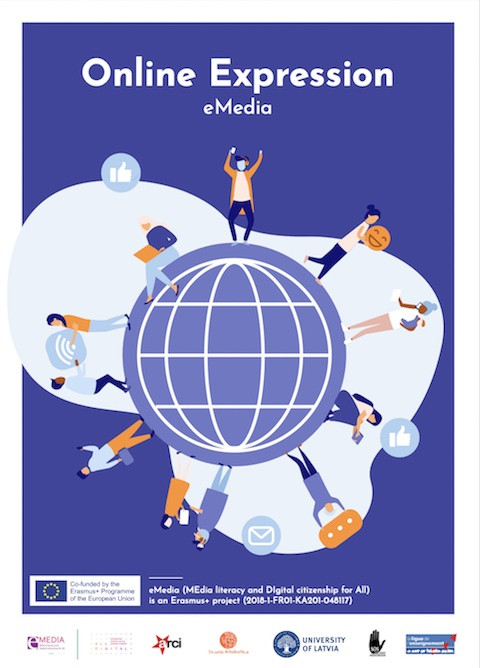 Online Expression: eMedia Year of publication: 2021 Corporate author: e-Media project Consortium | Erasmus+ The handbook on Online Expression gives an insight on what is online expression, and intends to promote a more creative, active and wise use of the web, exploring the opportunities given not only by social media and blogs. The aim of the handbook is to help teachers guide young people to hone their online expression skills by explaining how to be proactive in their online expressions and less reactive, to become a digital prosumer and not a consumer. The hanbook focuses on the following elements that characterizes online active participation: The creation of relationships; The building of a community or the fact of representing a community; The collective interest; The intention to produce a change, to influence society.
  Designing the World Around Me: Mathematics and Cultural Inspiration in Design Year of publication: 2017 Corporate author: Project in Citizenship and Mathematics(PiCaM) | Erasmus+ This activity supports the development of geometric understanding through the use of two dimensional shapes in cultural and religious symbolism and though their use in architecture, particularly in the use of tiling. Throughout there are opportunities for exploring how symbolic representations are underpinned by ideas and beliefs.
  Global Citizenship Education: Solidar Foundation Policy Paper Year of publication: 2020 Corporate author: Solidar Foundation | Erasmus+ The purpose of this paper is to provide recommendations supported by our members, based on their work in formal, non-formal and informal education, to expand GCE at national and European level. Considering how GCE is linked many times with formal education, the recommendations reveal the work of our members outside of this, building upon the need for a multi-stakeholder approach that spans across the entire learning process. This policy paper guides SOLIDAR Foundation’s work in influencing developments related to the EU’s Updated Skills Agenda, European Education Area, Action Plan for the Implementation of the European Pillar of Social Rights, and the European Green Deal, given how all provide an opportunity for GCE to be embraced as a necessity rather than an added-value.
  How Does Peer-Mentoring Contribute to Education for Sustainable Development in Schools?: Study & Analysis; France Year of publication: 2020 Author: Carole Coupez | Jérémie Morfoisse Corporate author: Solidarité Laïque | Peerment | Erasmus+ This document reports the findings of a study surveying French teachers about practices in education for sustainable development within France’s formal education system, and the development of educational approaches to peer-mentoring. Comment le peermentoring contribue à l’Éducation au développement durable en milieu scolaire ?: Étude et Analyse; Volet France Year of publication: 2020 Author: Carole Coupez | Jérémie Morfoisse Corporate author: Solidarité Laïque | Peerment | Erasmus+ Ce document restitue un travail d’enquête et de réflexion mené auprès d’enseignants français, sur les pratiques d’éducation au développement durable dans l’enseignement formel, et le développement des approches pédagogiques en peermentoring.
 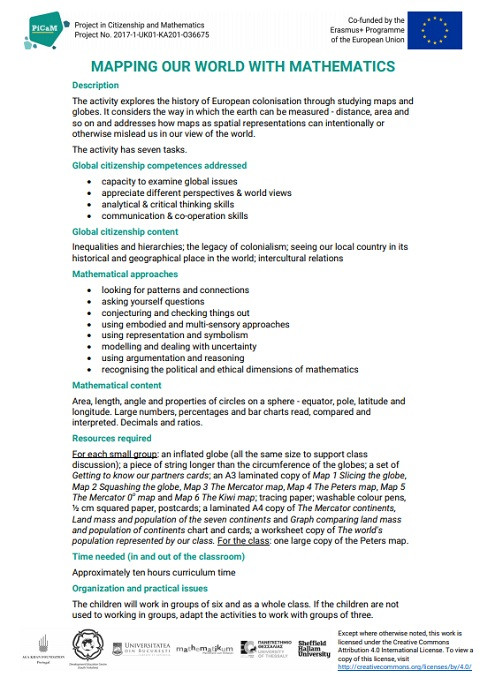 Mapping our World with Mathematics Year of publication: 2019 Corporate author: Project in Citizenship and Mathematics(PiCaM) | Erasmus+ This activity explores the history of European colonisation through studying maps and globes. It considers the way in which the earth can be measured - distance, area and so on and addresses how maps as spatial representations can intentionally or otherwise mislead us in our view of the world. The activity has seven tasks.
  Inscool: Activities Booklet; Practical Classroom Approaches to Rights-Based Learning Year of publication: 2020 Corporate author: Scotdec | European Union (EU) | Erasmus+ This toolkit is designed to guide you flexibly, in ways that suit your primary school, through the start of a journey towards including more pupils in learning and life at school. A key point to remember about this journey is that it does not have a final destination. Rather, it is about cumulative change that has, at its heart, a continuous focus on improving their access to and participation in quality, inclusive education.
  Putting the Voice of Young People at the Heart of Global Citizenship Education Year of publication: 2014 Author: Douglas Bourn Corporate author: UCL Institute of Education | Erasmus+ This briefing is aimed at policy-makers across Europe who are engaged with, or interested in ensuring that education and international development programmes give consideration to the voices of young people. It also aims to contribute to policy-makers responses to how they are implementing the Sustainable Development Goals.