
Resources
Explore a wide range of valuable resources on GCED to deepen your understanding and enhance your research, advocacy, teaching, and learning.
54 Results found
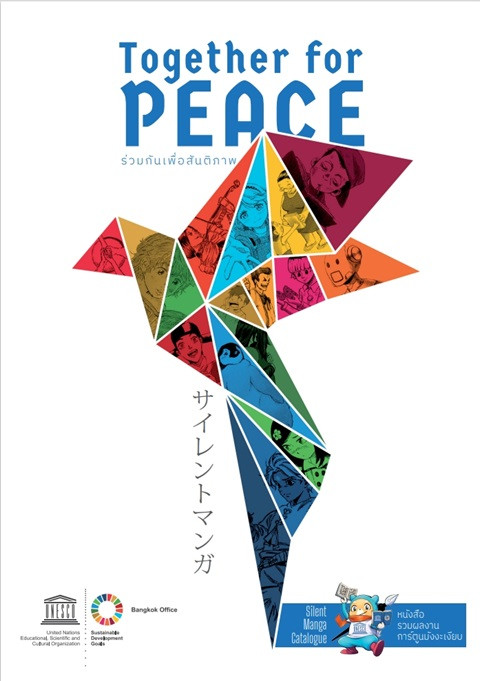 Together for Peace: Silent Manga Catalogue Year of publication: 2020 Author: Walden Schertz | Jeremy Clay | Santibhap Ussavasodhi Corporate author: UNESCO Bangkok | Coamix This Together for Peace Silent Manga Catalogue is a compilation of silent manga – manga stories told entirely through illustration without the use of dialogue. These works of art were selected from 274 entries submitted by artists in 117 countries worldwide to join SILENT MANGA AUDITION® Round 13 held under the theme Together for Peace, in collaboration with UNESCO Bangkok, the Asia and Pacific Regional Bureau for Education. Silent manga is a powerful medium of communication in the Asia-Pacific. Although the region is the most diverse in the world, it can be enjoyed by anyone regardless of their background. Silent manga has no language barrier. These works showcase different reflections of peace as expressed by artists around the world while conforming to the Japanese manga style.
  A Study on the Monitoring Framework of GCED in South Korea Year of publication: 2020 Author: Hwanbo Park | Daehoon Jho | Kyunghee Park | Jeongmin Eom Corporate author: APCEIU The purpose of this study is to establish a feasible monitoring system for the implementation of Global Citizenship Education (GCED) in South Korea that can both align itself with the global indicator (SDG 4.7.1) and reflect the domestic context and feasibility. The study further builds upon previous studies carried out by the Asia-Pacific Centre of Education for International Understanding (APCEIU). Particularly, it aims to refine and validate the GCED indicator system for domestic monitoring as proposed in the previous studies, which are also in line with SDG 4.7.1, the global indicator to monitor the mainstreaming of GCED/ESD.To this end, the study involved a Delphi survey and expert consultation to build the refined list and classification of GCED related thematic areas and keywords contextualized in Korea, and aligned these with global indicators so that it could establish a set of sub-indicators for the South Korean context. Then, it pilot-tested the sub-indicators by codifying and statistically analyzing key policy documents and the curricula of Teacher Education Institutes (TEIs) to validate the sub-indicators and to examine the extent to which GCED is mainstreamed in the given domains of the Korean context. Case analyses with focused interviews for some TEI curricula were also added to enrich the study. Lastly, the study draws key implications and proposes some recommendations for the establishment of a feasible and sustainable GCED monitoring system in South Korea. Considering the importance of national input in initiating the SDG agenda, the research concluded with a proposal on how to manage the global citizenship indicators in South Korea.
  Understanding GCED in Asia-Pacific: A How-to Guide for ‘Taking It Local’ Year of publication: 2020 Corporate author: APCEIU | UNESCO Bangkok The Asia-Pacific Centre of Education for International Understanding (APCEIU), in partnership with UNESCO Bangkok, has published “Understanding GCED in Asia-Pacific: A How-To Guide for ‘Taking It Local’”, a guidebook for GCED-themed workshop organizations in the region. The publication is developed by UNESCO Asia-Pacific Regional Bureau for Education under the framework of the Asia-Pacific Regional GCED Network that is coordinated by UNESCO Bangkok and APCEIU. Taking stock of the key data from the 2019 publication titled “GCED: Taking it Local in Asia-Pacific”, the guidebook presents full-detailed guidelines on preparing and conducting a ‘Taking it Local’ workshop on GCED with particular focuses on the three core notions of GCED – respect for diversity, solidarity and a shared sense of humanity. The purpose of the publication is to promote GCED in local contexts and support active GCED practitioners on the ground to design and carry out GCED workshops that are translated and designed fully within the local context of the Asia-Pacific region. <Contents>Chapter 1: Introduction1.1 What is GCED?1.2 Purpose of the Guidebook1.3 Pedagogical ApproachChapter 2: Preparing a ‘Taking it Local’ Workshop on GCED2.1 Workshop Objectives2.2 Target Audiences2.3 Workshop Preparation2.4 Tips for a Successful Workshop2.5 Sample Agenda for the WorkshopChapter 3: Conducting a ‘Taking it Local’ Workshop on GCED3.1 Welcome, Overview, and Agreements3.2 Introduction Exercise: Story Circles3.3 GCED in AsiaPacific Exercise3.4 Optional Activities for the Workshop 3.5 Application Exercise 3.6 Closing 3.7 Final Reflection and Workshop Evaluation 3.8 Sharing Reflections 3.9 FollowUp of the WorkshopReferences
  International Understanding and Cooperation in Education in the Post-Corona World Year of publication: 2020 Author: Dongjoon Jo | Edward Vickers | Dina Kiwan | Fei Yan | Kyujoo Seol | Kyoko Nakayama Corporate author: APCEIU Research Report of International Understanding and Cooperation in Education in the Post-Corona World APCEIU has published a report, including research studies from 6 experts in order to figure out the role of education in promoting international understanding and cooperation in the education sector in the post-pandemic world. Through this research project, APCEIU mainly sought to answer the following questions; ▲What will be the implications of COVID-19 for international exchange and cooperation especially in education?▲What should we as educators, researchers, and practitioners do to counter the rise of populist nationalism?▲What should be the focus and direction of international cooperation in education during and after the pandemic in order to promote international understanding and GCED? This research project is expected to provide insightful views on the desirable direction for international understanding and cooperation in the education sector. Table of Contents 1. The development of UNESCO’s exchange programmes and their possible rearrangements in the post-pandemic years (Dong-Joon Jo, Professor at Department of Political Science and International Relations, Seoul National University, Korea) 2. ‘Rethinking Schooling’ once again: Post-corona challenges for education for peace and sustainability in Asia (Edward Vickers, Professor of Comparative Education at Kyushu University, Japan) 3. Race, gender, disability, and their intersections under the impact of COVID-19 (Dina Kiwan, Professor in Comparative Education, University of Birmingham, United Kingdom) 4. Competition or cooperation: Configuring ‘International’ in Chinese school textbooks (Fei Yan, Post-Doctoral Research Fellow, South China University, China) 5. The implications of democratic citizenship education and global citizenship education in South Korea for the post-corona era (Kyujoo Seol, Professor of Social Studies Education, Kyeongin National University of Education, Korea) 6. What can we learn from the pandemic of COVID-19?: An attempt to develop teaching materials for international understanding and cooperation based on Japanese educational issues (Kyoko Nakayama, Professor of Social Studies Education and Multicultural Education, Teikyo University, Japan)
  Inaugural Meeting of the GCED Actors' Platform: Final Report Year of publication: 2020 Corporate author: APCEIU This final report gives an overview of discussions and outcomes from the “Inaugural Meeting of the GCED Actors’ Platform” on 2 September 2019 in Seoul, Republic of Korea, held back-to-back with the 4th International Conference on GCED (3-4 September 2019, Seoul) In line with the call for closer collaboration on GCED inter-regionally, the GCED Actors’ Platform was launched by UNESCO Headquarters and APCEIU in 2019. Convening regional coordinators and different partners working on GCED, the “Inaugural Meeting of the GCED Actors’ Platform” provided an open space for the participants to discuss ways to coordinate activities and promote synergies.The regional representatives have imparted their own experiences and challenges on the ground and shared best practices of facilitating GCED.
  Why Contextualization is Critical for Global Citizenship Education Year of publication: 2019 Author: Waqar Shams Corporate author: APCEIU This video is an interview on "Why contextualization is Critical for Global Citizenship Education". It is also under UNESCO's APCEIU "Meet the Global Citizens" series.Do you want to know why Contextualization is Critical for GCED? Check out what Waqar has to say. This is a story of Waqar Shams from Pakistan.In this video you will learn why Contextualization is Critical for GCED and through it, learn to think globally but act locally.
  Global Citizenship Education in Southern Africa: Learning to Live Together - the Role of Teachers; Report of a Networking Meeting Year of publication: 2019 Corporate author: UNESCO Harare | APCEIU This is a report on the second GCED networking meeting held from 28 to 29 October 2019 in Johannesburg, South Africa. It took stock of GCED in the region and discussed how GCED is and could be integrated in curricula and teacher education in the Southern African context to strengthen and expand the existing networks of GCED stakeholders and partners.
  [Summary] Global Citizenship Education Forum: Sharing Stories of Empowering Citizens to Tackle Global-Local Challenges Year of publication: 2022 Corporate author: Permanent Delegation of the Republic of Korea to UNESCO | Group of Friends for Solidarity and Inclusion with Global Citizenship Education | APCEIU This report shares the overview of the Global Citizenship Education Forum held under the theme ‘Sharing Stories of Empowering Citizens to Tackle Global-Local Challenges’ on Friday, 13 May 2022. The event was co-organized by the Permanent Delegation of the Republic of Korea to UNESCO and the Asia-Pacific Centre of Education for International Understanding (APCEIU) in collaboration with the Group of Friends for Solidarity and Inclusion with GCED (Afghanistan, Armenia, Austria, Bangladesh, Canada, Colombia, Italy, Jordan, Kenya, Kuwait, Philippines, Republic of Korea, Saudi Arabia, Senegal and Serbia). This report shares the summary of the event, particularly the presentations on GCED activities implemented by practitioners from Armenia, Austria, Colombia, Jordan, Kenya and the Philippines to influence more GCED programmes/initiatives on various contexts and backgrounds.
  APCEIU-MNUAC Joint Research on Establishing the Foundation for Promoting Global Citizenship Education in Higher Education Institutions in Mongolia Year of publication: 2025 Author: Daehoon Jho | Jihyang Lee | Odsuren Dagmid | Mandukhai Baldandorj | Tumennast Dashtsenden | Amartuvshin Myagmarsuren | Delgertsetseg Choijilsuren | Punsaldulam Binderiya Corporate author: APCEIU | Mongolia National University of Arts and Culture (MNUAC) This report reviews the integration of global citizenship education (GCED) in higher education and examines various approaches to establishing a foundation for promoting GCED in Mongolian HEIs. To this end, the study conducted a situational analysis on the current status of GCED at MNUAC. Based on this analysis, the report proposes a GCED integration roadmap for MNAUC, outlining a sequenced pathway that begins with achievable initiatives while also offering insights for other HEIs in Mongolia. The report is available in both English and Mongolian.
 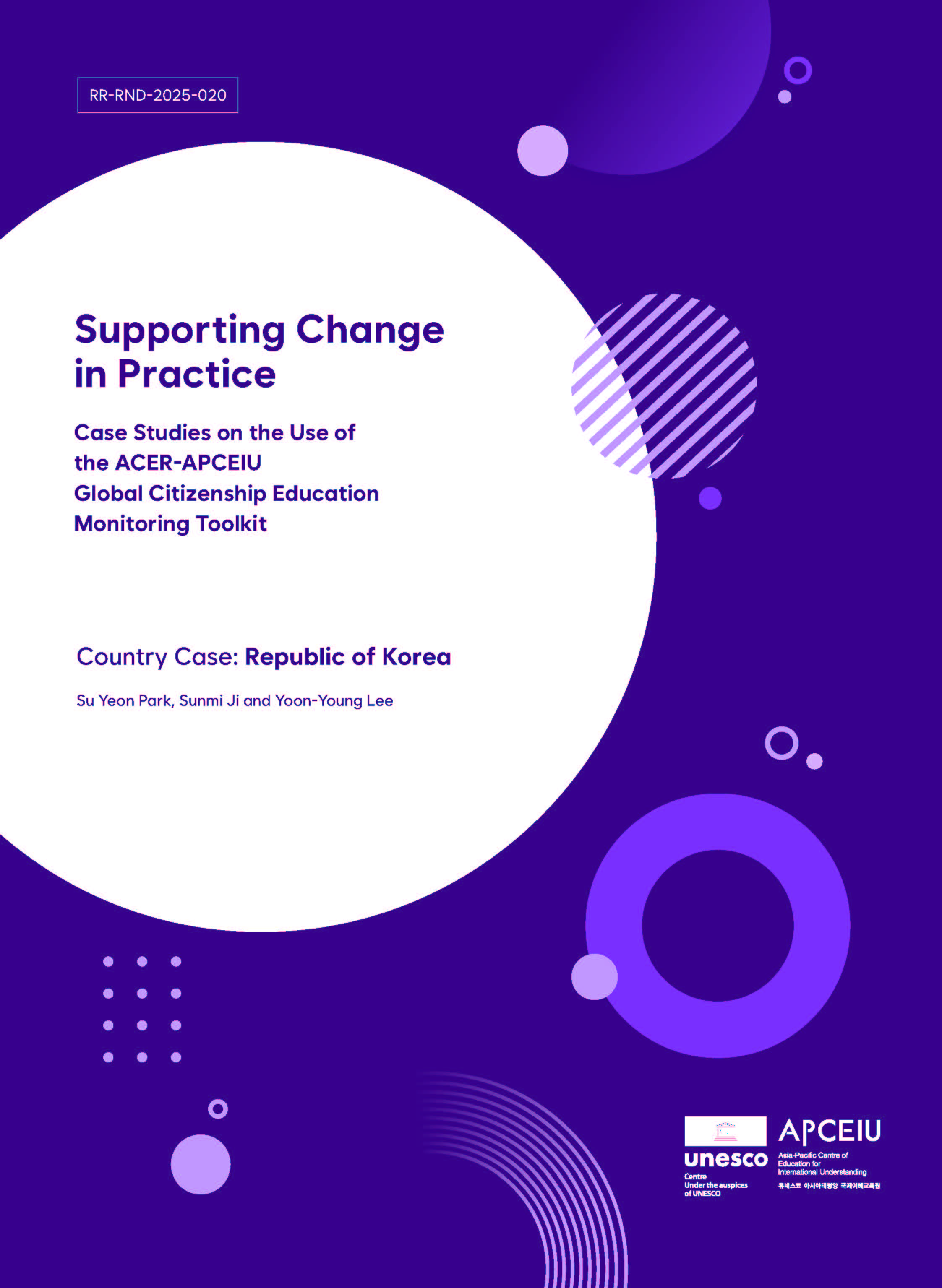 Supporting Change in Practice: Case Studies on the Use of the ACER-APCEIU Global Citizenship Education Monitoring Toolkit: Country Case-Republic of Korea Year of publication: 2025 Author: Suyeon Park | Sunmi Ji | Yoonyoung Lee Corporate author: APCEIU APCEIU is pleased to announce the release of its new publications, Supporting Change in Practice: Case Studies on the Use of the ACER-APCEIU Global Citizenship Education Monitoring Toolkit, which shares key findings from the research conducted in Australia and the Republic of Korea. The two reports, based on case studies from two countries, build upon the three-phase Asia-Pacific GCED Monitoring Project (2022–2024) jointly undertaken by ACER and APCEIU to strengthen monitoring and evaluation of GCED and support progress toward SDG 4.7 across the region. The three phases of the initiative identified enabling conditions for GCED, validated the regional GCED Monitoring Framework, and developed the ACER-APCEIU GCED Monitoring Toolkit. The reports for each phase can be found here: Phase I, Phase II, and Phase III. The newly released reports move the project forward by examining how the Toolkit can be practically applied in real educational settings. The study aimed to examine how the Toolkit could be used to support collaboration among key education stakeholders—teachers, school leaders, and education supervisors—in 1) goal setting, 2) planning, 3) implementing, and 4) reflecting on GCED practices. Through this process, the research sought to understand how the Toolkit could help strengthen the connection between policy commitments and everyday educational practice, supporting teachers, school leaders, and system leaders to embed GCED more systematically and sustainably within their existing framework. Both studies conducted in Australia and the Republic of Korea have been guided by the following research questions: 1. How does the GCED Monitoring Toolkit support key stakeholder groups to collaboratively embed GCED in policy and practice? a. What aspects of the Toolkit enable or challenge stakeholders to achieve their GCED goals and objectives? b. How do key stakeholders perceive its usefulness? 2. Are there any aspects of the Toolkit that stakeholders would change to improve its usefulness in supporting the implementation and contextualisation of GCED in policy and practice?The reports demonstrate how a GCED Monitoring Toolkit can be translated into actionable processes within real educational settings. It offers valuable insights for policymakers, school leaders, teachers, and researchers aiming to monitor and strengthen GCED implementation and systematically embed GCED within their educational ecosystems.