
Resources
Explore a wide range of valuable resources on GCED to deepen your understanding and enhance your research, advocacy, teaching, and learning.
8,340 Results found
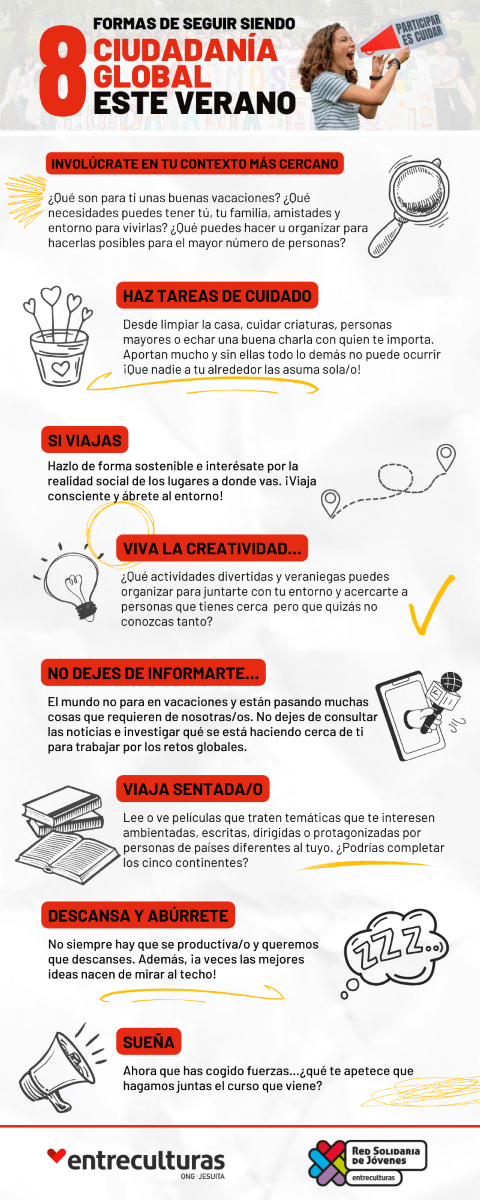 A Conscious Summer: 8 Ways to Remain a Global Citizen Year of publication: 2024 Corporate author: Entreculturas The holidays are here, and with them new ways of building global citizenship. Don't underestimate all that we can continue to do during the summer, through enjoyment, meeting and relaxation. In this infographic we present ideas to continue being global citizens. Go ahead and work on it with your groups and your environment!
 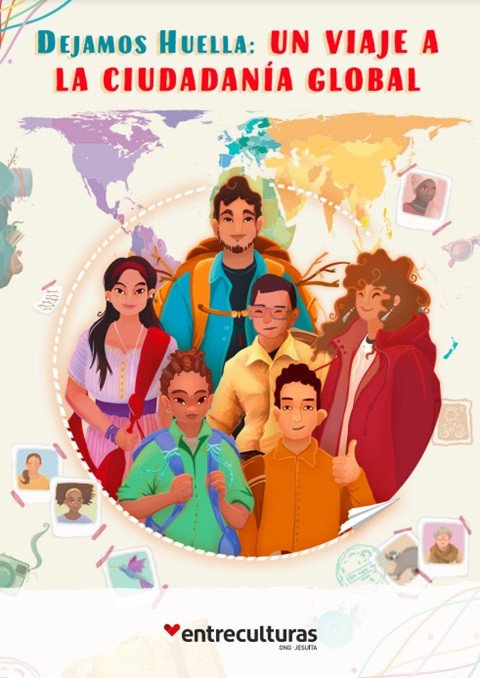 We Leave Our Mark: A Journey to Global Citizenship Year of publication: 2024 Corporate author: Entreculturas With this educational guide, students will be actively involved in exploring global and local issues with the aim of training agents of change in their own communities. They will take an educational journey through different themes (destinations) of Global Citizenship, such as gender equality, environmental protection, interculturality, inclusion, democratic participation, social justice and culture of peace. Each destination includes activities, games and practical exercises designed to raise students' awareness of the corresponding topic, using participatory dynamics such as games, puzzles, videos, and interactive simulations.
  Participatory Diagnosis of Youth Perceptions and Attitudes Towards Hate Speech and Denialism of Gender Violence and Rights of Migrants From the Approaches of Global Citizenship Education Year of publication: 2024 Author: Bárbara Biglia | Aloe Cubero Corporate author: InteRed | Agencia Española de Cooperación Internacional para el Desarrollo (AECID) This diagnosis seeks to respond to the need to explore the perceptions and attitudes of youth regarding hate speech, specifically those that deny gender violence and the rights of migrants. We wanted to carry out this process recognizing the agency of young people and therefore we seek to generate collective and mobilizing reflections that increase their commitment as agents of change in our society. To this end, we place ourselves within the framework of Feminist Activist Research (IAF) using photovoice as a research strategy.
 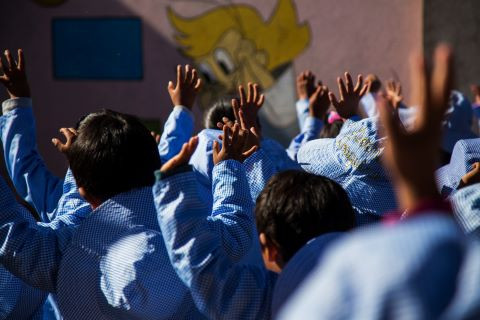 Weaving Education and Equity in Ibero-America Year of publication: 2024 Author: Ricardo Cuenca Corporate author: Organization of Ibero-American States for Education, Science and Culture (OEI) Addressing the complex relationship between education and inequality in Latin America is a challenge. Economic and social disparities create a complex network in the region. Despite progress, access remains an obstacle for many. During its 75-year history, the OEI has been working to break down the barriers that hinder equitable education for all. Ricardo Cuenca, member of the OEI Advisory Board, explains to what extent educational policies can contribute to mitigating these inequalities in Latin America.
  Media and Information Literacy: A Practical Guidebook for Trainers; Media Development Year of publication: 2018 Author: Sylvia Braesel | Thorsten Karg Corporate author: DW Academy The Media and Information Literacy (MIL) guide provides trainers with background information, ideas, methodology and practical exercises for training. Literacy is the ability to read and write. Media and Information Literacy (MIL) is the ability to understand how the media works and how it can be used to participate in public debate. MIL includes social media such as Facebook as well as traditional media such as books, newspapers, radio and television. This practical guide provides MIL trainers with background information, ideas, methodology and practical exercises for training.
  Location of INEE Resources on PSS-SEL Year of publication: 2024 Corporate author: Harvard Graduate School of Education (HGSE) | Inter-agency Network for Education in Emergencies (INEE) In these workshops, participants learned how to locate INEE PSS-SEL resources, including the INEE Background Document on Psychosocial Support and Psychoeducation for Children and Youth in Emergencies, the INEE Guidance Note on PSS, the PSS-SEL Toolkit, and the Guidance Note on Teacher Well-Being in Emergencies, and how to effectively adapt them to different contexts.
  No Fear at School: Prevention of Violence Against Children in Educational Settings; Colombia Country Report Year of publication: 2024 Corporate author: Aulas en Paz | Red Papaz This report presents an overview of progress in preventing and responding to violence against children and adolescents (NNA) in educational settings in Colombia, using the framework developed by Safe to Learn. This document is part of the initiatives led by the Latin American Hub for the Prevention of Violence Against Children in Schools, in which six Latin American countries participate and which is coordinated by Aulas en Paz.
  Brief Guidance Guide: To Combat Hate Speech on the Internet Through Human Rights Education Year of publication: 2016 Author: Ellie Keen | Mara Georgescu Corporate author: Youth Institute | Council of Europe The Youth Institute has published “Bookmarks”, a guide to combat hate speech on the Internet, which aims to be a brief and useful manual for the dissemination of concepts related to human rights and freedom of expression, as well as to raise and face the challenge of defending these rights on the Internet from a young perspective. It also aims to become a practical tool for action, training and awareness-raising work, aimed at both young people themselves and trainers, to establish in a simple way the essential concepts related to online hate speech and provide mechanisms to combat it.
  Guide to Coexistence and Restorative Practices Year of publication: 2020 Author: Juan de Vicente Abad Corporate author: Assembly of Cooperation for Peace This guide to coexistence and restorative practices aims to join this collective movement that places coexistence as the central axis of teaching practice. Its objective is to provide teachers with very practical and useful strategies to effectively manage coexistence in the classroom. It is a proposal to address coexistence from a preventive, participatory and people-centered dimension, which conceives coexistence not only as an objective but as an object of intentional learning, which perceives conflict as an opportunity and with an inclusive and restorative perspective, betting on a restorative approach. In the guide you can find practical activities, the purpose of which is to guide educational centers to know and implement the restorative model, through a series of resources that range from the analysis of coexistence to restorative conversations to resolve daily conflicts.
  How to Prevent Hate Speech? Year of publication: 2022 Author: Adrián Vives Corporate author: Assembly of Cooperation for Peace The guide “How to prevent hate speech?” is aimed at teaching staff and aims to serve as a support document for working to eradicate hate speech in and through the classroom. In this guide we aim to offer some keys to working against hate speech in and through the educational field, understanding that prevention is essential to ending it. To do so, it is necessary to address it directly, as we do in the first block; but also through intercultural education that eliminates stereotypes and prejudices, as we explain in the second block; and through practical activities that we present in the last block.