
Resources
Explore a wide range of valuable resources on GCED to deepen your understanding and enhance your research, advocacy, teaching, and learning.
8,340 Results found
 The Climate Dictionary: Speak Climate Fluently Year of publication: 2023 Corporate author: United Nations Development Programme (UNDP) The Climate Dictionary is a guide to understanding climate change. It aims to bridge the gap between complex scientific jargon and the general public, making climate concepts accessible and understandable to people of different backgrounds and levels of expertise. It is based on the belief that empowering people with knowledge is crucial to fostering collective action and responsibility in the face of climate change. Using a creative combination of engaging images, concise explanations and engaging storytelling, The Climate Dictionary effectively communicates complex climate concepts in a visual and easy-to-consume way.
  Our Common Agenda Policy Brief 10: Transforming Education Year of publication: 2023 Corporate author: United Nations (UN) Building on the Transforming Education Summit and the report of the International Commission on the Futures of Education, this policy brief takes a closer look at the current crisis in education and proposes ideas and guiding actions for countries and the international community to transform education. The right to education and lifelong learning is an essential part of the 2030 Agenda for Sustainable Development because education, knowledge and learning are fundamental to human dignity, growth and development. For centuries, education has been the great equalizer, the driving force of nation-building and the engine of social, cultural, economic and technological progress. But today, beset by a dual crisis of equity and relevance, education as we know it is no longer fit for purpose.
  Solidarity as the Future of Education: Perspectives From the Ibero-American Experience of Service-Learning Year of publication: 2024 Author: Elena Massat Corporate author: UNESCO | Latin American Center for Service-Learning (CLAYSS) With this work we have proposed to put into dialogue the recent UNESCO document “Reimagining our futures together. A new social contract for education. Report of the international commission on the futures of education” with the theory and practice of service-learning in Ibero-America. We would like to show how UNESCO's proposal for education for the future can already be verified as a practice in many educational institutions in the region, which develop solidarity service-learning projects even in the most vulnerable contexts. In these experiences, solidarity ceases to be just learning content, to become an educational process, a pedagogy to learn to solve complex problems of reality, and to use the SDGs as a “curriculum” for the education of the future (UNESCO, 2022:54). These practices are deeply innovative, as the experts who comment on them point out, and we hope that they can be inspiring for many other educational institutions.
 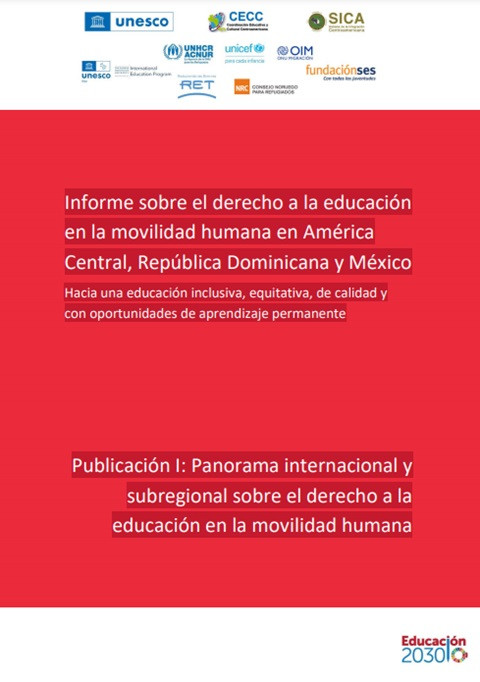 Report on the Right to Education in Human Mobility in Central America, the Dominican Republic and Mexico: Towards Inclusive, Equitable, Quality Education With Lifelong Learning Opportunities Year of publication: 2024 Corporate author: UNESCO San José | Central American Educational and Cultural Coordination | Central American Integration System Although human mobility is not a new phenomenon, data indicate that the number of people in this situation has reached its highest point since records began and there are no signs that the trend will decrease in the coming years. This scenario threatens to become a structural situation, strongly impacting the right to education and educational systems. Therefore, it is imperative that States and other key actors make a deep commitment to guarantee the fundamental right to education of people in situations of mobility through urgent measures, in line with the provisions of Sustainable Development Goal (SDG) 4 of the United Nations 2030 Agenda. For this reason, the preparation of this Report on the right to education of people in situations of mobility in Belize, Costa Rica, El Salvador, Guatemala, Honduras, Mexico, Nicaragua, Panama and the Dominican Republic has been undertaken. The Report is an effort by UNESCO and the Central American Educational and Cultural Coordination (CECC/SICA) in collaboration with UNHCR, IOM, UNICEF, the Norwegian Refugee Council and RET International, and with the technical support of the SES Foundation and the UNESCO Chair for the Development of International Education at George Washington University (United States).
  Young People: Protagonists of Democratic Transformation Year of publication: 2024 Corporate author: Organization of Ibero-American States for Education, Science and Culture (OEI) The involvement of young people in democracy is essential for the development and sustainability of our societies. Recognizing the value of their contribution as agents of change, the Citizen Academy project in Panama launched the course "The Role of Youth in Democracy." This educational tool is offered free of charge through the platform www.academiaciudadana.org. The initiative, promoted by the Organization of Ibero-American States (OEI), is the result of a collaboration with the Electoral Tribunal, Fundamorgan and the Panamanian Debate Association (Aspade), and aims to promote a more just and equitable society through civic education for the new generations. Daniela Hidalgo, institutional coordinator of Aspade, explains how they seek to transform youth participation in the democratic life of the Central American country.
 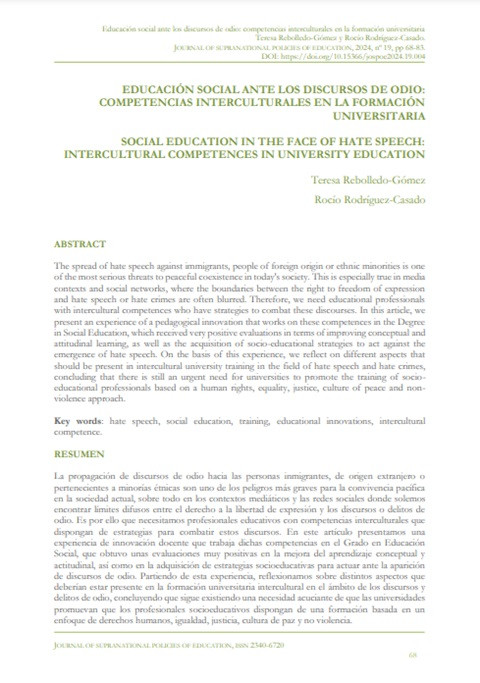 Social Education in the Face of Hate Speech: Intercultural Competences in University Education (Journal of Supranational Policies of Education; Vol. 1, No. 19) Year of publication: 2024 Author: Teresa Rebolledo Gámez | Rocío Rodríguez-Casado Corporate author: Autonomous University of Madrid The spread of hate speech against immigrants, people of foreign origin or ethnic minorities is one of the most serious threats to peaceful coexistence in today's society. This is especially true in media contexts and social networks, where the boundaries between the right to freedom of expression and hate speech or hate crimes are often blurred. Therefore, we need educational professionals with intercultural competences whohave strategies to combat these discourses. In this article, we present an experience of a pedagogical innovation that works on these competences in the Degree in Social Education, which received very positive evaluations in terms of improving conceptual and attitudinal learning, as well as the acquisition of socio-educational strategies to act against the emergence of hate speech. On the basis of this experience, we reflect on different aspects that should be present in intercultural university training in the field of hate speech and hate crimes, concluding that there is still an urgent need for universities to promote the training of socio-educational professionals based on a human rights, equality, justice, culture of peace and non-violence approach.
  Podcast: Right to Education Against Hate Speech (SAME 2024) Year of publication: 2024 Corporate author: Global Campaign for Education (GCE) The Global Action Week for Education (GAE) 2024 has been the perfect setting for children and adolescents to contribute their voice and perspective to the issue of hate speech. Through awareness-raising and reflection workshops, children and adolescents have shared complex personal situations and cases of hate that they have witnessed, reproduced or experienced first-hand. Guided by their reflections, the participants designed a two-chapter podcast, where they addressed the issues that concern them most. This process not only allowed them to deepen their understanding of the normalization of hate speech and structural violence, but also to prepare for the production of the podcast, where they were able to express their thoughts and proposals in a creative and accessible way for a wider audience.
 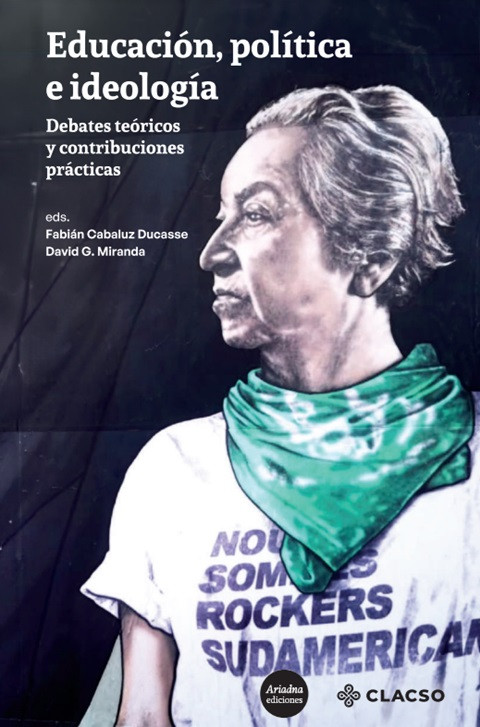 Education, Politics and Ideology: Theoretical Debates and Practical Contributions Year of publication: 2024 Author: David G. Miranda | Jorge Fabián Cabaluz Ducasse Corporate author: Latin American Council of Social Sciences (CLACSO) This book, "Education, Politics and Ideology: Theoretical Debates and Practical Contributions", is a work by the Latin American Pedagogies Research Group at the University of Playa Ancha, which is positioned from a critical perspective in the educational and pedagogical field. This currently implies, among other things, the relevance of discussing, polemizing and confronting those perspectives that have technified and instrumentalized pedagogy, reducing it to a merely practical, technical field, unrelated to epistemological, ethical, philosophical and/or political issues. In this direction, the essays that make up the book distance themselves substantially from those perspectives that conceive our field as a terrain that must advocate for neutrality, impartiality, and asepsis; and they propose clear and explicit positions with respect to social justice, democracy, equality, and dignity.
 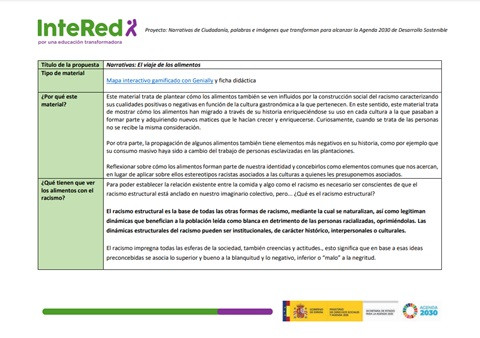 Narratives: The Journey of Food Year of publication: 2024 Corporate author: InteRed This is an interactive game that raises the question of how food is also influenced by the social construction of racism, characterising its positive or negative qualities, depending on the gastronomic culture to which it belongs. In this sense, this material tries to show how food has migrated throughout history, enriching its use in each culture it became part of and acquiring new nuances that made it grow and become richer. Curiously, when it comes to people, the same consideration is not given. On the other hand, the spread of some foods also has more negative elements in their history, such as the fact that their mass consumption has been in exchange for the work of enslaved people on plantations.
 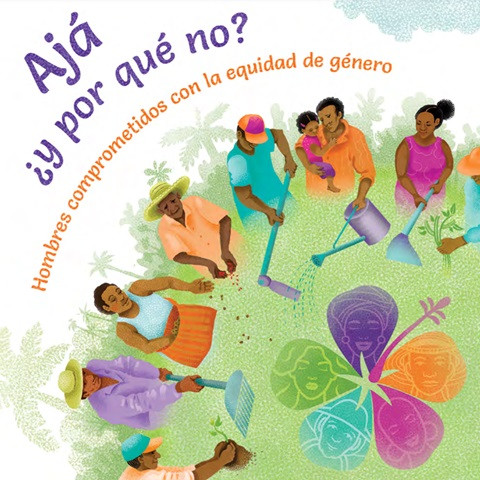 Aha, and Why Not? Men Committed to Gender Equality Year of publication: 2024 Author: María Camila Barrera Gutiérrez | Nyria Ramírez Ortega Corporate author: Center for Research and Popular Education / Program for Peace (CINEP/PPP) This political-methodological booklet has been prepared by the Caribbean Women's Coalition for Land and Territory within the framework of the Stand For Her Land – S4HL Colombia campaign. The purpose of this document is to make available to social organizations, popular educators, teachers, leaders, human rights defenders and facilitators of this training process that has been a communication and popular education initiative to promote community dialogues on non-violent masculinities. The strategy presented here is made up of two inputs: a sound series composed of five chapters and a methodological proposal to address them through community dialogue exercises.