
Resources
Explore a wide range of valuable resources on GCED to deepen your understanding and enhance your research, advocacy, teaching, and learning.
8,374 Results found
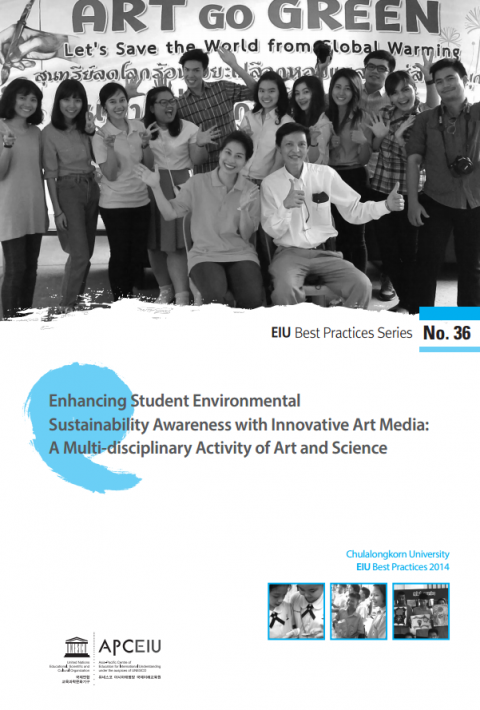 EIU Best Practices Series No. 36: Enhancing Student Environmental Sustainability Awareness with Innovative Art Media: A Multidisciplinary of Art and Science Activities Year of publication: 2014 Author: Poonarat Pichayapaiboon Corporate author: APCEIU This issue is one of APCEIU's EIU Best Practices Series, which aims to encourage educators, scholars, and activists to implement and share local initiatives on EIU. The Series No.36 introduces a multidisciplinary programme of art and science activities implemented in Thailand’s Chulalongkorn University to raise students’ awareness of environmental sustainability. Given the country’s large volume of green mussels, there is increasing concern for shell waste management and global warming. As students of varied age learn how shells can be transformed into pigment and clay, and use to create artwork as part of “Turning Waste into Art to Live a Sustainable Life” project, students come to appreciate the value of environmental protection and management. The programme is an exemplary case in which children are educated to live in harmony with the earth, following one of the key pillars of EIU.
  School-related gender-based violence: global guidance (Infographic) Year of publication: 2016 Corporate author: UNESCO | United Nations Entity for Gender Equality and the Empowerment of Women (UN Women) School-related gender-based violence: global guidance (Infographic)
  Global guidance on addressing school related gender based violence Year of publication: 2016 Corporate author: UNESCO | United Nations Entity for Gender Equality and the Empowerment of Women (UN Women) More than 246 million children are subjected to gender-based violence in or around schools every year. This is a violation of their human rights, and a form of gender-discrimination that has far-reaching physical, psychological and educational consequences. Ending schoolrelated gender-based violence (SRGBV) is a priority for countries wishing to achieve ambitious global goals on inclusive and quality education for all and gender equality.WHAT IS THE AIM OF THIS GUIDANCE? This guidance aims to provide a comprehensive, one-stop resource on school-related gender-based violence (SRGBV), including clear, knowledge-based operational guidance, diverse case studies drawn from examples of promising practice and recommended tools for the education sector and its partners working to eliminate gender-based violence. It distils programme knowledge based on existing global literature, promising practices, expert recommendations and practitioner consensus.WHO IS THIS GUIDANCE FOR? The primary audience for this global guidance is the national education sector, including government policy-makers, education ministries, school administrators, educators and other school staff. The guidance may also have wider interest for other national and international stakeholders that are interested in addressing SRGBV, including NGOs, bilateral and multilateral agencies, teachers’ trade unions and policy-makers in other domestic sectors. The guidance is intended primarily for use in low- and middle-income settings, but is based on norms and principles that are universally applicable.WHAT IS COVERED IN THIS GUIDANCE? Promising practice case studies and recommended tools are embedded throughout the relevant sub-sections of the guidance. These provide readers with illustrative examples of implementation in real-life contexts and can serve as resources that have been successfully used – and can be adapted – for application in different contexts.This guidance complements other existing tools and materials for specific bilateral, multilateral and NGO audiences on violence against women and girls, and violence in schools. An expanded online version, which will be regularly updated, is available at www.endvawnow.org
 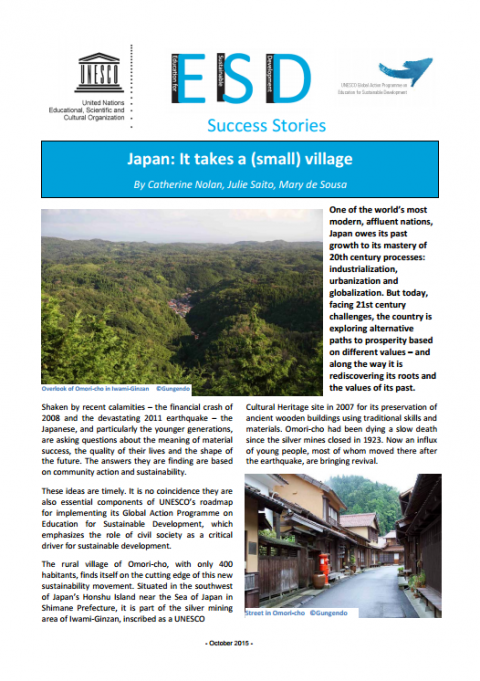 Japan: it takes a (small) village Year of publication: 2015 Author: Catherine Nolan | Julie Saito | Mary de Sousa Corporate author: UNESCO ESD Success Stories are showcasing compelling stories with a personal/human dimension from all five UNESCO regions (Africa, Arab States, Asia and Pacific, Europe & North America and Latin America & the Caribbean). The stories illustrate the wide diversity of ESD approaches and initiatives taking place in different parts of the world. They show how involvement with ESD has changed the lives of specific individual persons and how they have become more active in their community. Each story centers on one individual or a group of individuals.The small village of Omori-cho in Japan explores alternative paths to prosperity based on community action and sustainability.
 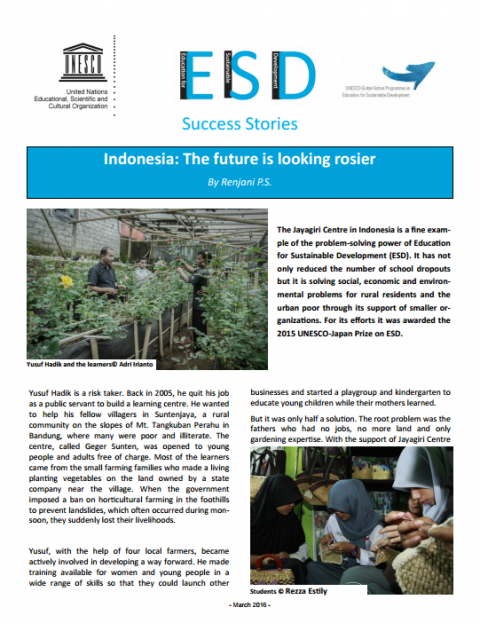 Indonesia: the future is looking rosier Year of publication: 2016 Author: P.S. Renjani Corporate author: UNESCO ESD Success Stories are showcasing compelling stories with a personal/human dimension from all five UNESCO regions (Africa, Arab States, Asia and Pacific, Europe & North America and Latin America & the Caribbean). The stories illustrate the wide diversity of ESD approaches and initiatives taking place in different parts of the world. They show how involvement with ESD has changed the lives of specific individual persons and how they have become more active in their community. Each story centers on one individual or a group of individuals.The Jayagiri Centre in Indonesia teaches environment-friendly business skills. It helps reduce the number of school dropouts and supports rural residents.
 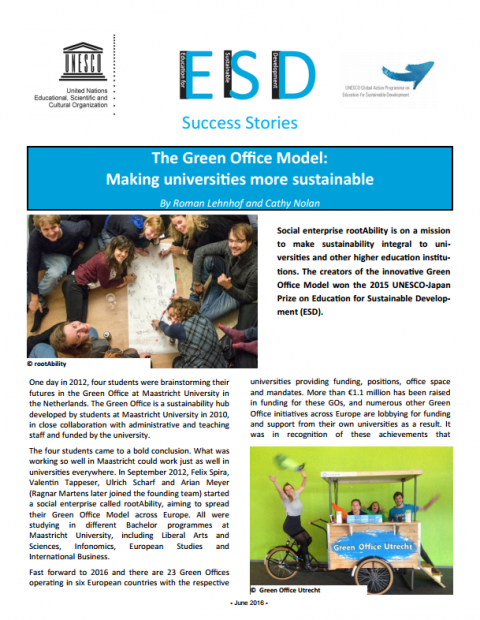 The Green office model: making universities more sustainable Year of publication: 2016 Author: Roman Lehnhof | Cathy Nolan Corporate author: UNESCO ESD Success Stories are showcasing compelling stories with a personal/human dimension from all five UNESCO regions (Africa, Arab States, Asia and Pacific, Europe & North America and Latin America & the Caribbean). The stories illustrate the wide diversity of ESD approaches and initiatives taking place in different parts of the world. They show how involvement with ESD has changed the lives of specific individual persons and how they have become more active in their community. Each story centers on one individual or a group of individuals.The rootAbility, a social enterprise, is planned by four students at Maastricht University, aiming to spread Green Office Model across Europe. The Green Office can effectively drive a dynamic sustainability process in universities and other institutions of higher education by collaboratively working with students and university staffs and integrating sustainability into university’s teaching and research.
 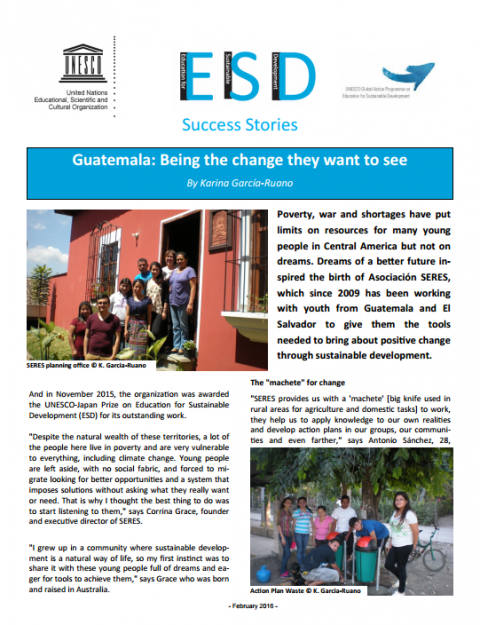 Guatemala: being the change they want to see Year of publication: 2016 Author: Karina García-Ruano Corporate author: UNESCO ESD Success Stories are showcasing compelling stories with a personal/human dimension from all five UNESCO regions (Africa, Arab States, Asia and Pacific, Europe & North America and Latin America & the Caribbean). The stories illustrate the wide diversity of ESD approaches and initiatives taking place in different parts of the world. They show how involvement with ESD has changed the lives of specific individual persons and how they have become more active in their community. Each story centers on one individual or a group of individuals.Asociación SERES, from Guatemala and El Salvador, works with youth to give them the skills needed to bring about positive change through sustainable development.
 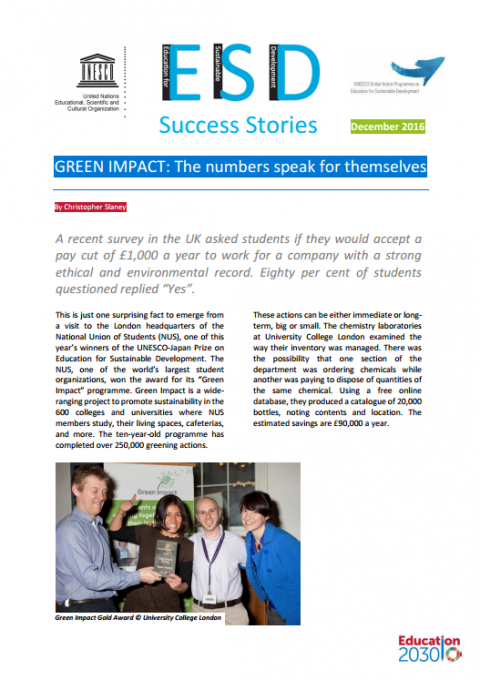 Green impact: the numbers speak for themselves Year of publication: 2015 Author: Christopher Slaney Corporate author: UNESCO ESD Success Stories are showcasing compelling stories with a personal/human dimension from all five UNESCO regions (Africa, Arab States, Asia and Pacific, Europe & North America and Latin America & the Caribbean). The stories illustrate the wide diversity of ESD approaches and initiatives taking place in different parts of the world. They show how involvement with ESD has changed the lives of specific individual persons and how they have become more active in their community. Each story centers on one individual or a group of individuals.The National Union of Students (NUS) UK enables, accredits and awards university departments for sustainability efforts through its "Green Impact" scheme.
 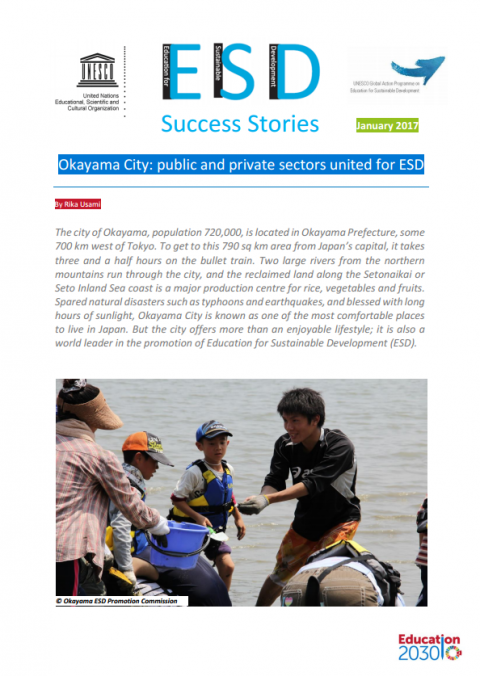 Okayama City: public and private sectors united for ESD Year of publication: 2017 Author: Rika Usami Corporate author: UNESCO ESD Success Stories are showcasing compelling stories with a personal/human dimension from all five UNESCO regions (Africa, Arab States, Asia and Pacific, Europe & North America and Latin America & the Caribbean). The stories illustrate the wide diversity of ESD approaches and initiatives taking place in different parts of the world. They show how involvement with ESD has changed the lives of specific individual persons and how they have become more active in their community. Each story centers on one individual or a group of individuals.Okayama City is known as one of the most comfortable places to live in Japan.The city offers more than an enjoyable lifestyle; it is also a world leader in the promotion of Education for Sustainable Development (ESD).
  Mainstreaming SDG4-Education 2030 in sector-wide policy and planning: technical guidelines for UNESCO field offices Year of publication: 2016 Corporate author: UNESCO The main responsibility for implementing the SDG4-Education 2030 Agenda lies with governments, with UNESCO and partners providing support through coordinated policy advice, technical assistance, capacity development and monitoring of progress at global, regional and national levels. By their position, UNESCO field offices have a key role to play in providing such support at country level and therefore require adequate technical capacity to fulfil their mission.These guidelines aim at providing a basic resource to field offices for ensuring adequate technical support to national authorities in this process. In doing so, it takes into account different profiles of country needs and capacities, thus avoiding a one-size-fits-all approach. Countries may have different levels of awareness of, or political commitment to, Sustainable Development Goal 4 (SDG4). In all cases, UNESCO is expected to ensure that all the relevant information about SDG4-Education 2030 is properly disseminated and that national authorities and stakeholders are reminded of its importance. To assist field offices in this task UNESCO has developed and made available a number of resources and support materials, notably the Unpacking SDG4-Education 2030 Guide, parts of which are excerpted here, and will continue coordination efforts in this respect.Inevitably, field staff will have to adapt the guidelines provided here to the reality of the country they are serving. That is why this document is full of resources and pointers that can be combined and tailored to fit the particular context of each country. At the same time, field staff are invited to require additional technical guidance from the corresponding regional bureaus, which can rely on the backstopping of Headquarters services and support from the specialized institutes.These guidelines represent a first attempt to provide specific directions and resources to allow field offices to technically support Member States. After a first evaluation, in which all field staff are invited to participate, the guidelines will be improved so as to make them even more suitable and useful. They will also be supplemented with other material to ensure that UNESCO plays its role as the leading United Nations agency in the field.