
Resources
Explore a wide range of valuable resources on GCED to deepen your understanding and enhance your research, advocacy, teaching, and learning.
8,376 Results found
 Combating Violence and Bullying in Schools: UNESCO's Action Year of publication: 2017 Corporate author: UNESCO This item has been included in the provisional agenda of the 201st session of the Executive Board at the request of Morocco, with the support of Algeria, Cambodia, Côte d’Ivoire, Egypt, France, Italy, Lebanon, Qatar and Sudan.
  Address by Irina Bokova, Director-General of UNESCO, on the occasion of the lecture: Preventing violent-extremism in the 21st century: fostering a new generation of global citizens at the Center for Conflict Resolution; Salisbury University, 4 April 2017 Year of publication: 2017 Corporate author: UNESCO. Director-General, 2009-2017 (Bokova, I.G.) This address was given by Irina Bokova, Director-General of UNESCO on the occasion of the lecture “Preventing violent-extremism in the 21st century: fostering a new generation of global citizens” at the Center for Conflict Resolution.
  UNESCO and Education Year of publication: 2017 Corporate author: UNESCO Education is a fundamental human right and
a public good and, as such, has been at the core of UNESCO’s work since its inception.Education is also the path to sustainability – to poverty alleviation, better health, environmental protection and gender equality.As the only United Nations agency with a mandate to cover all aspects of education, UNESCO was entrusted in 2015 to lead the coordination and monitoring of Sustainable Development Goal 4, as part of the new Global Education 2030 Agenda.Goal 4 aims to “ensure inclusive and equitable quality education and promote lifelong learning opportunities for all,” and renewed UNESCO’s and Member States’ commitment to a vision of education that is holistic, inspirational and which leaves no one behind.This commitment is reflected in the size and scope of the Education Sector, the largest in UNESCO, with staff working at its Paris Headquarters and spread across a global network of field offices and specialized institutes and centres. With its close links with education ministries and other partners, UNESCO is strongly placed to press for action and change.UNESCO’s Education Sector supports Member States in developing education systems that foster high-quality and inclusive lifelong learning for all, empowering learners to be creative and responsible global citizens while leading the debate to help shape the future international education agenda.There is no stronger, no more lasting, investment a country can make than educating its citizens. The Education Sector exists to further this collective vision worldwide by transforming lives one by one.
UNESCO and Education Year of publication: 2017 Corporate author: UNESCO Education is a fundamental human right and
a public good and, as such, has been at the core of UNESCO’s work since its inception.Education is also the path to sustainability – to poverty alleviation, better health, environmental protection and gender equality.As the only United Nations agency with a mandate to cover all aspects of education, UNESCO was entrusted in 2015 to lead the coordination and monitoring of Sustainable Development Goal 4, as part of the new Global Education 2030 Agenda.Goal 4 aims to “ensure inclusive and equitable quality education and promote lifelong learning opportunities for all,” and renewed UNESCO’s and Member States’ commitment to a vision of education that is holistic, inspirational and which leaves no one behind.This commitment is reflected in the size and scope of the Education Sector, the largest in UNESCO, with staff working at its Paris Headquarters and spread across a global network of field offices and specialized institutes and centres. With its close links with education ministries and other partners, UNESCO is strongly placed to press for action and change.UNESCO’s Education Sector supports Member States in developing education systems that foster high-quality and inclusive lifelong learning for all, empowering learners to be creative and responsible global citizens while leading the debate to help shape the future international education agenda.There is no stronger, no more lasting, investment a country can make than educating its citizens. The Education Sector exists to further this collective vision worldwide by transforming lives one by one. 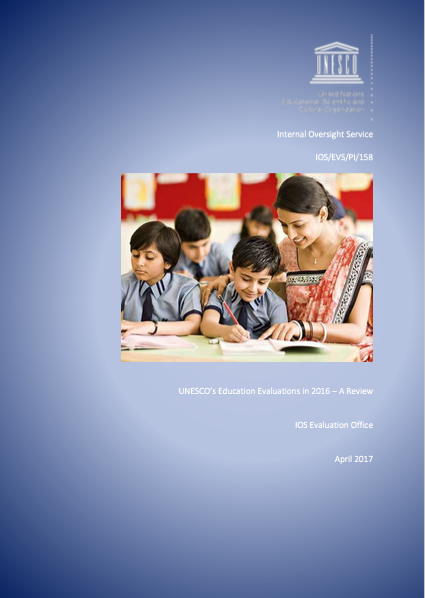 UNESCO's Education Evaluation in 2016: A Review Year of publication: 2017 Corporate author: UNESCO UNESCO completed 12 education related evaluations in 2016. Part A of this review presents the key insights and lessons learned from those evaluations. These learnings are designed to help enhance UNESCO’s leadership and coordination of the SDG 4 – Education 2030 Agenda. Part B of the review provides an assessment of the quality and usefulness of these evaluations based on the UNEG and OECD quality standards for evaluation reports.
  Curriculum in the Education 2030 Agenda: Latin America and the Caribbean Year of publication: 2017 Author: Renato Opertti Corporate author: UNESCO International Bureau of Education (IBE) “Curriculum in the Education 2030 Agenda: Latin America and the Caribbean”1 discusses the importance of rethinking the curriculum in light of a transformational, humanistic and holistic vision of education. The Education 2030 Agenda, which emerged from the World Education Forum (WEF) 2015 held in Incheon, Republic of Korea, positions curriculum as a powerful education policy tool leading the way to effective, relevant and sustainable learning opportunities, processes and outcomes. Curricula have a positive effect as levers for the sustainable, inclusive, fair and cohesive development of a country. They reflect and help to construct the type of society envisioned. The article provides recommendations to strengthen the positioning of curriculum toward an inclusive and equitable quality education in Latin America and the Caribbean. It therefore addresses the following questions: 1) How is curriculum currently conceived?; 2) What role does it play in the reforms aimed at improving equity and quality of the learning processes?; 3) What are the main regional challenges in relation to curriculum development?; and 4) How could countries align their curricula with their development needs?
  Evaluation of UNESCO's Capacity Development for Education for All (CapEFA) Programme Year of publication: 2016 Corporate author: UNESCO The main purpose of this evaluation is to determine the relevance and effectiveness of the Capacity Development for Education for All (CapEFA) programme’s overall contribution to progress towards the realization of the Education for All (EFA) goals in its target countries, and to provide actionable and timely recommendations to the United Nations Educational, Scientific and Cultural Organization (UNESCO) on the positioning of the Programme to meet future needs and challenges related to the adoption of the Sustainable Development Goals (SDG) in September 2015, and more specifically to the SDG 4 to ‘Ensure inclusive and equitable quality education and promote lifelong learning opportunities for all’. The focus of this evaluation is on assessing the CapEFA programme’s relevance, effectiveness, efficiency, and sustainability. This evaluation does not focus on how the programme impacts on the EFA goals, due to the challenge in assessing the causality between the programme’s goals and the EFA indicators. The focus of the assessment is on whether the right conditions at the systemic and institutional levels are created to have an impact on these EFA macro-indicators.
  UNESCO Global Action Programme on Education for Sustainable Development: information folder Year of publication: 2017 Corporate author: UNESCO This is a comprehensive folder containing 13 information sheets on different aspects of the Global Action Programme on ESD (GAP) and its key actors and partners. It aims to familiarize educators, learners and the general public with the GAP and advise them on how to spread the word.
  Address by Irina Bokova, Director-General of UNESCO, on the Role of UNESCO in Countering Anti-Semitism and Preserving the Legacy of the Holocaust on the occasion of the launch of UNESCO's guide on Holocaust Education and Genocide Prevention, 15th Plenary Assembly of the World Jewish Congress, New York, 24 April 2017 Year of publication: 2017 Corporate author: UNESCO. Director-General, 2009-2017 (Bokova, I.G.) This address was given by Irina Bokova, Director-General of UNESCO, on the role of UNESCO in countering anti-semitism and preserving the legacy of the holocaust on the occasion of the launch of UNESCO's guide on Holocaust Education and Genocide Prevention, 15th Plenary Assembly of the World Jewish Congress.
  Address by Irina Bokova, Director-General of UNESCO, on the occasion of the UNESCO Week for Peace and Sustainable Development: The Role of Education; Ottawa, Canada, 8 March 2017 Year of publication: 2017 Corporate author: UNESCO. Director-General, 2009-2017 (Bokova, I.G.) This address was presented by Irina Bokova, Director-General of UNESCO on the occasion of the UNESCO Week for Peace and Sustainable Development. She highlights on the role of education.
 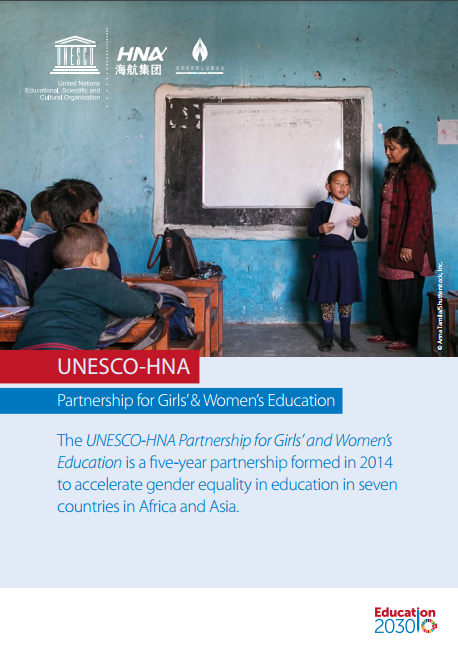 UNESCO-HNA Partnership for Girls' & Women's Education Year of publication: 2017 Corporate author: UNESCO The UNESCO-HNA Partnership for Girls’ and Women’s Education is one component of the “Better Life, Better Future” Global Partnership for Girls’ and Women’s Education launched by UNESCO in 2011. The Global Partnership recognizes that educating girls and women can break the cycle of poverty, foster greater social justice and contribute to the achievement of the Sustainable Development Goals. It aims to expand and improve the quality and relevance of education for girls and women, creating a better life and better future for all members of society for generations to come.