
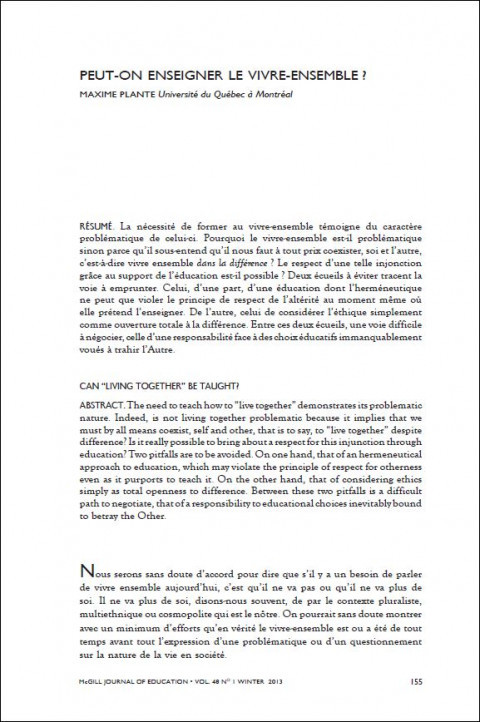
Can “Living Together” Be Taught?
- Autor
- Maxime Plante
- Autor Corporativo
- McGill University. Faculty of Education
- ISBN
- ISSN 1916-0666 (numérique)
- Colección
- p. 155–164
- Idioma del recurso
- francés
- Año de publicación
- 2013
- Tema
- Civiles / Ciudadanía / DemocraciaDiversidad / Alfabetización cultural / InclusiónPaz / Cultura de paz
- Tipo de Recurso
- International normative instruments / policy and advocacy documentsResearch papers / journal articles
- Nivel de Educación
- Educación no formal
- Región
- Global
- Lugar de publicación
- Québec
The need to teach how to “live together” demonstrates its problematic nature. Indeed, is not living together problematic because it implies that we must by all means coexist, self and other, that is to say, to “live together” despite difference? Is it really possible to bring about a respect for this injunction through education? Two pitfalls are to be avoided. On one hand, that of an hermeneutical approach to education, which may violate the principle of respect for otherness even as it purports to teach it. On the other hand, that of considering ethics simply as total openness to difference. Between these two pitfalls is a difficult path to negotiate, that of a responsibility to educational choices inevitably bound to betray the Other.
Recursos Relacionados
-
 IIEP-UNESCO 12th Medium-Term Strategy: 2026–2029
 -
 Youth Lens on the Silk Roads: Best Photos from the International Silk Roads Photo Contest; 6th Edition
 -
 Advancing Intergenerational Learning: Identifying Challenges and Opportunities for Older Adults; Integrated Case Study Report
 -
 Digital Empowerment for Lifelong Learning and Transformative Andragogy (DELTA) for Adult Educators: Introduction to the DELTA Framework and Resources