
Recursos
Exploren una amplia gama de recursos valiosos en GCED para profundizar su comprensión y promover su búsqueda, incidencia, enseñanza y aprendizaje.
54 resultados encontrados
 Gesturing Towards Decolonial Futures Collective: Global Citizenship Education Otherwise; Study Guide Año de publicación: 2019 Autor: Vanessa de Oliveira Andreotti | Sharon Stein | Rene Suša | Dani d’Emilia | Elwood Jimmy | Bill Calhoun | Sarah Amsler | Camilla Cardoso | Dino Siwek | Kyra Fay | Tereza Čajková Autor corporativo: Decolonial Futures Collective This booklet was developed with a specific audience in mind: educators working with global citizenship education in Europe. It presents an overview of the work of the collective and outlines two pedagogical experiments. The first pedagogical experiment, “Bare Basics” is a program for self or group study consisting of a collection of resources organized around 6 thematic areas (denial of violence, denial of unsustainability, denial of entanglement, how education has helped create the problem, so what/now what?, the difficulties/impossibilities of imagining otherwise). The second pedagogical experiment is an experiential learning program that we run by request (as a TTT or a residency). It involves mapping, imagination, body and land-based exercises. We invite you to engage with the outline of both programs, starting with our “broccoli seed agreement” on the back of the booklet.
  Localizing the 2030 Agenda and Global Citizenship Education: An Essential Dialogue Año de publicación: 2020 Autor corporativo: Diputació de Barcelona Diputació de Barcelona has produced a document that offers guidelines to strengthen the links between Global Citizenship Education (GCE) actions and localizing SDGs initiatives, in order to drive real changes in local policies.What we call Global Citizenship Education (GCE) brings together key elements of different educational trends, such as development education, peace education or education for sustainability, among others. Each of them has decades of experience in promoting changes in citizen’s knowledge, attitudes and behaviours through formal or informal channels. This experience can help to reinforce the 2030 Agenda’s capacity to generate real change towards a more sustainable future for the planet, connecting local and global realities and highlighting interdependencies and co-responsibility. The document points out what can be done at the local level to improve this dialogue between SDG and GCE with practical proposals such as introducing GCE perspective in the SDGs training activities or implementing joint initiatives between development cooperation departments and other areas to reach new audiences.
  Découvrir le monde, apprendre la solidarité Año de publicación: 2018 Autor corporativo: UNICEF Belgique | Croix-Rouge Belgique | Îles de Paix | Oxfam | Plan International Belgique Destinée aux futur.e.s enseignant.e.s des Hautes Écoles pédagogiques, la brochure "Découvrir le monde, apprendre la solidarité" a été développée par sept organisations: l’UNICEF Belgique, la Croix-Rouge Belgique, les Îles de Paix, Oxfam magasin du monde, Oxfam solidarités, Quinoa et Plan International Belgique pour aborder l’éducation à la citoyenneté mondiale et solidaire en classe avec les élèves.
  NISSEM Global Briefs (Volume II): Educating for the Social, the Emotional and the Sustainable; Pedagogy, Practice and Materials Año de publicación: 2020 Autor: Andy Smart | Margaret Sinclair Autor corporativo: Networking to Integrate SDG Target 4.7 and SEL skills into Educational Materials (NISSEM) The timeframe for achieving the Sustainable Development Goals (SDGs) is tight, and the world also faces the consequences of Covid-19. NISSEM Global Briefs aim to show how SDG Target 4.7 themes and social and emotional learning (SEL) can be embedded in education policies, programs, curricula, materials, and practice, to help make progress towards sustainable development.
  Découvrir le monde, apprendre la solidarité : Éducation à la citoyenneté mondiale et solidaire dans l’enseignement (ECMS) ; 2020-2022 Año de publicación: 2020 Autor corporativo: Fédération Francophone et Germanophone des Associations de Coopération au Developpement (ACODEV) | Annoncer la Couleur (ALC) | Îles de Paix Cette publication explique ce qu’est l’ECMS et sa plus-value dans la formation de vos élèves, comment s’en emparer dans vos (futures) classes et présente les différents types d’appui que vous pouvez attendre des ONG et d’Annoncer la Couleur.
  Reimagining Life Skills and Citizenship Education in the Middle East and North Africa: A Four-Dimensional and Systems Approach to 21st Century Skills; Conceptual and Programmatic Framework Año de publicación: 2017 Autor corporativo: UNICEF Middle East and North Africa The situation of learning in MENA calls for a holistic, lifelong and rights-based vision of education that maximizes the potential of all children and youth in the region and better equips them to create meaning out of knowledge and to face the transitions from childhood to adulthood, from education to work, and from unreflective development to responsible and active citizenship. This is what drives the MENA Life Skills and Citizenship Education (LSCE) Initiative, kicked off in 2015 with the aim of supporting the countries of the region – conceptually, programmatically and technically – to improve learning and to better invest such learning in individual, social and economic development.The LSCE Conceptual and Programmatic Framework (CPF) puts forth a roadmap to guide policies, strategies and programmes on life skills and citizenship education supporting the region-wide efforts to provide children and youth with opportunities to learn, transition from childhood to adulthood, move from school to work settings, and become responsible and active citizens of their communities.A set of twelve core life skills for MENA has been identified using the four-dimensional learning model: ‘Learning to Know’ (Cognitive Dimension), ‘Learning to Do’ (Instrumental Dimension), ‘Learning to Be’ (Individual Dimension), and ‘Learning to Live Together’ (Social Dimension). The twelve core life skills are life-long, and they build on evidence that underlines the importance of skills acquisition from an early age. Furthermore, the twelve core life skills are acquired and sustained through all forms of learning in a systems approach that recognizes multiple pathways of learning, formal, non-formal and informal.
 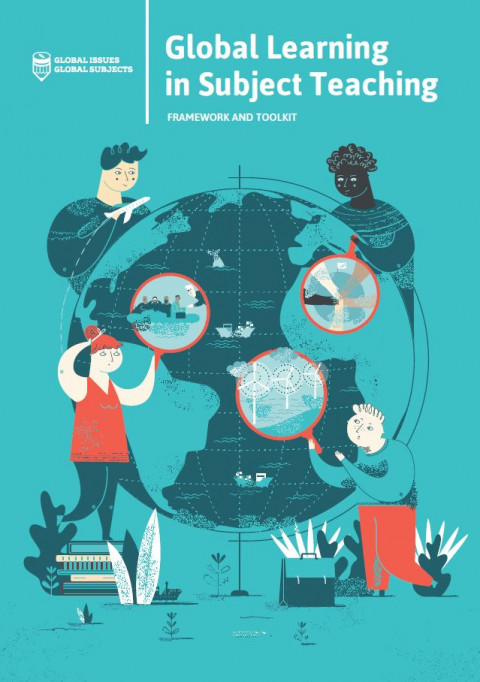 Global Learning in Subject Teaching: Framework and Toolkit Año de publicación: 2020 Autor corporativo: Center for Citizenship Education (CCE) | Global Issues, Global Subjects (GIGS) The brochure 'Global Learning in Subject Teaching: Framework and Toolkit' has been developed as a proposal for teachers, educators and educational institutions on how to reach pupils with Global Learning. In its practical part, the brochure provides the reader with a toolkit of 20 ready-to-use lesson plans for subject lessons where the subject curriculum topics are linked with global issues such as migration, climate change and gender equality.
 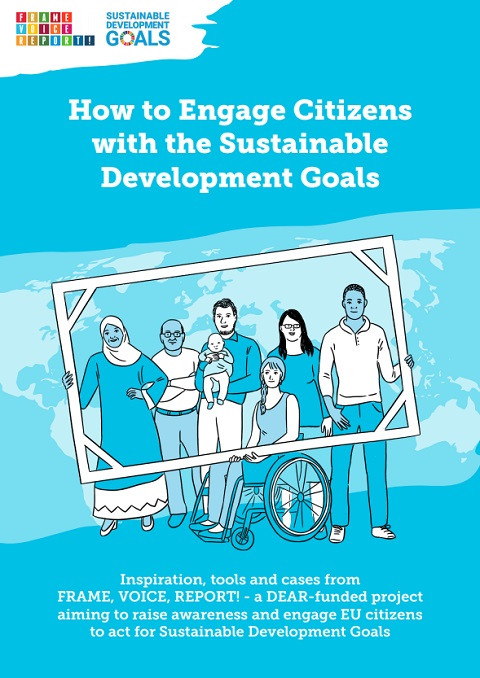 How to Engage Citizens with the Sustainable Development Goals Año de publicación: 2020 Autor corporativo: Finnish Development NGOs Fingo The purpose of this booklet is to share reflections, successes and learning outcomes from the FRAME, VOICE, REPORT! (FVR) project.It can be used to find inspiration from other civil society organisations (CSOs) working on the same topics and themes you do, but also as a source for ideas for new ways of looking at old issues.This booklet covers both the more theoretical approaches and concrete cases from CSOs across Europe. These cases are examples of the many projects funded by the FVR.The project had its roots in the previous successes and tried and tested approaches of the partner organisations. The aim of FVR! was to secure resources and develop the value-based, high quality work of civil society organisations. The second aim was to enable smaller organisations to learn about EU project funding and to build capacity on how to conduct high quality global citizenship education and development communications. Finally, the overarching aim of the project was to engage EU citizens with the SDGs.
  Global Citizenship Education (GCE) for Unknown Futures: Mapping Past and Current Experiments and Debates Año de publicación: 2019 Autor: Rene Suša Autor corporativo: Bridge 47 This Bridge 47-commissioned report by Rene Suša provides a thorough overview of current debates and opportunities within the field of Global Citizenship Education (GCE). The report addresses the following questions: 1) What is the benefit of GCE to our societies? 2) What is the impact of GCE to our societies? and 3) Why do we believe that GCE is the answer to global challenges?The publication also maps GCE-related or GCE-inspired initiatives, projects and partnerships, and offers key findings from a comparative study of these cases. Additionally, Susa also further builds on the recent work of Vanessa Andreotti by elucidating her taxonomy of soft, radical and beyond reform spaces for GCE, as well as relates these to current (international) policy developments in the field.
  Imagining and Practising Global Citizenship Education Año de publicación: 2020 Autor corporativo: UNESCO Venice This methodological guide illustrates the ways in which the International Cooperation Centre (ICC) has been promoting and practicing Global Citizenship Education in Italy for more than ten years. The training work developed by the ICC in the field of GCED, presented here in its theoretical articulation and in its practical outlining in some concrete experiences, may offer some reflections in the form of useful recommendations for continuing and strengthening the promotion of GCED.