
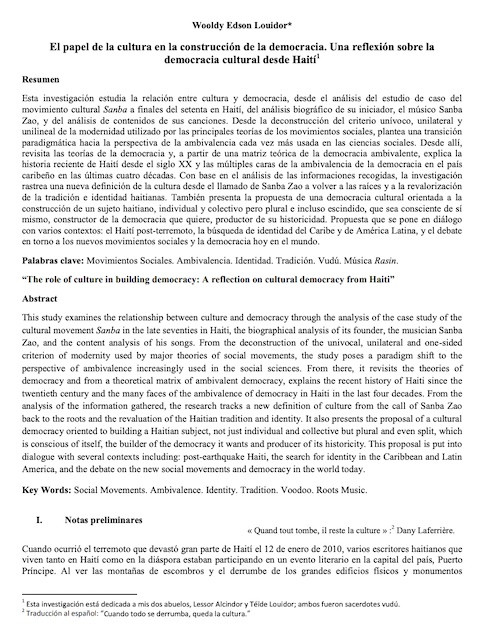
The Role of Culture in the Construction of Democracy: A Reflection on Cultural Democracy From Haiti
- Auteur
- Wooldy Edson Louidor
- Auteur institutionnel
- Latin American Council of Social Sciences (CLACSO)
- Collation
- 54 p.
- Langue de la ressource
- Espagnol
- Année de publication
- 2015
- Type de ressource
- Research papers / journal articles
- Niveau d’éducation
- Éducation non formelle
- Région
- Amérique latine et Caraïbes
- Lieu de publication
- Buenos Aires
This research studies the relationship between culture and democracy, from the analysis of the case study of the Sanba cultural movement in the late seventies in Haiti, from the biographical analysis of its initiator, the musician Sanba Zao, and from the analysis of the content of its songs. From the deconstruction of the univocal, unilateral and unilinear criterion of modernity used by the main theories of social movements, it proposes a paradigmatic transition towards the perspective of ambivalence increasingly used in the social sciences. From there, he revisits the theories of democracy and, based on a theoretical matrix of ambivalent democracy, explains the recent history of Haiti since the 20th century and the multiple faces of the ambivalence of democracy in the Caribbean country in the last four years. decades. Based on the analysis of the information collected, the research traces a new definition of culture from Sanba Zao's call to return to the roots and to the revaluation of Haitian tradition and identity.
Ressources associées
-
 IIEP-UNESCO 12th Medium-Term Strategy: 2026–2029
 -
 Youth Lens on the Silk Roads: Best Photos from the International Silk Roads Photo Contest; 6th Edition
 -
 Advancing Intergenerational Learning: Identifying Challenges and Opportunities for Older Adults; Integrated Case Study Report
 -
 Digital Empowerment for Lifelong Learning and Transformative Andragogy (DELTA) for Adult Educators: Introduction to the DELTA Framework and Resources